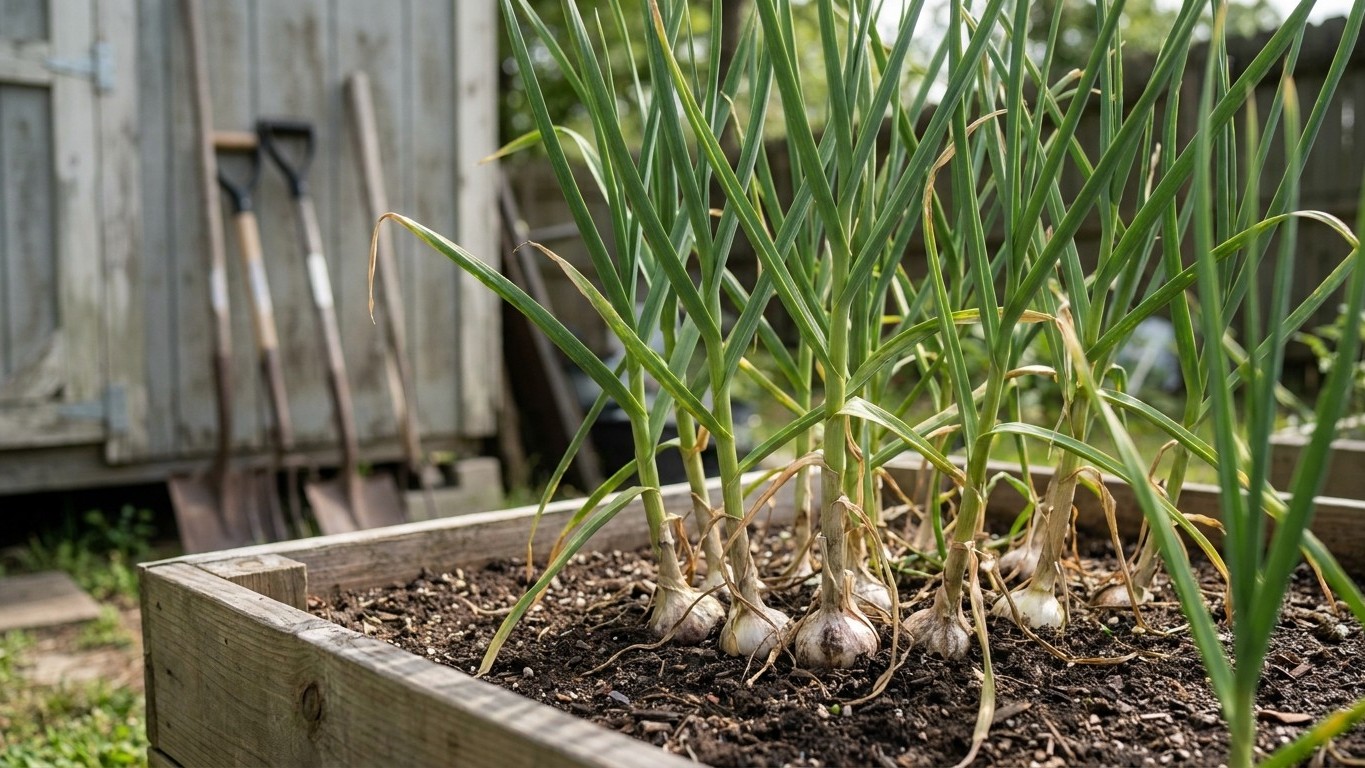

Garlic in North Carolina gets pulled based on what the leaves are doing, not a date circled on a calendar. Cloves go into the ground in fall, sit through winter, then bulk up as days lengthen in spring and early summer. The lift happens when the lower leaves have browned off but a handful up top are still green, usually meaning the bulb has finished sizing without the wrappers splitting open in the ground.
When garlic is ready to lift in North Carolina
The clock on a garlic bulb starts the previous fall, not the week you dig it. Cloves planted after the season’s first real cold snap spend winter building roots, then respond to the lengthening daylight of spring by shifting energy from leaf growth into bulb formation. In the Charlotte area, that starting point, the first fall frost, falls between October 30 and November 8, according to NOAA NCEI’s 1991-2020 Climate Normals. That’s a midpoint, not a guarantee. In roughly one year out of two, the first frost arrives later than that window, so treat it as a planning reference, not a safe date to circle.
Charlotte sits in the Piedmont, and that matters for anyone using this timing as a rough guide. The mountains to the west run several weeks behind in spring, which pushes both planting and lifting later in the calendar. The coastal plain warms earlier, so bulbs there tend to size up and come out of the ground ahead of the Piedmont. There’s no single “harvest week” that applies statewide, which is exactly why growers rely on the plant itself rather than a fixed date.
Reading the leaves instead of the calendar
The signal to watch for is straightforward: the bottom three to four leaves turn brown and dry while five or six leaves higher up stay green. That balance matters. Pull too early, while most of the plant is still green, and you get undersized bulbs with wrappers that haven’t fully formed. Wait too long, until nearly every leaf has died back, and the outer wrappers can split, exposing individual cloves to soil moisture and rot organisms before you’ve even gotten the crop out of the ground.
A test dig on one or two plants beats guessing. Loosen the soil with a fork rather than pulling by the stem, since a snapped neck won’t tell you much about bulb size and can bruise the top of the bulb. Look for wrappers that are tight and papery, cloves that are distinct and plump, not undifferentiated. If that test bulb looks right, the rest of the row usually is too.
Curing it, and where to hang it here
Curing is the step that turns a freshly dug bulb into something that survives storage. Freshly pulled garlic still carries moisture in its outer layers, and that moisture has to leave slowly and evenly, or the wrappers stay soft, patchy, and prone to mold instead of drying into the tight, papery shell that seals the cloves inside. Rushing this step, or curing in the wrong spot, is one of the more common reasons a home-grown batch doesn’t make it past a few weeks in the pantry.
What curing needs is airflow, shade, and time, in roughly that order of importance. Direct sun is the biggest mistake growers make with curing spots in this region. A hot, sealed shed or an uncovered patch of driveway can push internal bulb temperatures high enough to essentially cook the cloves, which shows up later as a mushy, off-smelling bulb in storage. What works better locally is a shaded carport, a covered porch, or a garage with the door cracked for cross-ventilation. The goal is warm and dry, not blazing hot.
Humidity is the real obstacle
North Carolina summers bring humidity that slows curing more than a drier climate would. That’s a reason to lean on airflow rather than just time. Hanging bulbs in loose bundles, or laying them in a single layer on a screen or mesh rack, gives air room to move around every bulb instead of trapping damp air between them. A box fan set to low, running a few hours a day in a shaded garage or porch, speeds things along without adding heat. Bulbs bundled too tightly or piled in a bin will cure unevenly at best, and mold at worst.
Most growers find their bulbs are ready to move to longer-term storage somewhere between two and four weeks after hanging, once the outer wrappers rustle like paper and the necks feel dry and papery rather than soft or green. At that point, trim the roots close to the base and cut the tops down to an inch or two if you’re not braiding, then move the crop to wherever it’ll spend the winter.
Storing it through a North Carolina winter
Once cured, garlic needs conditions that are almost the opposite of what got it there: cool rather than warm, but still dry, still dark, still moving a little air. A pantry shelf, a closet on an exterior wall, or an unheated but insulated space away from a furnace or water heater tends to work better than a kitchen counter, where warmth and light both shorten shelf life. Mesh bags, loosely woven baskets, or old onion sacks let air circulate around the bulbs, which matters more than the container itself.
The refrigerator is worth avoiding for whole bulbs. Cold, humid conditions like those inside a fridge can trigger sprouting, since the bulb reads that combination as a signal that it’s time to grow. A basement is a mixed bag in this region: cool, yes, but North Carolina’s clay-heavy soils and humid summers mean plenty of basements run damp, and damp air undoes curing fast. If that’s the only option, a dehumidifier or at minimum good ventilation in that space makes a real difference.
Garages and mild winters bring their own issues
An unheated garage can swing wildly between a cold snap and a 60-degree afternoon, and that kind of temperature bouncing stresses stored bulbs more than a steady cool space would. Mild winter stretches, which aren’t unusual in the Piedmont and are even more common on the coastal plain, can also nudge stored garlic toward early sprouting if it’s kept somewhere too warm for too long. Checking the stored crop every few weeks through winter, pulling any bulb that’s gone soft or started to green at the neck, keeps one bad bulb from spreading trouble to the rest of the bag.
Growers who want a second opinion on storage setups for their specific property can check with NC State Extension, which fields exactly these kinds of regional growing questions.
What goes wrong here
Most garlic failures in North Carolina trace back to timing or moisture, not disease. Harvesting before the bulb has finished sizing, curing in full sun, or storing in a damp basement each show up later as small bulbs, soft wrappers, or early sprouting. None of those problems come from bad luck so much as skipping a step described above.
On the pest side, NC State Extension documents a specific list of pests active in this region, and thrips are the one most relevant to a garlic bed, since they feed on leaf tissue and can weaken plants before bulbs finish sizing. The extension service also documents flea beetles, Japanese beetle, striped cucumber beetle, imported cabbageworm, cabbage looper, corn earworm, fall webworm, and hemlock woolly adelgid for the broader region, though most of those show up on other garden crops rather than garlic specifically. Watching for thrips on garlic foliage, especially in a warm, dry stretch of late spring, is worth the extra look.
- Pulling bulbs while more than half the leaves are still green
- Curing in direct sun or a sealed, unventilated shed
- Storing cured garlic in the refrigerator, which encourages sprouting
- Leaving bulbs in a damp basement without airflow
- Skipping the periodic winter check that catches a soft bulb early
A frost date used for planning fall planting is a midpoint, not a promise, and treating it as a hard deadline is its own small mistake. Building in flexibility around that date, and around the harvest signals described above, does more for a garlic crop here than chasing an exact day on the calendar ever will.
Common questions
Can I harvest garlic early if I need it for cooking?
Yes, garlic pulled before full maturity is edible right away, often called “green garlic,” but it won’t cure or store the way a fully mature bulb will. It needs to be used fresh within days.
Does North Carolina’s humidity mean I should skip curing altogether?
No. Humidity makes curing slower and more failure-prone, which is why airflow matters more here than in a drier climate, but skipping curing entirely leads to bulbs that rot or sprout within weeks rather than lasting through winter.
How is timing different between the coast and the mountains?
The coastal plain warms earlier in spring, pushing both planting and harvest earlier, while the mountains run several weeks behind the Piedmont in both directions. Charlotte-area timing sits between the two.
Is there a published NC-specific harvest date I should use?
No verified, NC-specific harvest date is published here. The reliable approach is watching leaf color and doing a test dig, rather than relying on a fixed calendar date for this region.