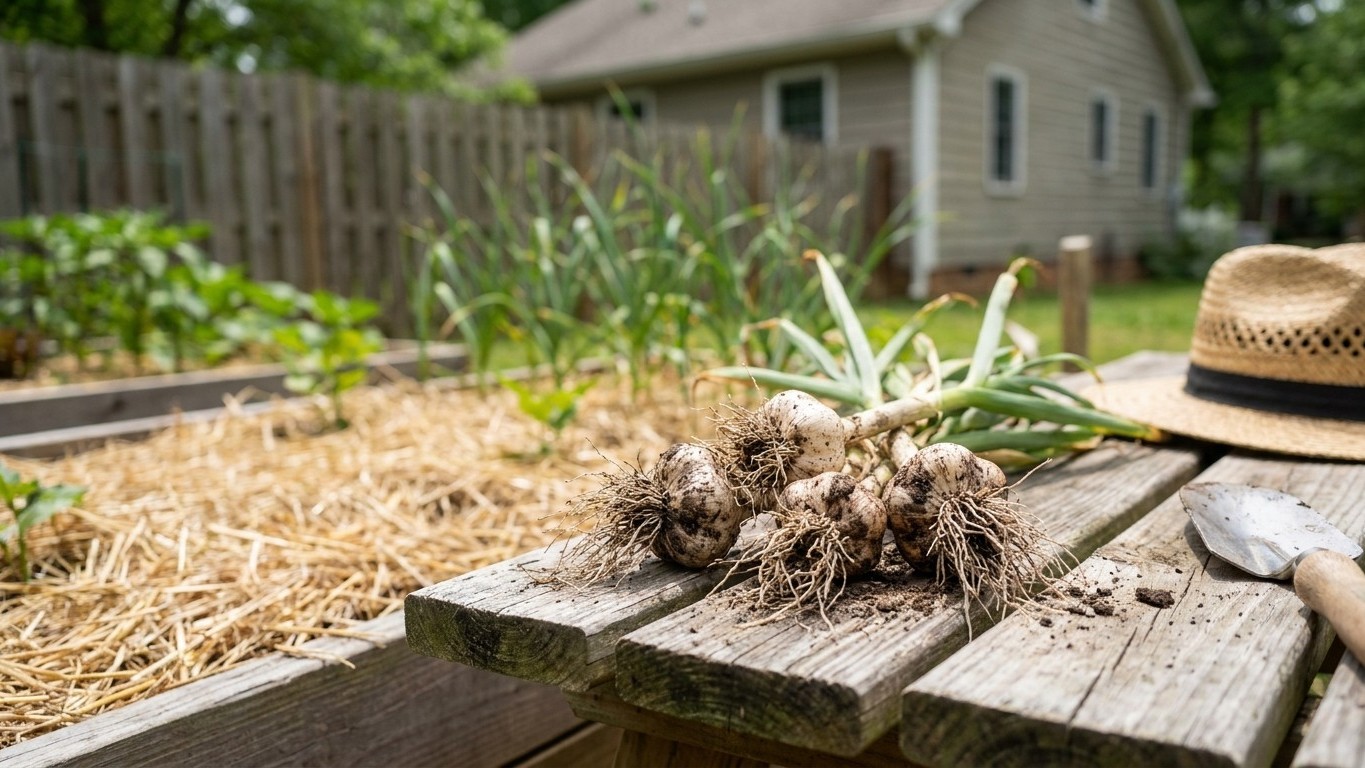

Six to eight weeks of soil under 40°F is what turns a single round clove into a proper head of garlic, and that stretch of cold is the whole story in North Carolina. The mountains bank it easily, the Piedmont usually scrapes by, and the coastal plain often comes up short, especially after a soft winter. Fall short and you dig up one smooth, undivided bulb come summer, regardless of how well you fed or watered it. Where the ground can’t deliver, the refrigerator can stand in for winter instead.
Will garlic get the cold it needs in North Carolina

Clove division, the process that turns one round clove into a full head of many cloves, depends on a real stretch of cold after planting. University of Georgia Extension publication C854 puts the requirement at six to eight weeks with soil temperatures below 40°F. Skip that cold and you lift a single rounded bulb at harvest instead of a head split into cloves, no matter how well the bed was fed or watered along the way.
North Carolina’s geography makes the answer depend heavily on where in the state you garden. The Blue Ridge mountains in the west hold long, genuinely cold winters that clear the six-to-eight-week mark most years without any help from the gardener. The Piedmont, where Charlotte sits, runs milder but still typically strings together enough sub-40°F nights across the heart of winter to satisfy hardneck types in an average year. The coastal plain in the east is the region most likely to fall short, since its winters run mild enough that clove division can be marginal, especially after an unusually warm one. Getting the timing right for your region matters as much as the cold itself, which is why it’s worth checking When to Plant Garlic in North Carolina before you put cloves in the ground.
What to do where the cold falls short
If you garden on the coastal plain or the winter ran mild, refrigerate seed cloves for four to eight weeks at 35-40°F before planting to substitute for cold the ground itself may not deliver in full. This is standard practice among garlic growers across the milder parts of the Southeast, and it costs nothing but some space in the crisper drawer. The other option is simply to grow softneck garlic, which carries a lower chill requirement than hardneck and is the reason softneck varieties dominate commercial garlic production in warm-winter regions generally. Save hardneck for the mountains and the colder Piedmont pockets, and do not skip a cold treatment and hope. A bed planted without either sufficient ground cold or a refrigerator substitute produces that single round bulb, not the crop you set out to grow. For a closer look at which types suit each region, see our guide to Garlic Varieties That Suit North Carolina Winters.
North Dakota sits at the opposite extreme, where the concern is protecting garlic from cold that goes well past what division requires, a problem covered in Growing Garlic in North Dakota: Planting Dates, Varieties and Winter Cold. North Carolina’s task is closer to making sure there is enough cold, not too little of it.
When to put the cloves in
Garlic needs several weeks of root growth before the ground turns cold enough to stop it, but it should not be pushing tall green leaves above the soil when winter actually arrives. That timing runs off the first fall frost, not off any generic autumn date. NOAA’s 1991-2020 climate normals put the first fall frost near Charlotte, in the Piedmont, at October 30 to November 8, a window whose midpoint falls around the very start of November.
Working back from that midpoint, planting in early October to mid October, the window that applies to every variety named in this article, puts cloves in the ground roughly three to five weeks ahead of the average first frost. That is enough time for roots to establish and anchor the clove before the soil cools sharply, without so much growing season left that the shoot pushes up tall and soft heading into winter.
This window shifts with elevation and with proximity to water. Higher ground in the Blue Ridge mountains to the west cools faster in autumn than the Piedmont does, so gardeners there should expect their own first frost earlier than Charlotte’s and plant toward the early end of the October window, or even late September, to keep the same three-to-five-week head start. The coastal plain in the east, and any garden close to a large lake, holds warmth longer into fall, pushing the first frost later and allowing planting into mid or even late October without rushing the clove into cold weather it has not rooted against yet.
Do not treat a single calendar date as gospel here. The October 30 to November 8 window is measured at Charlotte and describes the Piedmont around that city. Both the mountains and the coast run on their own schedule, and the safest approach is to plant by the early-to-mid-October range and let your own region’s frost history, not a fixed day, tell you whether you are early or late.
Which types suit North Carolina
Hardneck and softneck garlic split apart on one axis above all others: how much winter cold each one wants. This is not a matter of taste in North Carolina, because the state’s winters vary widely from the mountains to the coast, and getting the type wrong costs you the crop’s basic structure even if every other step goes right.
Hardneck for the mountains and cold pockets
Hardneck garlic sends up a flowering stalk called a scape, wants a real winter chill to divide well, and rewards that chill with big, easy-to-peel cloves and the strongest flavor of the two types. It suits the Blue Ridge mountains and the colder pockets of the Piedmont. Varieties worth planting there include German Red, Chesnok Red, Duganski, Bavarian Purple, Georgian Crystal, Georgian Fire, Blue Music and German White, all set out in the same early-October-to-mid-October window as every other variety in this article. Hardneck stores for only a few months after curing, so plan to use it earlier in the pantry year and save any softneck bulbs for the long stretch.
Softneck for the Piedmont and coastal plain
Softneck garlic, the type braided into strings at the farmers market, tolerates a milder winter and still divides reliably even where the cold falls well short of the mountains’ long freeze. It is the safer default for the coastal plain and much of the Piedmont, including any garden where a mild winter is a real possibility. Inchelium Red and Lorz Italian are both reliable choices, and Early Red Italian and Italian Late round out the softneck options, all planted in the same early-to-mid-October window. Softneck also cures down to a papery, long-storing bulb that typically keeps in the pantry for months longer than hardneck does.
British Columbia spans a similar divide, from mild coastal winters to cold interior valleys, covered in Growing Garlic in British Columbia: Planting Dates, Varieties and Winter Cold, and the same logic that separates North Carolina’s coast from its mountains applies there too.
Soil and bed preparation
Garlic sits in the same bed for eight to nine months, through the wettest part of the North Carolina year in many regions, so drainage matters more for this crop than for almost anything else in the vegetable garden. A clove sitting in saturated clay through a rainy December rots long before any disease organism gets involved. Raised beds or ridged rows are worth the effort anywhere the native soil is heavy clay, which describes much of the Piedmont.
Work the bed over several weeks before the early-to-mid-October planting window rather than the day before. Turn in a couple of inches of finished compost or well-rotted manure to loosen the structure and feed the crop through winter and into the vigorous growth of spring. Garlic is a heavy feeder over a long season, and this early feeding matters more than anything applied later, since the bulb is already forming by the time most gardeners think to fertilize.
Check soil pH and correct it ahead of planting rather than after, since amendments like lime take time to move through the soil profile. A soil test through your local extension office before planting beats guessing, and garlic generally performs best where the soil is neither strongly acidic nor alkaline. Break up compaction to a full spade’s depth, since garlic roots run deep for a shallow-planted crop and hit resistance in compacted clay quickly.
Set cloves individually rather than in a solid trench, root end down and pointed tip up, about two inches deep across most of the state, spaced so mature bulbs will not crowd each other by early summer. In beds that flood easily, plant slightly shallower and lean on mulch, covered in the next section, to protect against cold rather than relying on depth alone.
What the climate here favours, and what it does not
The thresholds below come from UC IPM’s Pest Management Guidelines for Onion and Garlic, UC ANR Publication 3453, and they are published as soil temperatures. The figures used to check them against North Carolina’s climate here are monthly mean air temperatures, which run cooler than soil in winter and warmer than soil in summer, and a monthly average of course hides the day-to-day swing beneath it. Treat what follows as a tendency this climate creates, not a forecast of infection in any particular garden.
Two diseases with wide windows here
White rot, caused by the pathogen Sclerotium cepivorum, has its published 50-75°F range met by the mean air temperature in six months of North Carolina’s growing season: September, October, November, March, April and May, with one of those months landing at the pathogen’s published optimum. That is a wide window, essentially bracketing the entire planting-through-spring-growth period, which is part of why white rot is taken so seriously across the Southeast. It does not mean every garden gets it. It means temperature is rarely the factor standing in its way, so clean seed stock and crop rotation matter more here than in a climate where the window is narrow.
Fusarium basal rot, caused by Fusarium oxysporum f. sp. cepae, shows a similarly wide six-month window: September, October, April, May, June and July, again with one month landing at the published optimum. Between white rot and fusarium basal rot, North Carolina’s mild autumn and warm early summer keep both fungi within range for a large share of the year the crop spends in the ground.
One narrow window, and one that stays closed
Pink root, caused by Setophoma terrestris, has a narrower reach here. Its 75-85°F optimum is met in only two months, June and July, both landing squarely at the optimum. That falls late in the season, close to harvest, which is why pink root tends to show up as a curing-time problem rather than an early one.
Southern blight is the one disease this territory’s temperatures do not favor. Its pathogen, Sclerotium rolfsii, has a published 86-95°F optimum, and no month of North Carolina’s growing season reaches a mean air temperature inside that range at this reference station. That is real reassurance, but not a guarantee. Outside its optimum the fungus is simply less active, not absent, and infected planting stock can still introduce it regardless of the season’s weather.
Getting it through the winter
Mulch is what separates a bed that survives a Piedmont freeze-thaw cycle from one that does not, more than raw cold does on its own. Lay it once the ground has cooled but before a hard freeze locks the surface, generally a few weeks after planting once the cloves have had time to root. A four-to-six-inch layer of straw or shredded leaves insulates the soil surface and slows the freeze-thaw swings that heave shallow-planted cloves out of the ground over winter.
Heaving, not a single hard freeze, is the real winter threat to garlic across most of North Carolina. A clove planted at the two-inch depth typical for this state can work its way to the surface as soil repeatedly freezes and thaws through a Piedmont winter, exposing the root system to drying wind and cold air it was never meant to face. Mulch buffers that cycle by keeping the soil temperature more stable day to day, even where it cannot keep the ground from freezing at all.
Pull the mulch back partway, not all the way, once new green growth pushes up in late winter or early spring. Leaving the full depth on too long as weather warms can trap excess moisture against the shoot and invite rot, while pulling it off entirely exposes the bed to a late cold snap the plant is not yet hardened against. Leaving an inch or two in place through spring splits the difference well across most of the state.
Gardeners on the coastal plain, where winters run mild and heaving is less of a threat, can generally use a lighter mulch layer than growers in the Piedmont or mountains, where the freeze-thaw cycle runs harder. Check the bed occasionally through winter regardless of region, and reseat any clove that has pushed up rather than leaving it exposed to the air.
Harvest and curing here
Lift garlic by reading the plant, not the calendar. The signal to dig is when the lower third to half of the leaves have gone brown or yellow while the upper leaves are still green, since each leaf corresponds to a wrapper layer around the bulb, and pulling too early or too late costs you either bulb size or storage quality. Because planting happens in fall here, harvest lands the following summer, months after winter did its work of dividing the cloves.
Dig rather than pull, loosening the soil with a fork first, since a snapped stalk with the bulb still underground means digging for it by hand afterward. Handle bulbs gently once they are out, since a bruise now becomes a soft, rotten spot in storage weeks later.
Curing in North Carolina has to reckon with humidity, and much of the state runs humid through the summer harvest window. Cure in a spot with good airflow and shade rather than direct sun, since a covered porch, carport or open shed works better than a closed garage, and keep bulbs out of direct rain. Hang them in bunches or lay them on screens with space between each bulb so air can move around it. Expect curing to take several weeks in humid conditions, longer than the shorter curing times often quoted for drier climates, and check a bulb or two along the way by feeling for a fully dry, papery neck before trimming and storing the rest. A bulb cured too fast, in a rush to get it into storage, will mold from the inside where the neck stayed damp, and that loss only shows up after you thought the crop was already safe.
Local help
County-level frost dates, soil test results and disease identification all vary enough across North Carolina that a state-wide page like this one can only get you close. Contact your county office of the North Carolina Cooperative Extension Service, run through NC State Extension, for the specific planting dates, soil recommendations and variety notes that apply to your exact location, whether that is a mountain valley, the Piedmont around Charlotte, or the coastal plain.
Common questions
Is it too late to Plant Garlic if I miss the October window?
Not necessarily, but every week later shortens the root establishment time before the ground gets cold and typically produces a smaller bulb the following summer. If you miss the early-to-mid-October window entirely, plant into November as soon as you can and mulch heavier than usual to compensate for the shorter rooting period. Planting late beats skipping the year.
Can I plant grocery-store garlic instead of buying seed garlic?
You can, but it is a gamble. Grocery garlic is often a variety never selected for fall planting in the first place, and it can carry diseases such as white rot or fusarium basal rot into a bed that had no history of them before. Certified seed garlic costs more per clove but starts the bed clean.
Do I need to cut the scapes off my hardneck garlic?
Cutting the scape, the curling flower stalk that hardneck varieties send up, redirects the plant’s energy into the bulb rather than the stalk, and most growers remove it once it curls for that reason. The scape itself is edible and worth cooking with rather than composting.
Will an ice storm or heavy snow kill my garlic over winter?
A snow cover generally insulates the bed rather than harming it, acting much like the mulch layer described earlier in this article. The bigger risk after an ice storm is the freeze-thaw cycling that follows, which can heave a shallowly planted clove out of the ground, so check the bed once the ice clears and reseat anything that has pushed up.
Can I grow garlic in a raised bed or a container through a North Carolina winter?
Yes, and a raised bed is often the better choice on heavy Piedmont clay because it drains faster through the wet months. A container works too, but it freezes and thaws faster than an in-ground bed since it holds less soil mass around the roots, so give a container extra mulch or set it against a sheltered wall for the winter.