
North Carolina sits at a latitude where the growing calendar bends toward the mild-winter pattern of the Southeast rather than the hard-frost rhythm of the Northeast. That single fact, more than soil type or rainfall, decides when an onion goes into the ground here. Get the season wrong and the bulb size follows the mistake all the way to harvest.
The short answer for North Carolina

The reference point for this state’s climate data is Charlotte, where the long-term weather station sits at 35.22 degrees north. On the longest day of the year, that location gets 14 hours and 23 minutes of daylight. Onions don’t care about the calendar date or the soil temperature the way tomatoes do. They care about how many hours of light hit their leaves, and once that number crosses a variety’s threshold, the plant stops building leaves and starts building a bulb, whether it’s ready or not.
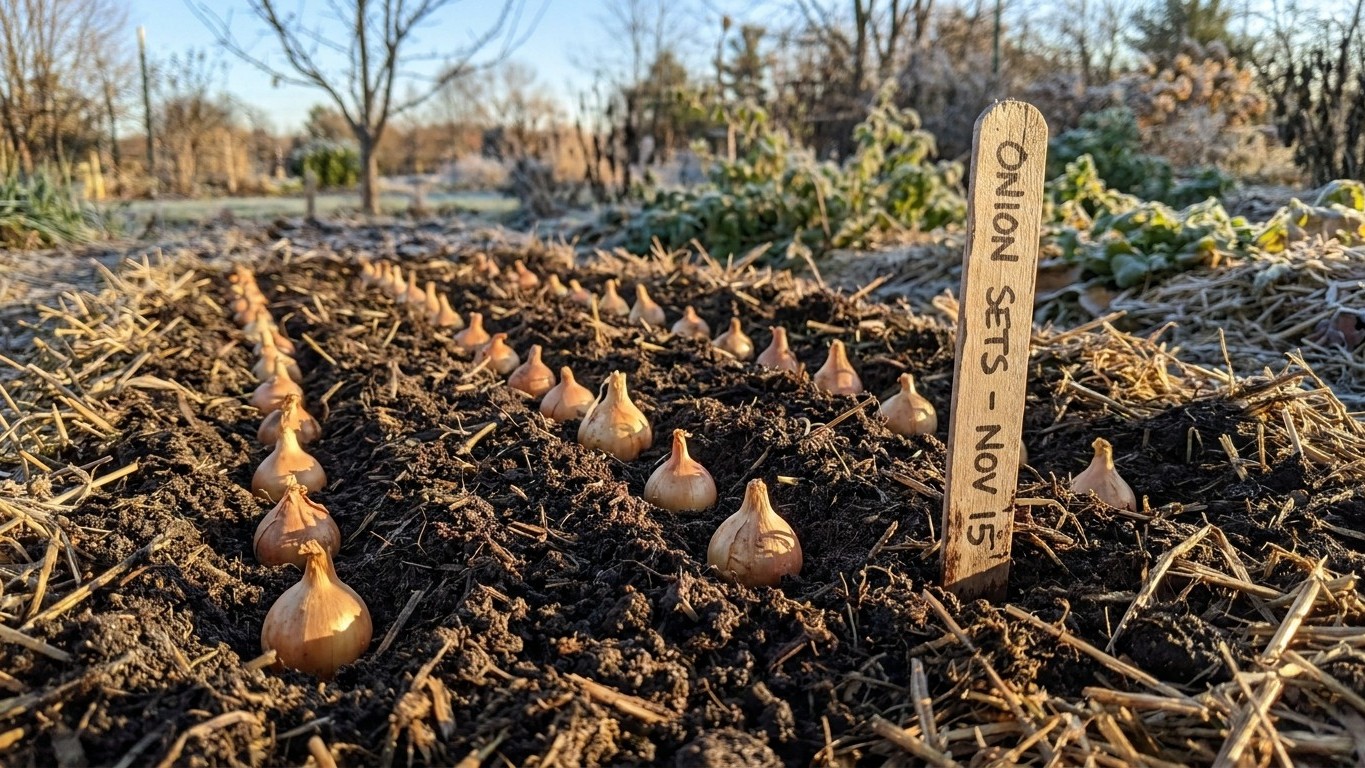
In a mild-winter state like North Carolina, that mechanic points toward planting in autumn or very early in the year rather than waiting for late spring the way a gardener in Minnesota would. Onion transplants or sets go in while the plant still has months of cool, mild weather ahead of it to grow leaves before day length crosses the bulbing trigger. In the piedmont and coastal plain, winters rarely hold hard, sustained freezes, so a young onion plant can sit in the ground through the cold months and keep adding a little growth on the mild days. In the mountains of the western part of the state, winters run colder and longer, which pushes the safe planting window later, into the tail end of winter or very early spring instead of autumn.
This is also why the advice differs from state to state, and it isn’t about temperature preference so much as survival. A gardener in coastal Georgia or South Carolina can plant onion sets in October with real confidence. A gardener in Maine would lose that same planting to a hard freeze before Christmas, so they wait for the ground to thaw in April instead, and their onions get a very different amount of daylight to grow in before the trigger hits. North Carolina’s mild winters put most of the state in the autumn-to-late-winter camp, but the far western counties, with their higher elevation and sharper cold snaps, behave more like a state one zone colder.
The season, then, isn’t a single date. It’s a window that opens earlier the closer a garden sits to the coast and closes earlier the higher it climbs into the mountains.
What will not work here
Long-day onions are built for latitudes where summer daylight stretches well past 14 hours and often toward 16. At 35.22 degrees north, the longest day tops out at 14 hours and 23 minutes, and that ceiling never moves. A long-day variety planted in North Carolina will grow leaves all spring and summer, waiting for a daylight trigger that the state’s geography simply does not produce. It will not bulb small. It will not bulb late. It will not bulb at all. What it does instead is keep pushing green growth into fall, then rot in the ground once the plant runs out of season.
Based on the published latitude ranges for the varieties tracked on this site, thirteen fall into that category for North Carolina:
- Ailsa Craig (long-day, rated for 38 to 60 degrees north), the state’s daylight never reaches its trigger
- Barolo (long-day, 38 to 55 degrees north), same shortfall
- Blush (long-day, 38 to 55 degrees north), needs longer summer days than the state provides
- Frontier (long-day, 40 to 50 degrees north), well north of what North Carolina offers
- New York Early (long-day, 38 to 50 degrees north), bred for a longer-day climate
- Patterson (long-day, 38 to 55 degrees north), will not reach its bulbing threshold here
- Powell (long-day, 43 to 47 degrees north), far outside the state’s range
- Red Carpet (long-day, 40 to 45 degrees north), same issue
- Red Long of Florence (intermediate-day, but rated 38 to 50 degrees north), still above what the state’s daylight supports
- Redwing (long-day, 43 to 65 degrees north), built for far northern summers
- Rossa di Milano (long-day, 38 to 50 degrees north), daylight ceiling too low here
- Safrane (long-day, 42 to 50 degrees north), no bulbing trigger available
- Talon (long-day, 42 to 50 degrees north), same shortfall
None of these are marginal cases. Planting any of them in a North Carolina garden isn’t a gamble on a smaller harvest, it’s a guarantee of no harvest at all from the bulb itself, just a season’s worth of green tops and a wasted bed.
What changes across North Carolina
North Carolina isn’t one climate. The state stretches from roughly 33.8 degrees north near the southern coast to close to 36.6 degrees north along the Virginia line, a span of nearly three full degrees of latitude. That’s enough to shift both the winter survival picture and the summer daylight total meaningfully from one end of the state to the other.
| Location type | Approx. latitude | What it changes |
|---|---|---|
| Southern coast | ~33.8°N | Milder winters, longer autumn planting window, closer to the lower edge of short-day variety ranges |
| Charlotte (reference city) | 35.22°N | Baseline figures used on this page: 14h23 of daylight on the longest day |
| Northern border / mountains | ~36.6°N | Colder winters, later safe planting, slightly more summer daylight, edges closer to intermediate-day territory |
That spread matters most for the five varieties sitting in the blurred zone, all short-day types whose published range brushes right up against this latitude: Gabriella, Madalyn, Red Sensation, Texas Grano 1015Y, and Vidora are all rated for roughly 20 to 35 degrees north. A garden near the southern coast sits comfortably inside that range. A garden near the state’s northern border, or up in the mountains, is pushing past the edge of what those varieties were bred for, and results there are far less predictable, not a flat yes or a flat no.
A gardener in Wilmington and a gardener in Boone are technically in the same state, but they aren’t gardening under the same sky. The closer a garden sits to the reference latitude of 35.22 degrees, the more directly the figures on this page apply. The farther it drifts north or south of that line, the more worth it becomes to check a local latitude figure before trusting a state-wide answer.
Sweet now, or onions that last
North Carolina’s daylight numbers push most gardeners here toward short-day and intermediate-day varieties, and that choice comes with a trade-off that has nothing to do with luck and everything to do with chemistry. University of Missouri Extension notes that sweet onion varieties simply do not store as well as the more pungent types, and the reason is the same compound in both directions. The sharp, eye-watering bite of a pungent onion comes from volatile sulfur compounds, and those same compounds are what slow down spoilage in storage. Breed the sulfur out for a milder, sweeter bite, and the bulb loses its natural protection along with it.
Short-day varieties, the ones best suited to the southern half of North Carolina, tend to run sweeter precisely because they carry fewer of those compounds. That makes for a great slicing onion in July, but not one built to sit in a pantry basket through the winter. Intermediate-day varieties, which cover most of the published ranges that fit Charlotte’s latitude, land somewhere in the middle, sharper than the classic sweet types and holding a little longer, without matching the months-long storage life of a true long-day onion grown farther north, a group that, as established above, can’t be grown here at all.
What that means for a North Carolina pantry is fairly direct. Onions harvested from a home garden here tend to get used within a few months of curing rather than stretching all the way to March. Choosing one of the more pungent intermediate-day varieties, and curing the bulbs properly before storage, buys some extra weeks. But nobody gardening in this state should expect the same shelf life a Minnesota or Wisconsin grower gets from a long-day storage onion. The trade is built into the latitude, not into how well the onions were grown.
Checking this against your own garden
Every figure on this page comes from a single reference point at 35.22 degrees north. That’s a solid stand-in for a garden in or near Charlotte, but a much rougher fit for a garden three degrees away in either direction. Before committing a season’s worth of bed space to a variety, a few quick checks are worth the ten minutes they take:
- Look up your own town’s latitude, not just “North Carolina” as a whole, especially if you’re near the coast or up in the mountains
- Check your first and last frost dates through your county’s NC State Extension office, since that determines the safe autumn or late-winter planting window in your area
- Confirm which day-length group a variety is bred for before buying transplants or sets, not after
- If you garden at higher elevation in the western counties, expect a later safe planting date than the coastal plain, even at a similar latitude
- Ask your local extension agent which varieties other gardeners in your county have had success with, since microclimates can shift results within the same region
A planting calendar built on one city’s coordinates is a starting point, not a guarantee. The daylight math holds steady across the whole state, but frost dates, elevation, and soil conditions don’t, and those are the details a local extension office tracks far than any statewide figure can.