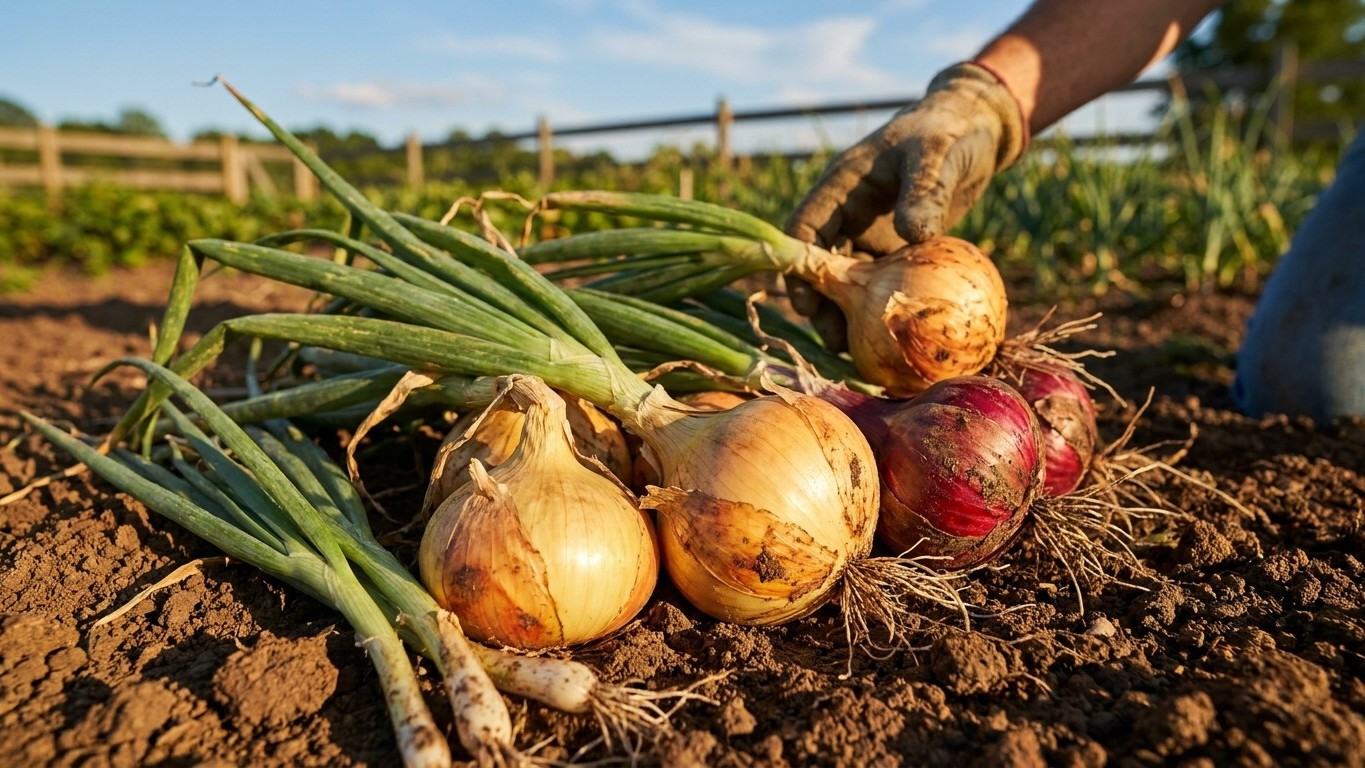

Growing Onions in North Carolina works best with intermediate-day and short-day varieties — the state sits at a latitude where the longest day of the year gives just over 14 hours of light, enough to trigger bulbing in those two groups but not in most long-day types. Get the day-length category wrong and you’ll harvest a fistful of green leaves and nothing underground. Here’s what actually bulbs, when to plant it, and what it’ll taste like.
How long your longest day is

Charlotte sits at 35.22 degrees north, and on the longest day of the year it gets 14 hours and 23 minutes of daylight, calculated from that latitude using the standard sunset hour-angle formula. That single number decides almost everything about which onion you should buy. Onions don’t bulb because the weather warms up. They bulb because the days get long enough to flip a switch inside the plant, and each variety has its own trigger point.
Short-day onions start bulbing once the day reaches about 12 hours, a threshold published by Clemson Cooperative Extension’s Home & Garden Information Center. At Charlotte’s 14 hours and 23 minutes, that threshold is crossed with room to spare, which means short-day types bulb reliably here. Intermediate-day varieties need somewhere in the 13 to 14 hour range, and they too fit comfortably inside what Charlotte’s summer offers. Long-day onions are the problem. Most of them don’t start bulbing until the day stretches to 14, 15, even 16 hours, and Charlotte’s ceiling of 14 hours 23 minutes leaves several of the most common long-day varieties without enough daylight to ever flip that switch.
That’s the whole story of this page in one paragraph. For the full rundown of which cultivars to buy, see The Best Onion Varieties for North Carolina, and for exact planting dates by region, check When to Plant Onions in North Carolina. Everything below is just detail on top of it.
One caution worth repeating: 35.22 degrees is Charlotte’s latitude, not North Carolina’s. The state runs from the coastal plain near Wilmington, a couple of degrees south, up through the Piedmont and into the mountains near the Tennessee and Virginia lines, several degrees north and noticeably later in spring. A gardener in the far western counties, or up near the Virginia border, is picking up meaningfully more summer daylight than someone in Charlotte, and that shifts which varieties sit safely inside the bulbing range versus which ones land in the blurred zone. If you’re near the edge of the state, it’s worth checking your own latitude rather than assuming Charlotte’s numbers apply exactly.
Which varieties bulb in North Carolina
Thirteen varieties documented on this site have a published latitude range that covers Charlotte’s 35.22 degrees, meaning their catalogue data puts this location comfortably inside their bulbing window:
- Bridger (long-day, 35-50N)
- Cabernet (intermediate-day, 35-45N)
- Calibra (intermediate-day, 35-45N)
- Candy (intermediate-day, 33-40N)
- Elsye (intermediate-day, 32-45N)
- Expression (intermediate-day, 32-45N)
- Monastrell (intermediate-day, 35-46N)
- Red Long of Tropea (intermediate-day, 35-48N)
- Red Rock (short-day, 30-36N)
- Scout (intermediate-day, 32-46N)
- Sierra Blanca (intermediate-day, 32-45N)
- Walla Walla Sweet (long-day, 35-55N)
- White Castle (short-day, 30-38N)
Five more sit within 1.5 degrees of a published boundary, which puts them in a genuine gray zone rather than a clear yes: Gabriella, Madalyn, Red Sensation, Texas Grano 1015Y, and Vidora, all short-day types with ranges topping out around 35 degrees. These may bulb in Charlotte, but a gardener planting them is working at the edge of what the catalogue data supports, not inside the safe middle.
Now the list that matters more, because it explains a failure a lot of North Carolina gardeners have already had without knowing why. Thirteen varieties are published for latitudes above this one, meaning the day here never gets long enough to trigger them:
- Ailsa Craig (long-day, 38-60N)
- Barolo (long-day, 38-55N)
- Blush (long-day, 38-55N)
- Frontier (long-day, 40-50N)
- New York Early (long-day, 38-50N)
- Patterson (long-day, 38-55N)
- Powell (long-day, 43-47N)
- Red Carpet (long-day, 40-45N)
- Red Long of Florence (intermediate-day, 38-50N)
- Redwing (long-day, 43-65N)
- Rossa di Milano (long-day, 38-50N)
- Safrane (long-day, 42-50N)
- Talon (long-day, 42-50N)
If you’ve ever grown onions from a supermarket set and ended up with tall green tops but no bulb worth pulling, this list is probably why. These varieties don’t give you a small onion when the daylight falls short of their trigger. They give you leaves, then, as the plant keeps waiting for a day length that never arrives, the bulb they never formed simply rots in the ground. It isn’t a fertility problem or a watering mistake. It’s a daylight mismatch, and no amount of compost fixes it.
When to plant onions in North Carolina
Planting time follows the day-length group, and that’s exactly why onion advice from a friend in Minnesota or Maine won’t transfer here. Because Charlotte’s winters are mild enough that the ground rarely freezes solid for long, North Carolina gardens generally do best starting onions in fall for a spring harvest or getting sets and transplants in the ground in late winter, well ahead of what a colder state could manage.
The frame for that window comes from NOAA’s 1991-2020 climate normals for the Charlotte station. The last spring frost, the date after which a 32-degree freeze becomes unlikely, falls between March 23 and April 5. The first fall frost, when that risk starts climbing again, arrives between October 30 and November 8. Onion transplants and sets tolerate a light frost better than most vegetables, so gardeners here often go in a few weeks before that spring window closes, giving the plants a long cool stretch to build leaves before the June solstice pushes daylight past the bulbing threshold.
Two things to keep in mind about those dates. First, they’re averages built from three decades of data, not a promise. A 30 to 70 percent freeze probability band means frost is genuinely possible on either side of it, so treat late March as a target to plan around, not a date to bet a whole tray of transplants on. Second, the caution that applies to latitude applies here too: this is Piedmont data. The coastal plain, where Wilmington sits, tends to warm up earlier and can usually plant sooner. The Blue Ridge counties to the west run weeks behind Charlotte in spring, with frost risk lingering well into what would be comfortable planting weather in the Piedmont. If you garden in the mountains, push your dates later; if you’re near the coast, you likely have more room to plant early than these numbers suggest.
Sweet onions or onions that keep
North Carolina’s daylight numbers point toward sweet, short-keeping onions rather than the sharp, long-storing kind, and the reason is chemistry rather than luck. The compounds that give an onion its bite, volatile sulfur compounds, are the same compounds that protect the bulb once it’s in storage. University of Missouri Extension puts it plainly: sweet onions do not store as well as more pungent types, because they simply contain less of the substance doing the protecting.
Short-day and intermediate-day varieties, the ones that actually bulb at Charlotte’s 14 hours 23 minutes of summer daylight, tend to run milder than long-day onions grown farther north. That’s not a coincidence tied to any particular seed line. It tracks with day length itself: onions bred to bulb under shorter days generally build fewer of those sulfur compounds, which is part of why the classic sweet onion reputation belongs to southern growing regions rather than northern ones.
What that means for a North Carolina pantry is worth being honest about. The onions from this garden will taste better raw, sliced into a sandwich or a salad the week you pull them. But they won’t be the onion you’re still cooking with in March. Expect to eat your harvest through summer and into fall, then buy onions again for winter cooking, rather than counting on a braid hanging in the garage to carry you to spring. A gardener farther north, working with long-day varieties and their heavier sulfur load, gets the opposite trade: sharper onions that sting a little more on a cutting board but hold up in storage for months longer. Neither is better. They’re just what the daylight where you live can actually deliver, and no variety choice changes that trade-off.