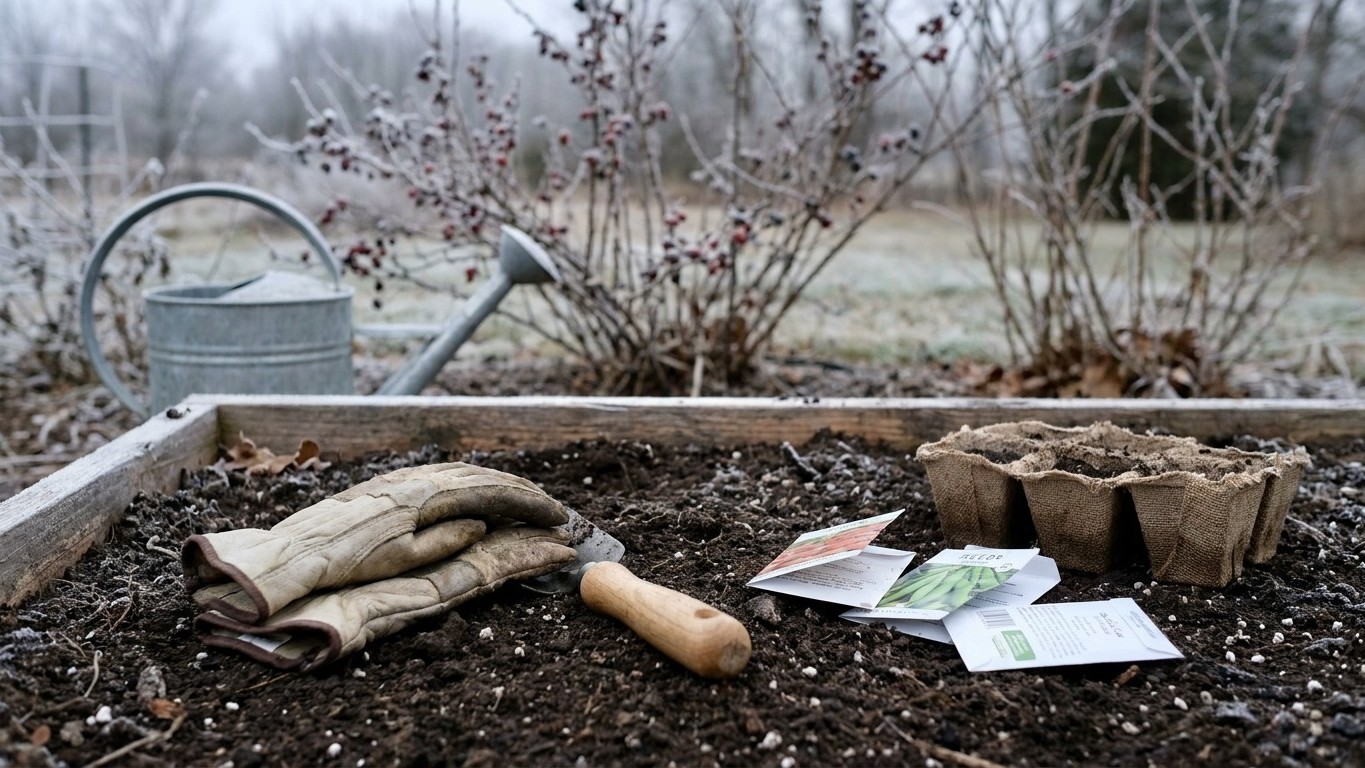

February in North Carolina still sits weeks ahead of the last frost across most of the state, so this is a month for cold-hardy crops, dormant planting, and cover, not for anything that fears a freeze. Garlic, shallots, peas, spinach, and kale can go into workable soil where drainage allows; everything else waits for seed starting indoors or bare-root planting while plants are still dormant.
What goes in the ground in February

The last spring frost across the Piedmont, using Charlotte as the reference station, runs March 23 to April 5 (NOAA NCEI 1991-2020 normals). That puts February six to nine weeks ahead of that window, which rules out anything warm-season but leaves real room for crops that shrug off a hard freeze. The deciding factor isn’t the date on the calendar, it’s whether the soil is workable: dry enough to crumble in your hand, not the sticky, waterlogged clay that Piedmont gardens are famous for after a wet winter.
Where soil is workable, garlic and shallot cloves can still go in dormant on the coastal plain and in milder Piedmont pockets, though most growers set these in fall. Sugar snap and English peas tolerate a light freeze once germinated and can go in directly. Spinach, kale, mustard greens, radishes, and onion sets from seed or transplant handle cold soil better than almost anything else in the vegetable garden, and all five are reasonable direct-sow choices this month.
The Blue Ridge counties run several weeks behind the Piedmont in spring, and growers there should treat all of the above as premature outdoors, holding crops under cover instead. A cold frame or a low tunnel over a raised bed buys two to four weeks of season on either end and is the safest way to get greens and peas started without betting on the weather. This is also the month for bare-root planting: fruit trees, roses, asparagus crowns, and cane fruit go in while still dormant, before the first flush of growth makes transplant shock worse. Forcing rhubarb or chicory indoors, in a dark, cool spot, is another low-risk way to get something edible out of a garden that isn’t ready for much else yet.
What to start under cover
Seed starting this month is arithmetic, not guesswork, and it runs backward from that March 23 to April 5 frost window. Peppers need roughly eight to ten weeks indoors before they’re ready to go outside, which puts a mid-to-late February start right on schedule for a Piedmont garden. Tomatoes need about six to eight weeks, so starting them now lines up with transplanting once the frost risk clears in late March or April. Broccoli and cabbage for an early spring crop run six to eight weeks as well, making February the natural start date for both.
Onions from seed are a tighter case: they typically need ten to twelve weeks before transplant, so a February start is already running late for gardeners who want onion transplants ready by early spring. Anyone counting from their own frost date, rather than a fixed month, should work the same way: take the earliest and latest local last-frost dates, subtract the weeks a given crop needs indoors, and that’s the seed-starting window, no further out.
The two ways this goes wrong are opposite failures. Start too early and seedlings sit indoors under weak late-winter light for too long, stretching into leggy, rootbound plants that struggle after transplant. Start too late and there isn’t enough time left before the ground warms enough to plant out, which shortens the harvest window all season. Mountain gardeners should add one to two weeks of cushion to every one of these counts, coastal plain gardeners can trim a week off.
What is ready to pick
Outdoors, February offers little in most of the state, but “little” isn’t “nothing.” Kale, collards, and leeks that overwintered in the garden are often still standing and are usually sweeter after cold exposure, since frost converts some of their starches to sugar. Spinach and mustard greens under a cold frame or low tunnel keep producing through this month with almost no added care beyond venting on mild days.
Indoors, sprouts and microgreens are the fastest payoff in the whole gardening calendar, ready in one to two weeks from seed on a windowsill, and they’re a reasonable way to keep fresh greens on the table while the outdoor garden sits dormant. This is also the month to go through the root cellar or pantry shelf and check stored crops before small problems become big losses. Winter squash should feel firm with no soft spots; a squash that’s starting to give under light pressure near the stem is close to turning and should be used first. Potatoes with green tinges or sprouting eyes need to be moved to a darker spot or used immediately, and onions that have gone soft at the neck won’t last much longer no matter how they’re stored.
The jobs that matter this month
February carries more weight than its short, cold days suggest, mostly because several jobs here have hard deadlines tied to plant dormancy and the seed trade calendar rather than to weather.
Pruning and planning
Dormant pruning of apple, pear, and peach trees, along with blackberry and raspberry canes, should happen before bud swell starts pushing new growth. Prune too late and every cut costs the plant stored energy it’s already committed to spring growth; prune now, while the plant is fully dormant, and the cut costs nothing. Ordering seed also has a real deadline, not a habit: popular varieties of tomatoes, peppers, and heirloom crops sell out from catalogs well before planting season, and waiting until March often means settling for whatever’s left.
Soil and structure
A soil test now, through the county extension office, gives results back in time to amend before spring planting, which a test submitted in April doesn’t. Turning the compost pile speeds decomposition and is easier to do now, before the pile is needed for spring beds. Tool maintenance, sharpening pruners and shovels, oiling wooden handles, belongs on a slow month, not squeezed in between spring planting jobs. Repairing raised bed frames, fencing, and trellis structures while the garden is otherwise idle avoids doing it later with plants already in the ground underfoot.
What not to do in February
The most common mistake this month is planting warm-season crops outdoors because a stretch of mild days feels like spring arrived early. Tomatoes, peppers, beans, and squash set out now will meet the last frost, which doesn’t land until March 23 to April 5 in the Piedmont, and a single freeze at that point kills them outright. A run of 65-degree days in February is weather, not a season change.
A related error is uncovering cold frames or low tunnels too early after a mild spell, only to have the greens or peas underneath hit by the next hard freeze with no protection back in place fast enough. Vent on warm days if needed, but leave the cover accessible and ready to close again overnight.
Nitrogen fertilizer applied to lawns or woody plants this early pushes tender new growth before the frost risk has passed, and that new growth is exactly what a late freeze damages worst. Hold nitrogen applications until closer to the actual last frost date for the area. Working wet Piedmont clay this month, rather than waiting for it to dry to a crumbly texture, compacts the soil structure and can undo a season’s worth of amendment work in one afternoon with a tiller or even foot traffic on a bed.
Checking this against your own county
Everything above describes the Piedmont, using Charlotte as the reference point for a state that runs from USDA Hardiness Zone 5b in the mountains to 8b on the coast. That’s a wide range built on one measurement, average annual extreme minimum temperature, and it means a frost date for Charlotte can be off by weeks for a garden in Asheville or Wilmington. Elevation in the mountains and proximity to the coast both shift the real planting window in ways a single state-wide date can’t capture.
The most reliable next step is checking against local data rather than a statewide average. NC State Extension maintains county-level offices with local frost data and planting guidance specific to each region of the state.
Common questions
Can I plant tomatoes outdoors in North Carolina in February?
No. The last spring frost in the Piedmont runs March 23 to April 5, and tomatoes have no frost tolerance. Start seed indoors instead, roughly six to eight weeks before the local last-frost date.
Is it too late to plant garlic in February?
It’s later than ideal, since garlic is normally set in fall for a full dormancy period, but cloves can still go in where soil is workable, particularly on the coastal plain and in milder Piedmont spots, with a smaller harvest expected than a fall-planted crop.
What USDA hardiness zone is North Carolina in?
The state spans USDA zones 5b to 8b, from the cooler Blue Ridge mountains to the milder coastal plain, according to the USDA Plant Hardiness Zone Map. That range is based only on average annual extreme minimum temperature, not on frost dates or growing season length.
Why is my soil too cold to plant even though the air feels warm?
Soil warms and cools far more slowly than air temperature, especially heavy Piedmont clay, so a few mild days don’t mean the soil underneath has warmed enough for seeds to germinate reliably. Checking soil temperature directly, or simply testing whether it crumbles rather than clumps, is a better guide than the forecast.