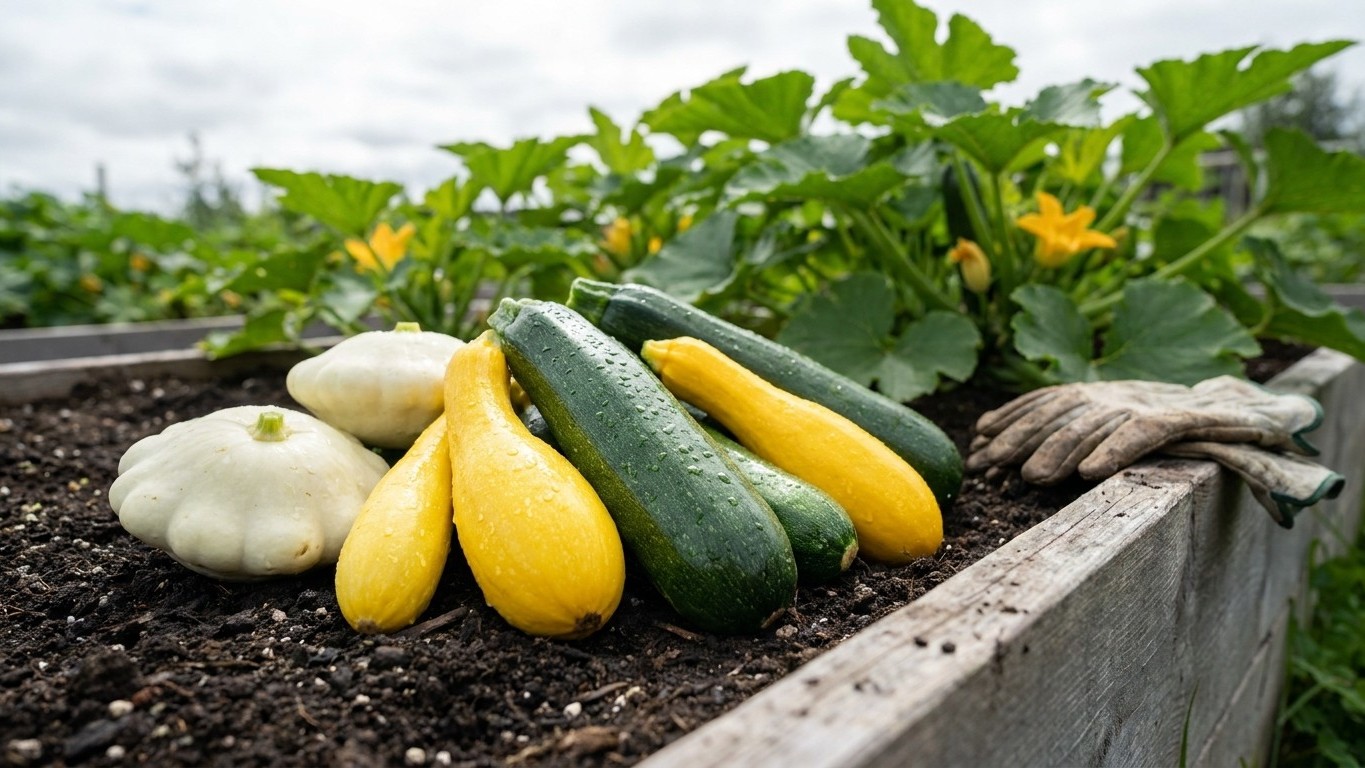

The Piedmont’s frost-free window runs from roughly April 5 to October 30, about 208 days of growing time. That’s long enough to rule out almost nothing on days-to-maturity alone. The real filter for North Carolina gardens is heat and humidity: 35 days a year hitting 90F or hotter, paired with summer rain that averages 12.1 inches but often shows up as a hard July thunderstorm rather than a steady soak. That combination decides which squash types thrive and which quietly rot or wilt by August.
The short answer for North Carolina
Choose summer squash types bred for airflow and heat tolerance over classic dense-bush heirlooms. In a state with this much frost-free time, maturity speed barely matters. Yellow crookneck, straightneck, and zucchini types with an open, semi-vining habit outperform the old-fashioned tight bush forms once the Piedmont’s summer humidity settles in, because loose foliage dries faster after rain and resists powdery mildew longer.
The math behind this is simple. Between the April 5 spring frost date and the October 30 fall frost date, a gardener has 208 days to work with. Even the slowest summer squash types mature in 50 to 65 days, which means there’s room for two full plantings, or a spring crop and a fall backup, in almost any part of the Piedmont. Season length isn’t the constraint here. Disease pressure and heat stress are.
Days above 90F average 35 per year at the Charlotte reference station, and that heat load does two things to squash. It pushes water demand up fast in July, the driest summer month at 3.74 inches, and it stresses pollination, since squash blossoms can drop or fail to set fruit when daytime highs stay in the mid-90s for stretches. Types with a longer bloom window and repeat flowering, common in modern zucchini and crookneck strains, cope with a bad heat week better than older varieties that flower in one tight flush.
| Type | Habit | Best fit for NC summer |
|---|---|---|
| Yellow crookneck / straightneck | Open bush | Strong, dries fast after rain |
| Zucchini | Semi-open bush | Reliable, wide flowering window |
| Pattypan / scallop | Compact bush | Fine in spring, struggles in peak humidity |
| Cousa / Lebanese | Open bush | Good heat tolerance, less common locally |
| Tromboncino | Vining | Excellent airflow, needs trellis space |
The takeaway for a Piedmont garden: pick for how the plant handles a wet, hot July, not for how fast it fruits. Nearly everything fruits fast enough here.
What will not work here
Tight, compact bush varieties planted close together are the first casualty of a North Carolina summer. With 12.1 inches of rain typically falling across June, July, and August, and July arriving as the driest but often stormiest month at 3.74 inches, foliage that stays wet after a downpour becomes a mildew farm. Pattypan and scallop types, bred for a neat compact shape, keep their leaves packed close to the crown. That’s a liability once daytime highs push toward the 35 annual days above 90F, because humid air trapped under dense leaves doesn’t clear until well into the afternoon.
Weekly watering routines fail for the same reason the rainfall figure is misleading on its own. A single July thunderstorm dropping an inch of rain in twenty minutes mostly runs off, especially on compacted clay soil common across the Piedmont, rather than soaking down to root depth. A squash plant relying on that storm to carry it through a stretch of 90-degree days will show it: leaves wilting by mid-afternoon even when the soil looks damp on the surface. Gardeners who water once a week and assume the summer rainfall total covers the gap are underestimating how fast that heat load pulls moisture out of the top few inches of soil.
Short-season thinking doesn’t help either. Because the frost-free window runs 208 days from April 5 to October 30, there’s no need to chase the fastest-maturing cultivar out of fear of running out of time. Gardeners who prioritize speed over disease resistance often end up with a bush that fruits hard in June, then collapses to powdery mildew in July precisely when the humidity and heat overlap. A slightly slower variety with better airflow and mildew tolerance will still finish well before the October 30 frost, and it’ll still be producing when the fast one has already quit.
Dense spacing compounds every one of these problems. Squash planted on tight centers to save space traps humid air at the crown, right where the plant is most vulnerable to rot after a heavy rain event.
What changes across North Carolina
North Carolina isn’t one garden, and the hardiness zone range makes that plain: the state spans USDA zones 5b to 8b, one of the widest spreads of any state in the eastern U.S. The Charlotte reference station used for the frost dates and heat totals in this article represents the Piedmont, not the whole state. That’s a meaningful gap, and there’s no single planting date or variety pick that covers a state stretching from sea level to well over 5,000 feet.
The Blue Ridge Mountains to the west run several weeks later in spring than the Piedmont figures given here, which pushes both the safe planting date and the effective frost-free window later and shorter. A gardener at higher elevation working with a compressed season benefits more from the faster-maturing types this article’s Piedmont numbers make optional. The coastal plain runs the opposite direction: earlier spring frost dates, a longer stretch of heat, and likely more days above 90F than the Charlotte total of 35, which raises the case for mildew-resistant, heat-tolerant types even further than in the Piedmont.
Humidity and rainfall patterns shift too, even though this article’s summer rainfall figures come from a single reference station. Coastal counties typically see more consistent summer moisture and higher humidity, while the mountains can run drier in a summer dry spell despite cooler temperatures overall. None of that shows up in a Piedmont-based number, which is exactly why a state-level answer has limits.
None of this points to a single correction a reader can make from home. The spread across 5b to 8b is simply too wide for that. What it does mean is that a gardener outside the Piedmont should treat the frost dates and heat totals here as a reference point, not a rule, and expect their own dates to shift earlier or later depending on where they sit in that range.
Where to check this for your own county
North Carolina State Extension publishes county-level guidance that this article can’t replicate. Every county has its own extension center, and that center’s planting calendar reflects local frost data rather than the single Piedmont reference station used above. A gardener in Buncombe County at elevation is working with a different spring than one in Craven County near the coast, and the state-level dates here average out those differences rather than resolving them.
Two things are worth pulling from the county extension office specifically. The first is the local frost-free window, since county centers often maintain records closer to the actual garden than the regional NOAA station cited in this article. The second is the list of squash varieties the county has trialed or recommends, which accounts for local disease pressure like squash vine borer activity and powdery mildew timing that vary block by block across the state and aren’t captured in a statewide article.
A county recommendation beats a state one every time. This page works from a single Piedmont reference station and a statewide hardiness zone range, which is useful for understanding the mechanism (why heat and humidity matter more than season length in North Carolina) but not a substitute for the specific numbers a county agent has for the reader’s own soil and elevation. The extension office is also typically the fastest way to find out which squash varieties are actually thriving in gardens a few miles away this season, information no statewide climate normal can offer.
Checking this against your own garden
None of the numbers above beat a gardener’s own eyes and hands on the actual plot. Three signs settle the question faster than any calendar date.
Soil warmth by feel is the first. Summer squash seed germinates poorly in cold soil, and a hand pressed into the top few inches of bed in early spring will tell a gardener more about planting readiness than the calendar date for last frost. If the soil still feels cool and damp rather than warm to the touch, waiting another week costs nothing given how much frost-free time the season allows.
The first flush of male flowers is the second signal, and it matters because squash plants typically produce several rounds of male blossoms before the female flowers, the ones with the tiny swollen base that becomes fruit, start appearing. A garden showing male flowers only, week after week, isn’t failing. It’s just early in the plant’s own bloom sequence, and patience usually resolves it once temperatures stabilize.
The first true leaves, the second set that emerges after the rounded seed leaves, indicate the plant has moved past the fragile seedling stage and into active growth. A slow or stalled appearance of true leaves, especially compared to how a neighbor’s plants are doing at the same point in the season, often points to a specific microclimate issue on that plot: a shadier corner, heavier clay, or a cooler pocket that the county’s general dates don’t account for. That observation, on that plot, outranks every date in this article.