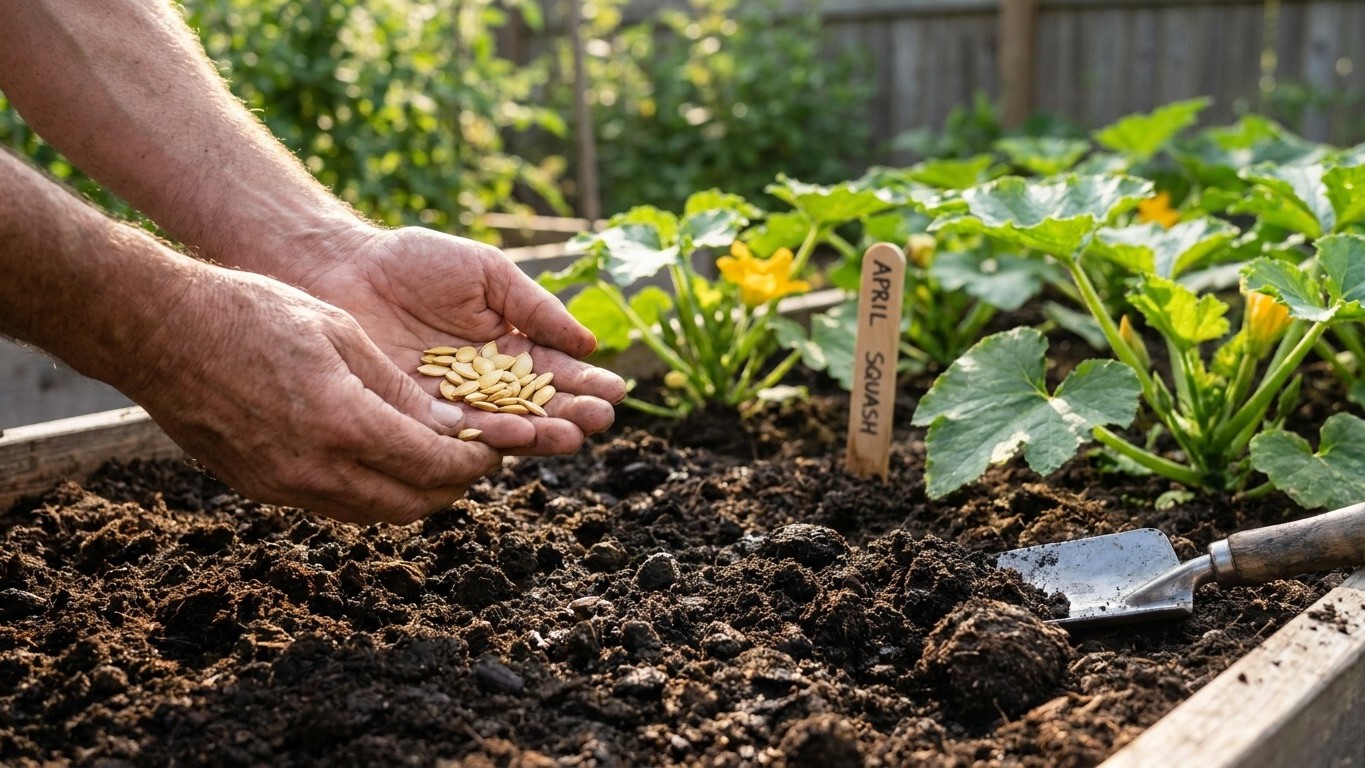

Direct-sow Summer Squash in North Carolina’s Piedmont once the last spring frost window has passed, roughly after April 5, and keep planting in succession through early July. That timing comes straight from Charlotte’s 1991-2020 frost data, but the mountains and coast shift it by weeks in either direction.
The short answer for North Carolina
NOAA’s 1991-2020 climate normals put Charlotte’s last spring freeze (32F) somewhere between March 23 and April 5. That’s not a single date, it’s a probability band: the 30-70% range where a freeze becomes progressively less likely as the calendar moves toward April. On March 23, there’s still roughly a 70% chance of one more freeze. By April 5, the odds have dropped to about 30%. Summer squash seedlings die at 32F, so the safer play is to treat April 5 as a floor, not a target, and wait a few extra days if a cold snap shows up in the short-range forecast.
On the other end of the season, the first fall freeze at the same Charlotte reference station lands between October 30 and November 8, using the same 30-70% method. Summer squash varieties typically need 45 to 65 days from seed to first harvest, so a planting made in early July still has a comfortable cushion before that window opens in late October.
That gives Piedmont North Carolina a working sowing calendar of roughly mid-April through the first week of July for direct-seeded summer squash, with succession plantings every three to four weeks in that stretch to keep fresh plants coming as older ones wear down from vine borers or powdery mildew. Anyone gardening on the coastal plain can likely push the start earlier and the end later, since that region’s frost dates run ahead of Charlotte’s. Anyone in the mountains needs to shift the whole calendar later and shorten the season, for reasons the next section covers with the actual numbers behind them.
One more piece worth flagging here: these frost dates describe probability, not certainty. A grower who plants right at the early edge of the window accepts real risk of losing a first sowing to a late freeze. A grower who waits until the risk drops closer to 10-20% trades a slightly later start for much better odds of the seedlings surviving without row cover or replanting.
What will not work here
Squash seed sown before the soil has actually warmed is the most common failure in this region, and it has nothing to do with air temperature or the calendar date. Squash seed rots in cold, wet soil rather than germinating, and a Piedmont spring in March or early April, sitting inside that 30-70% freeze band, usually means soil still running cold from repeated overnight chills. Rushing a planting to beat the neighbors gets a bare row and a second trip to the seed rack two weeks later.
Charlotte’s climate normals also show 35 days a year averaging 90F or higher, concentrated in June, July and August, right when squash plants are flowering and setting fruit. That heat load does two things badly for squash. It stresses pollen viability, so blossoms can drop without setting fruit during the hottest stretches. And it drives evaporation hard enough that a weekly watering schedule, which might carry a garden through a mild June, falls short by midsummer. July is the driest of the three summer months at just 3.74 inches of rain, compared to 4.35 inches in August, so a grower watering once a week straight through summer on the assumption that “it rained” is very likely underwatering right when the plants need consistency most.
The reverse mistake shows up in humidity, not heat. Charlotte’s summer rainfall of about 12.1 inches over June through August often arrives as heavy, brief thunderstorms rather than steady soaking rain, which means foliage gets wet fast and stays wet. Summer squash planted at tight spacing, with leaves touching and airflow blocked, turns that humidity into powdery mildew almost every year in this region. Wider spacing than a seed packet from a drier climate might recommend, and watering at the soil line rather than overhead, both matter more here than in places with lower summer humidity.
Finally, a single planting made in April and left to run all season is a bad match for this climate. Squash borers and mildew both build up as the season goes on, and Piedmont summers are long enough to support two or three separate plantings rather than one that has to survive from May through October.
What changes across North Carolina
The USDA hardiness zone map lists North Carolina spanning 5b to 8b, using the 2023 map’s average annual extreme minimum temperature. That’s a three-and-a-half zone spread inside a single state, which means a Piedmont date built around Charlotte’s frost data cannot simply be exported to the rest of the state without adjustment.
The caution behind the frost dates already flags the two directions this pulls in. West into the Blue Ridge Mountains, elevation delays spring by several weeks and can bring fall frost earlier, shrinking the whole squash-growing season on both ends. A mountain garden working from the Piedmont’s April 5 last-frost estimate risks planting into ground that’s still weeks away from safe, and risks losing a late planting to an early fall freeze that Charlotte’s own data wouldn’t predict.
East toward the coastal plain, the pattern reverses. Milder winters and a longer frost-free season generally mean an earlier last spring frost and a later first fall frost than the Piedmont sees, opening a wider sowing window and making an earlier first planting and a later final succession both realistic.
Because this spread runs from 5b at the coldest end to 8b at the warmest, there is no single planting date that fairly represents the whole state, and this page isn’t going to invent one that pretends otherwise. Rather than guess at a personal zone from a description of geography, the USDA’s interactive map is the only reliable way to confirm which zone applies to a specific address, since two properties a few miles apart in hilly terrain can sit in different zones from elevation and cold-air drainage alone.
Where to check this for your own county
North Carolina’s land-grant extension service, NC State Extension, runs county centers across the state, and the state-level entry point is ces.ncsu.edu. That’s where a county-specific answer replaces the statewide estimate this page has been working from.
Two things are worth asking a county center for specifically. The first is the local vegetable planting calendar, which will reflect that county’s actual frost data rather than the Charlotte reference station used throughout this page, and which matters most for anyone gardening in the mountains or on the coastal plain where the dates genuinely diverge from the Piedmont. The second is a list of summer squash varieties that county’s extension agents have actually trialled or recommend for local disease pressure, since powdery mildew and squash vine borer severity both vary by region within the state and a variety bred for resistance to one may not address the other.
A county recommendation will always outrank a state one for the simple reason that it’s built on data closer to the actual garden. This page draws on a single Piedmont reference station’s climate normals to describe a pattern that holds reasonably well across a wide swath of central North Carolina, but it was never built to replace what a county agent knows about frost pockets, local soil types or which squash varieties have struggled with a particular pest in that specific area over recent seasons. Treat the ranges here as a starting point for a conversation with a county extension office, not the final word.
Checking this against your own garden
Every date on this page is an average built from thirty years of weather records at one station. A specific garden, on a specific afternoon, will tell a gardener more than any of those averages can.
Soil warmth is the first and most reliable check. Squash seed wants soil that feels warm and dry-ish to the hand, not the residual chill of a spring morning. A quick way to judge it without a thermometer: if bare soil still feels cool and damp an hour or two after full sun has been on it, it likely hasn’t reached the mid-60s (F) that squash seed needs to germinate promptly rather than sit and rot.
The first flush of male flowers is the second signal, and it tells a grower something the calendar can’t: whether the plant has reached reproductive maturity under that particular garden’s light and heat conditions. Male flowers typically show up before female flowers on summer squash, and their appearance is a decent proxy for how the plant is tracking against a typical season in that spot, regardless of what the calendar predicted at planting time.
The third is the timing of the first true leaves, the leaves that appear after the initial pair of seed leaves and actually look like squash foliage. A quick emergence of true leaves after germination suggests the soil and air temperatures matched what the plant wanted; a slow, stalled emergence suggests the planting went in a bit early for that particular microclimate, information worth remembering for the next succession sowing a few weeks later.