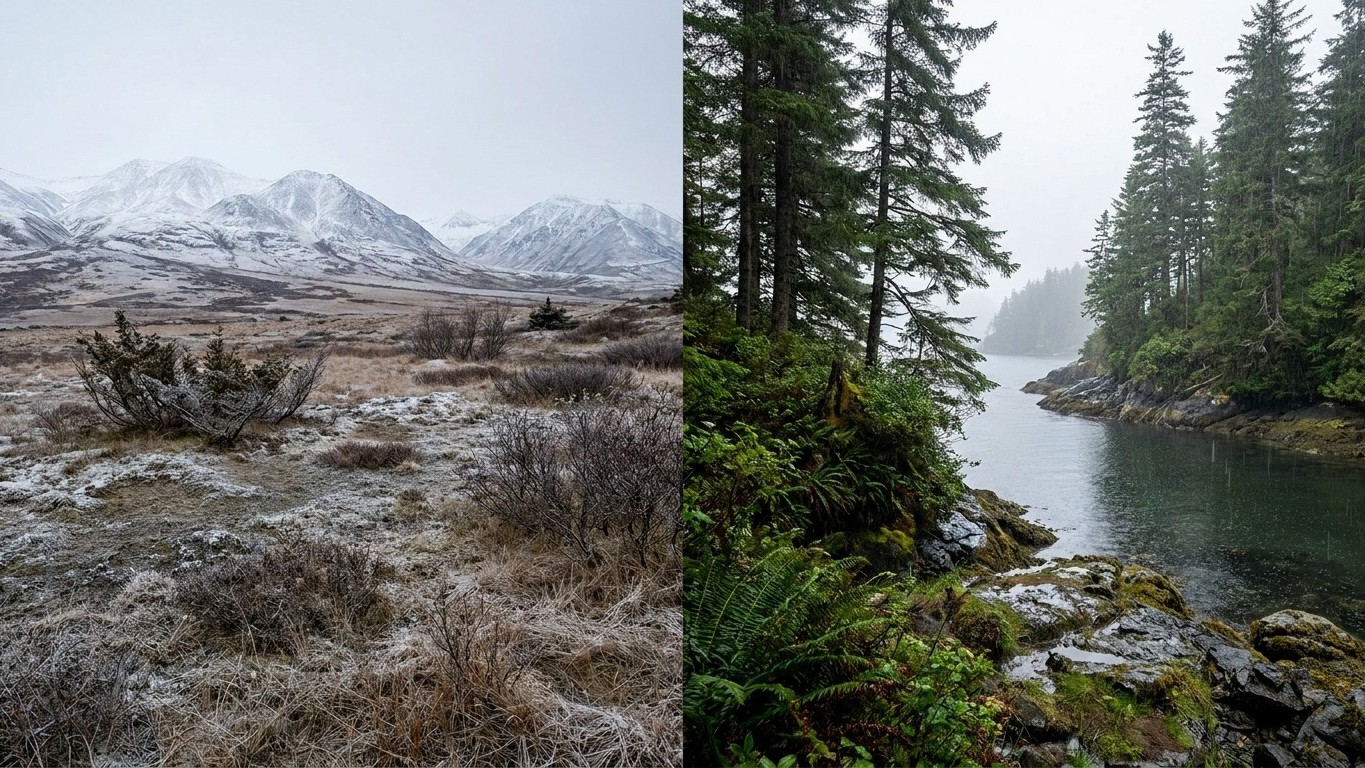

North Carolina’s USDA hardiness range runs from zone 5b in the high country to zone 8b on the coastal plain. Cross that range against the 65 landscape plants documented on this site and the answer is short: none of them fail across the whole state. Nine fail in part of it, and which part depends entirely on which zone you’re standing in.
What will not survive a winter in North Carolina

The state’s hardiness range, as mapped by the USDA Plant Hardiness Zone Map (2023 edition, built on 1991-2020 minimum-temperature averages), stretches from zone 5b to zone 8b. That’s one of the widest spreads any single state carries, and it’s the reason a plant guide written for “North Carolina” as a whole has to work harder than one written for a state with a single zone.
Here’s the part that matters most for anyone trying to avoid a dead plant next spring: of the 65 landscape Trees, Shrubs and Perennials this site tracks, zero fail everywhere in North Carolina. There’s no plant on the documented list that is simply wrong for this state, top to bottom. That’s worth sitting with for a second, because plenty of state guides elsewhere carry a list of species that die no matter where in the state you plant them. This one doesn’t.
That doesn’t mean every plant is comfortable everywhere it survives. Hardiness zone numbers measure one thing only, the average annual extreme minimum temperature at a location, and the warm end of a plant’s listed range is frequently a heat ceiling rather than a cold floor. A plant rated hardy through zone 8b can still sulk through a hot, humid Piedmont summer even though it technically survives the winter. Survival and thriving are not the same claim, and this page is only making the survival one.
One more caution before moving on: the count above describes the 65 plants this site documents, not the full universe of species that can grow in North Carolina. There are far more than 65 Trees, Shrubs and Perennials capable of living somewhere in this state. This is a crossing of a documented list against a hardiness range, not a census of the state’s flora.
The plants that work in part of the state and not the rest
Nine plants on the documented list are hardy in part of North Carolina’s zone range and not the rest. This is the group that actually justifies treating North Carolina as its own page rather than lumping it in with neighboring states, because a reader in the mountains and a reader on the coast are not getting the same answer from a single yes-or-no verdict.
The zones each plant fails in split into three rough groups: plants that struggle at the cold end of the state’s range, plants that struggle at the warm end, and one that fails in the middle band.
| Plant | Fails in these North Carolina zones | Where that falls |
|---|---|---|
| Ficus carica (fig) | 5b, 6a, 6b | Cold end of the range |
| Hydrangea macrophylla | 5b | Cold end of the range |
| Lagerstroemia indica (crape myrtle) | 5b | Cold end of the range |
| Magnolia grandiflora | 5b | Cold end of the range |
| Weigela florida | 7a, 7b | Middle of the range |
| Syringa vulgaris (lilac) | 7b, 8a, 8b | Warm end of the range |
| Amelanchier canadensis | 8b | Warm end of the range |
| Picea abies (Norway spruce) | 8a, 8b | Warm end of the range |
| Thuja occidentalis (arborvitae) | 8a, 8b | Warm end of the range |
Notice the pattern: four plants drop out at the coldest tip of the state’s range (zone 5b, the high Blue Ridge), four drop out at the warmest tip (zones 8a-8b, the coastal plain), and one, Weigela florida, fails in the middle band of 7a-7b rather than at either edge. The documented data names the zones where each plant fails; it doesn’t say why, and this page isn’t going to guess.
Finding out which of those zones covers your own address is the whole ballgame here. This site’s North Carolina insulation guide carries the county-level zone breakdown for the state, and checking your county there before shopping for anything on this list will settle the question faster than any general rule.
The soil and the summer they will be planted into
North Carolina’s representative soil, as recorded by USDA NRCS for the Cecil series, is an Ultisol: old, heavily weathered, naturally acid, and thin on nutrients. Surface pH runs about 5.5, slightly acid. Texture leans sandy, 68 percent sand against 13 percent clay and 20 percent silt, with organic matter around 0.8 percent. It’s classified well drained.
For a woody plant going into the ground, that drainage rating matters more than almost anything else in this list. Winter-wet soil kills far more shrubs and young trees than winter cold does, because saturated soil around a root ball in freezing weather does more damage than the air temperature above it. A well-drained, sandy-leaning soil like the Cecil series is, on that specific count, an advantage. But this is the soil that represents the state on a map, not the soil in any one yard. River bottoms run heavier, hillsides run thinner, and anywhere a builder has scraped or filled the topsoil will behave nothing like the mapped series. A soil test is still the only way to know what’s actually under a given planting bed.
Summer rainfall across the reference station’s period of record runs about 12.1 inches over June, July and August, out of 43.6 inches for the year. July is the driest of the three summer months at 3.74 inches, June comes in at 3.99, and August at 4.35.
None of those numbers describe how often a new planting needs water, because rainfall never reads alone. The same inch of rain behaves differently depending on what it lands on: a sandy surface like the Cecil series lets water through within a day, while a more clay-heavy pocket holds it for a week or more. A state that gets a reasonable 12 inches of summer rain on paper can still leave a sandy bed dry within 48 hours of a storm. Heat pushes the same effect further, since a single thunderstorm mostly runs off compacted or dry ground rather than soaking in. The rainfall figure is a starting expectation, not a schedule, and a rain gauge on the actual planting site is what settles the question from there.
When to plant, here
At the reference station, the last spring frost falls between March 23 and April 5, and the first fall frost arrives between October 30 and November 8. Those dates aren’t a guarantee, they’re the 30-70 percent probability band for a 32°F freeze built from 1991-2020 averages at one Piedmont station. The mountains run several weeks behind that in spring and see their first frost earlier in fall; the coastal plain runs the opposite direction.
The reasoning behind planting windows matters more than any single date. A newly planted tree or shrub needs time to grow new roots into the surrounding soil before it’s asked to do anything demanding, whether that’s pushing out a full canopy of leaves in a dry June or surviving a hard freeze with a root system that hasn’t spread past its original pot shape.
| Window | What it suits | Main risk |
|---|---|---|
| Spring (after March 23-April 5) | Plants that need a full growing season to establish before their first winter | A late frost after an early warm spell can still catch new growth off guard |
| Autumn (before October 30-November 8) | Most trees and shrubs, since cooler air and warm soil favor root growth over leaf growth | Less time to root before the ground goes cold, especially in the coldest zones of the state’s range |
In the coldest slice of North Carolina’s zone range, roughly the high country sitting in zone 5b, the autumn window closes faster than it does in the Piedmont or the coastal plain, because the first freeze there arrives earlier than the reference station’s date. A plant going in during October at 3,000 feet has less time to root than one going in on the coast the same week.
Whatever a plant’s drought tolerance rating says, treat it as a description of an established root system, not a newly planted one. Every plant on this list needs regular water through its first season in the ground regardless of how it’s rated once it’s settled in.
Where to read about each one
The plants confirmed hardy across North Carolina’s entire zone range, cold end to warm end, split cleanly into three groups. Among trees: Acer rubrum, Acer saccharum, Betula nigra, Carpinus caroliniana, Cercis canadensis, Cornus florida, Ginkgo biloba, Juniperus virginiana, Liquidambar styraciflua, Nyssa sylvatica, Pinus strobus, Platanus occidentalis, Quercus alba, Quercus rubra, and Tilia americana.
Among shrubs: Aronia arbutifolia, Buxus sempervirens, Clethra alnifolia, Fothergilla gardenii, Hydrangea paniculata, Ilex glabra, Ilex verticillata, Itea virginica, Kalmia latifolia, Physocarpus opulifolius, Spiraea japonica, and Viburnum dentatum.
Among perennials: Achillea millefolium, Amsonia hubrichtii, Asclepias tuberosa, Baptisia australis, Anacis verticillata, Echinacea purpurea, Heuchera americana, Iris sibirica, Lavandula angustifolia, Monarda didyma, Phlox paniculata, Rudbeckia fulgida, Salvia nemorosa, and Hylotelephium spectabile.
Every hardiness range cited on this page comes from the North Carolina Extension Gardener Plant Toolbox, a university extension database, crossed against the state’s own USDA zone range as recorded on this site. These are hardiness figures describing winter survival by zone, and they carry a different meaning from the adaptation ranges used elsewhere on this site for apple varieties, which measure something else entirely and shouldn’t be read side by side with this list.