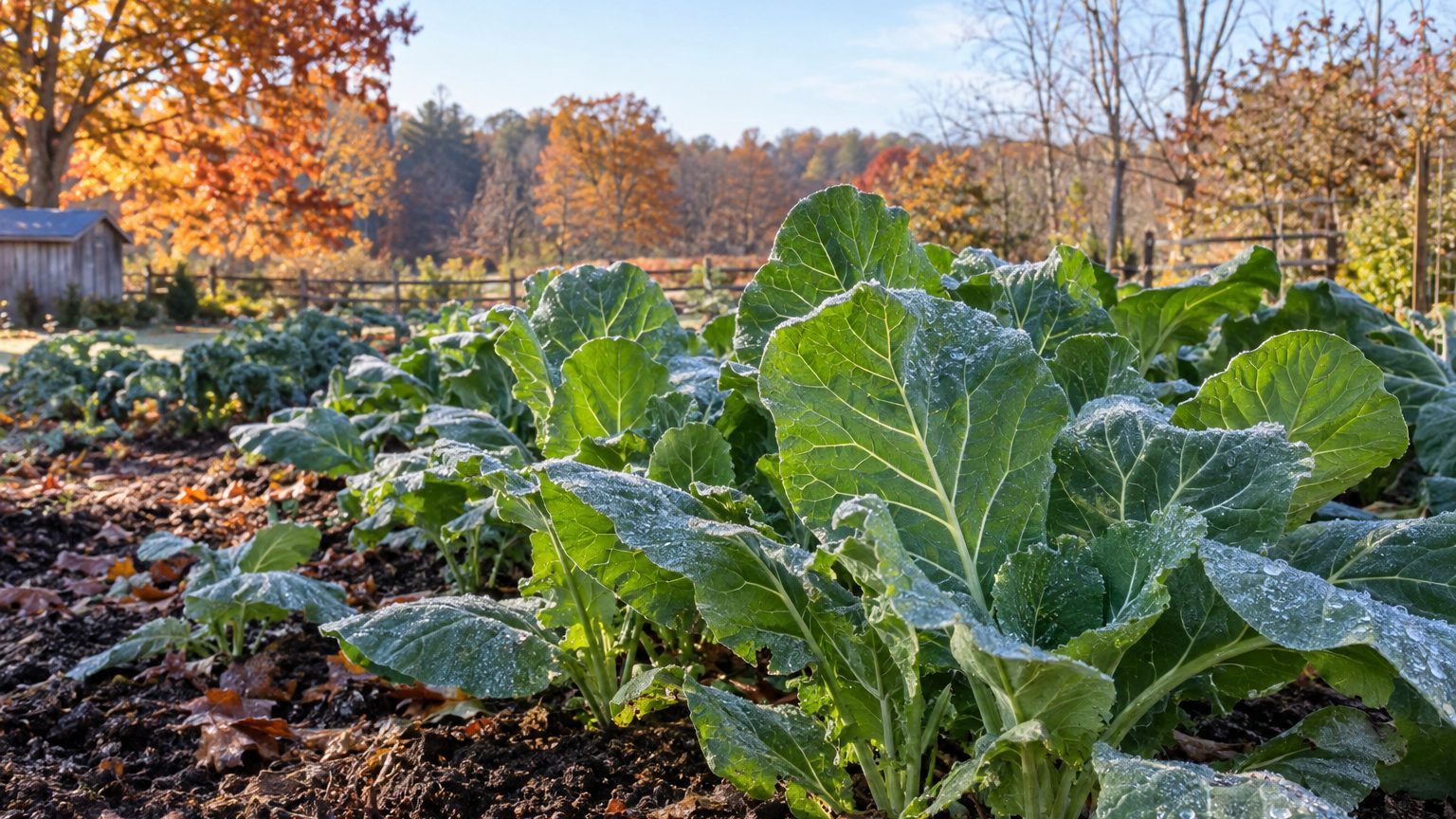

Start collard seed indoors in late March to early April, then set transplants outside from about May 4 to May 15, when a late freeze stops being a coin flip. Direct-sowing in April soil fails more often than it works. A second sowing in late June or early July can ride into a fall harvest, since collards shrug off light frost.
The short answer for North Dakota
Plan on indoor sowing in late March to early April and transplanting between May 4 and May 15. Those dates are the Fargo reference-station window from NOAA’s 1991-2020 U.S. Climate Normals. They mark the band where the chance of one more 32°F freeze falls between 70 and 30 percent. That is a probability of a freeze, not a date the cold stops. Collards tolerate a light frost, so a transplant sitting through a 30°F night under a sheet of row cover usually survives. A bare seedling in a hard freeze does not.
The spring crop
Six to seven weeks of indoor growing yields a stocky transplant with four to five true leaves. Harden it off for about a week, then set it out. Rural and suburban gardens tend to see the last spring frost one to two weeks later than the airport station, so a farmstead outside town should lean toward the late end of the window or past it.
The fall crop
The first fall freeze at the reference station arrives between September 25 and October 5, again on a 30-to-70-percent probability band. Counting forward from the last spring frost band, that leaves roughly 133 to 154 days between freezes at the reference station. Rural gardens often lose one to two weeks off the fall end. A late-June or early-July sowing needs about two to three months to give usable leaves, so it sits at the edge of what the season allows.
| Task | Reference-city timing | Rural adjustment |
|---|---|---|
| Sow indoors | Late March to early April | Wait a week for cold, exposed sites |
| Transplant outdoors | May 4 to May 15 | One to two weeks later |
| Sow for fall | Late June to early July | Early end of that range |
| Fall freeze begins | September 25 to October 5 | One to two weeks earlier |
For the full picture on growing the crop after it is in the ground, see Growing Collards in North Dakota.
What will not work here
Overwintering is out. The coldest month at the Fargo reference station averages a daily minimum of 0.2°F, and the USDA Plant Hardiness Zone Map (2023) places the state in zones 3a to 4b. Collards that stand through a mild Southern winter will not come back from a plains January, even under heavy mulch. Treat every planting as an annual, and do not count on a spring regrowth.
Direct-seeding in April comes next. The last-freeze band does not open until May 4, and soil that is cold and wet in mid-April rots seed or leaves seedlings stalled for weeks. Seed sown outdoors in early May then has to make leaves on a calendar that closes in late September. Transplants skip the slowest part of that race.
Long-season Southern selections are the third problem. A collard bred for a nine-month growing season in the Deep South is still making leaves when a September or early-October freeze arrives. Gardens a week or two colder than the airport station, which is common outside town and at elevation, run out of days even sooner. The practical rule is to pick types sold as early or quick-maturing, and the variety guide, The Best Collards and Greens for North Dakota, sorts them by speed.
Setting transplants out the first warm week of April fails for a related reason. A warm spell in this climate is often followed by a hard freeze, and the 30-to-70-percent probability band means a freeze after May 4 is still a real possibility. Collards in the ground that early need cover on short notice. Gardeners without row cover or old bedsheets handy lose plants.
Late summer is the quieter killer. A July sowing for fall harvest has to germinate in hot, drying soil, and watering once a week will not hold a seedbed. A sprinkle every day or two until seedlings emerge, plus a light mulch of straw, does. Skip that, and the stand thins before it has a chance to beat the fall freeze.
What changes across North Dakota
No single zone covers the state. The USDA map runs from 3a to 4b, and other parts of the territory differ. That number matters for perennials. For collards, which are grown as annuals, the more useful difference is how many frost-free days a garden gets, and zone does not measure that. Two gardens in the same zone can differ by two weeks in either frost date.
Someone in the far north, near the Canadian border, or on high ground should shift later in spring and earlier in fall. Add a week to the transplant window, move fall sowing to the early end, and choose the quickest collards available. Warm pockets near the Red River, in town, or against a south-facing wall may match or beat the airport figures. In those spots, the early end of the window is realistic.
Do not treat the reference city as the rule for the state. It describes one airport, and gardens outside it typically run one to two weeks later in spring and earlier in fall, with more difference at elevation. Look up your own location on the USDA Plant Hardiness Zone Map to see which zone your ZIP code falls in, and treat the answer as a starting point. Zone tells you about winter survival. Your own last-frost experience tells you about sowing.
Where to check this for your own county
NDSU Extension runs the state’s land-grant extension service, with offices in the counties. A county recommendation beats a state one, because it reflects local frost pockets, soil, and what has been grown there. The calendar above is the state-level version, built from one reference station.
Two things are worth asking for. The first is the local planting calendar for cool-season vegetables, which should give frost dates closer to your county than the Fargo numbers. The second is the list of varieties that have been trialled in your county or a neighboring one. Trial results show which collards and greens actually finished before frost on local ground, which beats a seed catalog’s days-to-maturity number.
Extension offices also answer practical questions on the phone or by email: what the soil is like in your area, which flea beetles and cabbage worms are active, and when local gardeners usually get their first fall freeze. Bring your town or rural route, because the answer for a river-valley lot differs from one on the western plains. Extension publishes calendars crop by crop, so ask specifically about collards or other cole crops rather than a general vegetable chart.
Checking this against your own garden
Your own yard outranks any date printed for a reference city. Three observations are worth making each spring, and none needs a gadget.
- Soil warmth by hand. Push your hand a few inches into the bed in the morning. If it feels cold and clammy, transplants will sit. Soil that is cool but not numbing is ready. A bed that warms ten days before the neighbor’s is a warm microclimate.
- Male flowers on the first willows or cottonwoods nearby. When catkins open and shed pollen, the ground is waking up. A tree that blooms early in your yard marks a warm spot, and a late one flags a cold hollow where frost lingers.
- The first true leaves on your seedlings. Seedlings under lights or in a window should show their first true leaves once they have grown on a while. If they appear slowly, your setup is too cool, and your transplant date should slip with them.
Write down the dates you see each year. After two or three seasons, those notes will tell you more about your garden than the state’s calendar can.
The Moon calendar is a separate, older custom: see when to plant collard greens by the moon, written as tradition rather than fact.
Common questions
Can I direct-sow collards in North Dakota?
You can, but only for a fall crop sown in late June or early July. Spring direct-seeding in cold, wet soil is slow and leaves too few days before fall frost for a full harvest.
Will collards survive a frost?
Light frost, yes, and the leaves often taste better afterward. A hard freeze is the point where gardeners usually harvest everything left and call the season done.
Can collards overwinter outside?
No. With a coldest-month average minimum of 0.2°F at the Fargo reference station, the plants will not survive in the ground. Pull them or compost them in the fall.
Which date should I follow, May 4 or May 15?
Both belong to the same band at the reference station. Gardens outside town or at elevation often run one to two weeks later, so a rural gardener is better off aiming for the second date or beyond.