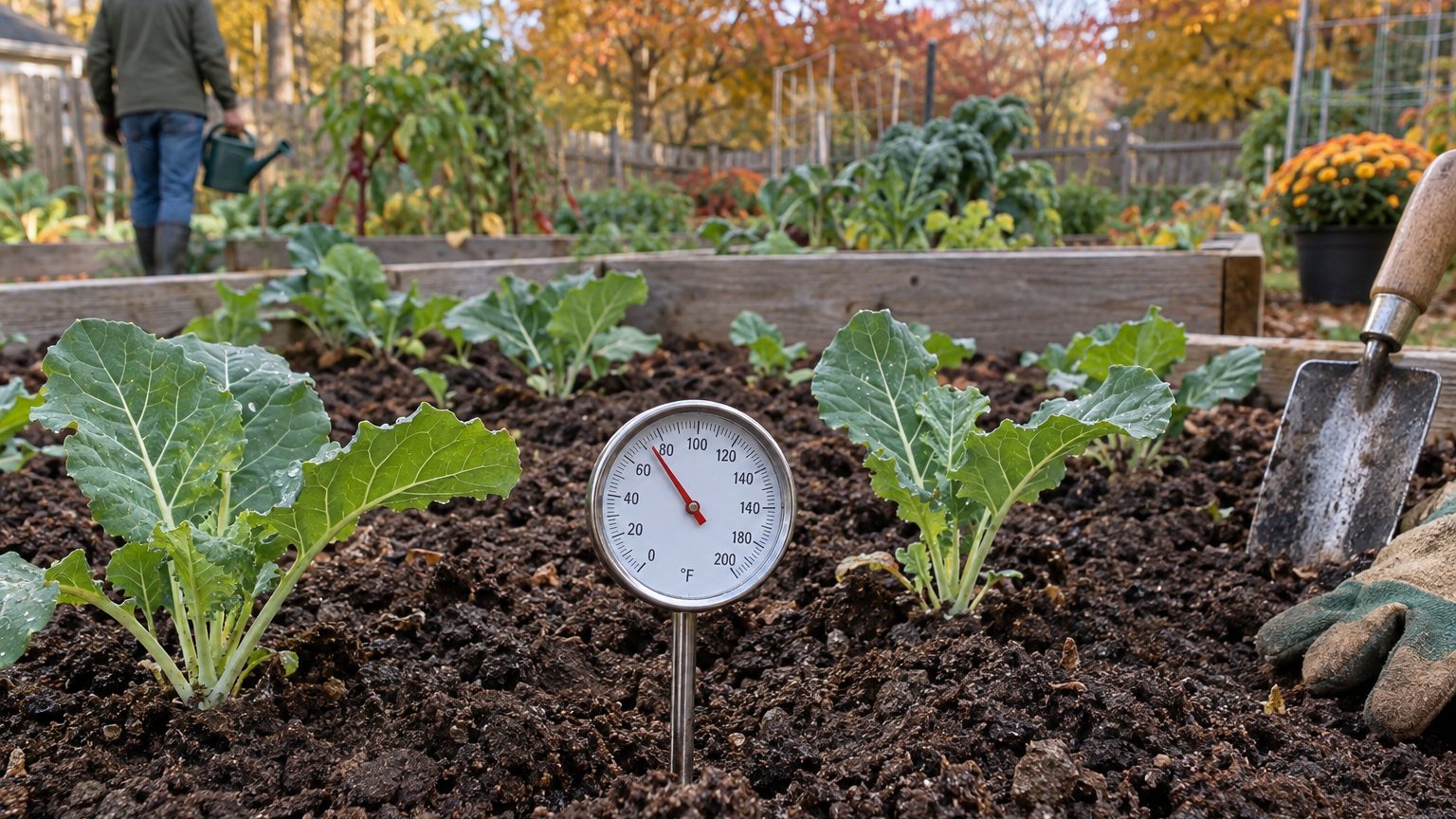

Collards can grow in North Dakota, but only as a single-season crop timed tightly between two frost dates. Transplants go in after the mid-May frost risk fades and come out by the hard freeze in late September or early October. There’s no standing winter harvest here, and no room for guesswork on timing.
When the soil is warm enough in North Dakota

The question every gardener asks first isn’t really about frost. It’s about soil. Frost dates get all the attention because they’re easy to look up, but they’re a proxy for something slower: how long it takes bare ground to warm past the point where young brassica roots stall out. At the Fargo reference station, NOAA’s 1991-2020 Climate Normals put the last spring frost window at May 4 to May 15. That’s a 30-to-70 percent freeze probability band, not a guaranteed date, so treat it as a statement of odds rather than a promise the ground will cooperate on any single calendar day.
Soil temperature lags behind that frost window by a week or more in a typical year, which means gardeners who transplant collards the moment the frost risk clears are often setting them into cold, sluggish dirt. Collards planted as transplants tend to handle that lag better than direct-seeded collards, since the seedlings have already built some root mass indoors or in a cold frame before facing outdoor soil. If you’re direct-seeding, waiting an extra week past the stated frost window costs little and spares the crop weeks of stalled growth.
North Dakota gardens outside the Fargo airport, especially those in low-lying or rural spots, often see frost linger later in spring and arrive earlier in fall than the reference station shows. Check your own county’s pattern before locking in a planting date, rather than assuming Fargo’s numbers apply exactly to your yard.
On variety choice at planting time: this page won’t name a specific collard type, because the varieties that actually perform well in this climate are the ones trialled by North Dakota State University’s extension service, not a generic list. What’s worth knowing in general terms is that early-maturing types suit a short window better than long-season types bred for the Deep South.
One more thing worth building into the planting plan from day one: collards are brassicas, in the same family as cabbage, kale, mustard, turnip and rutabaga. Setting them into a bed that grew any of those crops last year isn’t rotation, it’s repetition, and it invites the same soil-borne troubles right back. A proper rotation plan matters more here than in warmer states, since the short season gives the crop less time to outgrow early setbacks.
How long the season lasts here
Subtracting the frost dates gives a real number. Using the earliest possible last spring frost (May 4) against the latest possible first fall frost (October 5), the frost-free window stretches to roughly 154 days. Using the later end of the spring window (May 15) against the earlier end of the fall window (September 25), it shrinks to about 133 days. Either way, that’s a 133-to-154-day frost-free season, and it’s the number that decides almost everything else about how this bed gets planned.
That length is on the short side for a leafy brassica that likes cool weather but also needs weeks to bulk up leaves before harvest begins. In practice, it means most North Dakota gardeners get one solid planting of collards per year, not two. A second sowing, the kind that’s routine in states with a six-month or longer window, is marginal here. It only makes sense if the gardener already has transplants ready to go rather than starting seed from scratch after the first planting is harvested.
This is where the distinction between transplanting and direct-seeding really matters. Transplants shave weeks off the time a bed needs to produce a harvestable crop, since the plant arrives with a head start instead of starting from a seed in cold ground. In a 133-day window, that head start can be the difference between a full harvest and a crop caught by the first fall freeze halfway grown.
Anyone weighing whether a second planting is worth attempting should look at the site’s succession sowing guide before deciding, since the math on timing a follow-up crop depends on details, like how fast the first planting clears the bed, that go beyond frost dates alone. For most North Dakota gardens, though, the honest answer is that the frost-free window here supports one planting done well rather than two done in a rush.
Heat and water in North Dakota

Collards elsewhere split into two very different lifestyles depending on winter. Where the coldest month stays mild, they become a standing crop, picked leaf by leaf from November into March. Where it doesn’t, they’re strictly an autumn crop that ends the day a hard freeze arrives. North Dakota falls firmly into the second category, and the number that proves it is the coldest month’s mean daily minimum at the Fargo reference station: 0.2°F. That’s not a record low or a monthly average, it’s the typical overnight low across the coldest month, and it’s cold enough to kill a collard plant outright, not just knock back its leaves.
The USDA Plant Hardiness Zone Map (2023 edition, based on 1991-2020 normals) puts this territory at zone 3a-4b, a range built entirely on average annual extreme minimum temperature. Nothing in that range comes close to what collards need to overwinter as a standing crop. So the planning question for North Dakota isn’t how to protect collards through winter, it’s how to get the most out of the single autumn window before the hard freeze ends the season for good.
On summer conditions, this reference station’s data set doesn’t include the day-count-above-90°F or seasonal rainfall figures that matter more in hot southern Territories, and this page won’t invent numbers that aren’t verified. What can be said honestly is that North Dakota summers run considerably cooler and drier than the Southeast, which changes the crop’s main risk from heat stress to slow, uneven growth if a summer runs cool and damp. Collards that sit in soggy, cool soil for weeks are more prone to mildew than to the fungal rots that plague hot-climate gardens, so drainage and air circulation between plants matter more here than shade cloth or extra irrigation.
Because the growing window sits mostly in late spring through early fall rather than deep summer, the crop spends less time exposed to whatever heat spikes do occur, which works in its favor given how short the frost-free period already is.
Which collards suit North Dakota
Everything in this territory’s numbers points the same direction: pick early types, not because they yield more, but because they finish before the season runs out. A 133-to-154-day frost-free window doesn’t leave slack for a collard bred to take its time. Types described by seed suppliers and extension programs as early-maturing or fast-growing fit a short northern season better than those marketed for the long Southern growing calendar.
Because summers here run cool rather than brutally hot, disease resistance matters less for heat-driven wilt and more for the mildew and leaf spot issues that show up in a cool, damp stretch. That’s a different priority than a gardener in a humid southern state would weigh, where disease resistance is often the first filter applied to any variety list.
This page deliberately won’t name a specific collard variety. The reason is straightforward: the only variety recommendations worth trusting are the ones tested in local trial plots under this exact climate, and that data lives with North Dakota State University’s extension service, not with a general gardening article. Contact NDSU Extension through its extension service directory for the current list of collard and brassica varieties trialled for this state’s growing conditions, since that list changes as new trials come in and a name printed here would go stale.
Whatever type gets chosen, remember the rotation rule from earlier: collards, cabbage, kale, mustard, turnip and rutabaga all share the same family troubles, and a bed that grew any of them in the past couple of seasons needs a different family in between. In a season this short, a crop that starts behind because of soil-borne disease rarely catches up before the first hard freeze closes things out.