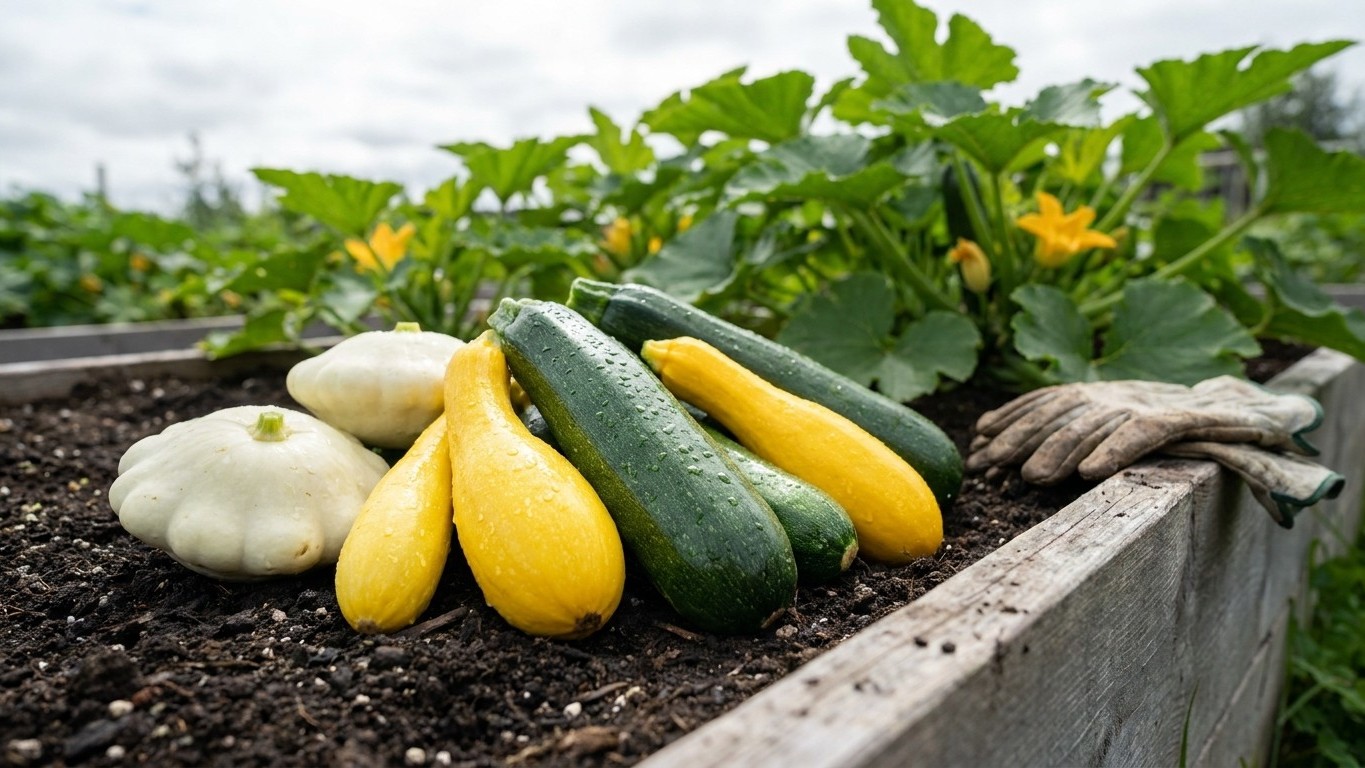

North Dakota’s growing season runs roughly 133 to 154 days between the reference-station frost dates, and that number, not the calendar month, is what decides which summer squash actually finishes here. The short answer: pick bush-type zucchini, yellow crookneck, straightneck or patty pan varieties rated 45 to 55 days to maturity, and skip anything vining or slow.
The short answer for North Dakota
Start with the math. At the reference weather station (Fargo, USW00014914), the last spring frost falls between May 4 and May 15, and the first fall frost arrives between September 25 and October 5. Take the tightest realistic window, mid-May to late September, and you get somewhere close to 130 frost-free days. Take the widest, and it stretches toward 154. That range matters because summer squash seed does not germinate reliably in cold soil, so the real planting date is usually later than the frost date itself, and the usable season is shorter than the frost-free count suggests.
Summer squash types differ in how much of that window they need. Bush zucchini, yellow crookneck, straightneck and patty pan (scallop) types generally run in the 45 to 55 day range from transplant or direct seed to first harvest, according to the maturity windows commonly used by seed suppliers and extension trial programs. Vining summer squash and longer-season specialty types often run past 60 days before first fruit, and that pushes harvest dangerously close to the fall frost band, especially in a year that lands on the early end of the September 25 to October 5 range.
Why heat load doesn’t change the decision much
The reference station averages only 11.7 days a year at 90°F or above. That’s a low heat load compared to states where summer squash struggles from heat stress rather than cold. in North Dakota, the limiting factor is almost never too much heat killing the plant. It’s the length of the warm window itself. That’s why the variety decision here is driven by days-to-maturity, not by heat tolerance.
| Summer squash type | Typical days to maturity | Fit for North Dakota’s season |
|---|---|---|
| Bush zucchini | ~45-50 days | Strong fit, leaves margin before fall frost |
| Yellow crookneck / straightneck | ~50-55 days | Good fit if planted promptly after soil warms |
| Patty pan / scallop | ~50-55 days | Good fit, compact habit suits shorter beds |
| Vining summer squash types | 60+ days | Risky, little margin against early fall frost |
What will not work here
Vining, long-season summer squash is the first thing to cross off the list. A variety needing 60 or more days to first fruit, planted after the reference station’s own last-frost window closes, leaves almost no cushion before the first fall frost arrives as early as September 25. One cool stretch in late summer, and that planting simply doesn’t finish.
Direct-seeding too early fails just as often, in the opposite direction. Squash seed sits and rots in soil that’s still cold in early May, even after the calendar says the frost risk has passed. Because suburban and rural gardens in this territory typically see their own last frost later than the reference-station date, sometimes by a week or two, gardeners who seed the moment the airport date clears often lose the first sowing anyway.
Watering on autopilot is the third failure point, and it’s specific to this region’s rainfall pattern. Summer rain totals about 10.0 inches across June, July and August, but it isn’t spread evenly: June averages 4.29 inches, July 3.07, and August drops to just 2.6, the driest of the three. A once-a-week watering habit, common advice in wetter states, leaves squash short on moisture right when August heat and fruit-set demand the most. On sandy soil that rain drains through within a day, the gap is worse. Blossom drop and stunted fruit in late summer are usually a watering-timing problem, not a variety problem.
One more thing to drop: any planting strategy built around wide, humid-climate spacing rules to fight fungal disease. This isn’t a humid state, and cramming in extra plants isn’t the local risk either, uneven soil moisture is. Spend the effort on a consistent watering routine through August rather than on spacing adjustments borrowed from a wetter region’s playbook.
What changes across North Dakota
The USDA Plant Hardiness Zone Map, built on average annual extreme minimum winter temperature, places North Dakota across zones 3a to 4b. That’s a wide spread for one state, and it means there is no single frost-date or maturity-window answer that applies everywhere. Zone 3a sits at the colder end of that extreme-minimum measurement, generally found toward the north and at higher elevation. Zone 4b sits at the milder end, closer to the conditions the reference station itself experiences.
Because the hardiness zone measures winter extremes rather than frost timing directly, it’s a signal, not a substitute for a local frost date. But the signal is useful. Gardeners in the colder end of that 3a-4b range should assume both a later effective last frost and an earlier first fall frost than the reference-station figures used above, compressing the already tight window further. In that setting, the safest move is to lean toward the fastest-maturing bush varieties, 45 days or under where available, and to consider row cover or cold frames to buy extra weeks on either end of the season.
Gardeners closer to the milder end of the range have more room to work with. A 50 to 55 day variety carries less risk there, and a slightly later direct-seed date, once soil has genuinely warmed, is less likely to cost real harvest time.
This page can’t tell an individual reader which end of that 3a-4b range their own yard falls into. What it can say is that the difference between the two ends is large enough to change the variety decision, and the map is the tool for finding out. The USDA Plant Hardiness Zone Map, searchable by ZIP code, is the standard reference for that.
Where to check this for your own county
Everything above is built from one weather station’s normals, and North Dakota is a big state with real differences in soil, elevation and microclimate from one county to the next. The North Dakota State University Extension Service is the place that turns a state-level answer into a county-level one.
Two things are worth looking for there specifically. First, a county or regional planting calendar, which will reflect local frost timing than a single airport station can. Second, variety trial results for summer squash conducted in North Dakota conditions, which show how specific cultivars actually performed in the state’s soils and season length rather than in a seed catalog’s generic description.
A county-level recommendation from that extension office will always beat a state-wide one. This page is the state-wide version, useful for understanding the pattern and the reasoning behind it, but not a substitute for what NDSU Extension publishes for a reader’s own county. Treat the numbers here as the frame, and the extension office’s local data as the fine-tuning.
Checking this against your own garden
Every date and figure above is a normal, an average built from three decades of records at one station. A reader’s own garden will confirm or contradict it faster than any chart, through three things worth watching directly.
Soil warmth by feel comes first. Squash seed wants soil that feels warm to the hand, not just soil that’s thawed. If a handful of garden soil in mid-May still feels cool and damp rather than warm and crumbly, that’s a sign the local microclimate is running behind the reference station, and seeding should wait a few more days regardless of the calendar.
The first flush of male flowers is the second signal. Summer squash typically produces male blossoms before female ones, and a run of male-only flowers for a couple of weeks is normal, not a failure. But if that stage drags on much longer than expected, or the plant looks stalled rather than actively growing, it usually points to a stress the plant is under right now, most often uneven watering rather than temperature.
Third, watch how fast the first true leaves appear after the seed leaves. A quick jump to true leaves within a week or so suggests the local soil and air have genuinely warmed; a long stall suggests the garden is still running cooler than the season’s calendar date implies, which is useful information for timing next year’s planting a few days later or earlier than this year’s.