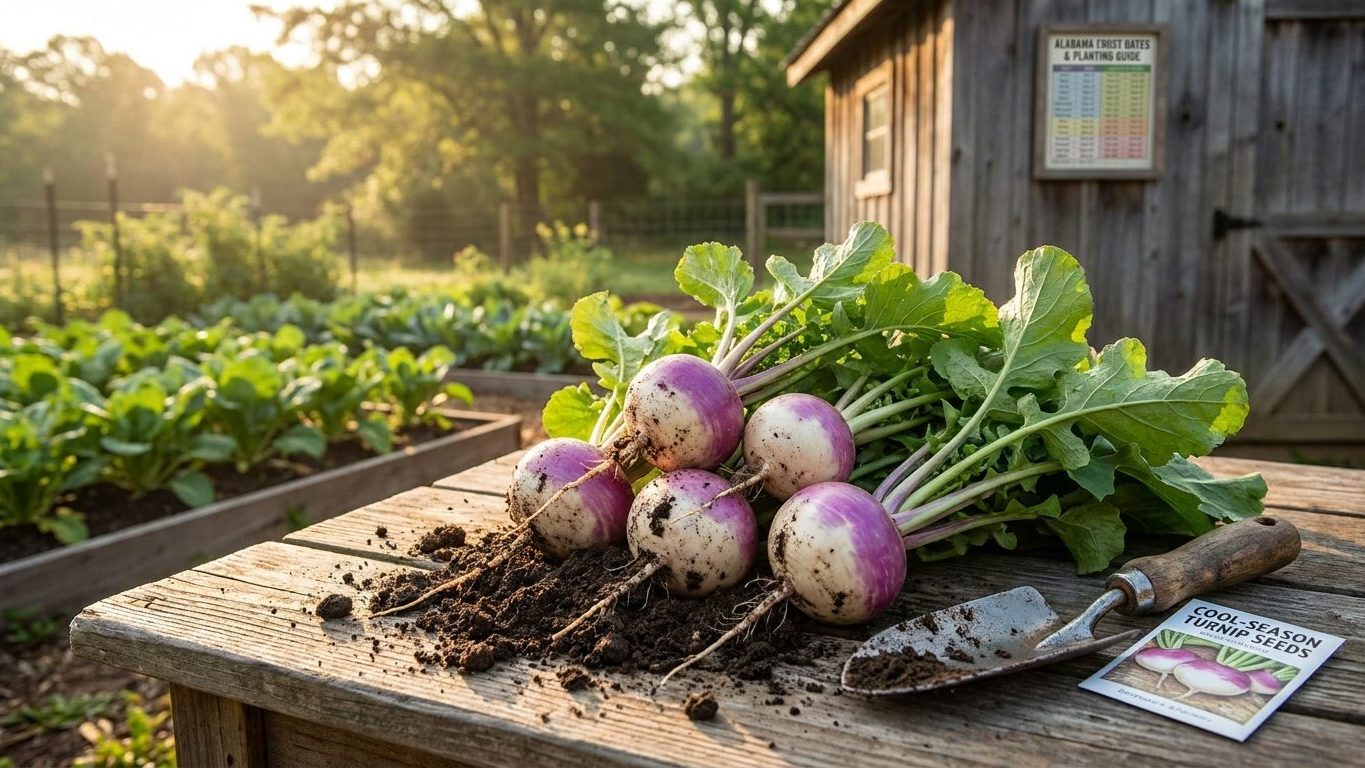

North Dakota gardeners get two real windows for turnips: a spring sowing from mid-April into early May, timed around the region’s last-frost odds, and a summer sowing from mid-July into early August for a fall crop that actually sweetens after a light frost. Rutabaga, which needs nearly twice the days a turnip does, almost always has to go in during the earlier window.
The short answer for North Dakota
NOAA’s 1991-2020 climate normals for the Fargo station put the last spring frost somewhere between May 4 and May 15, and the first fall frost between September 25 and October 5. Those dates aren’t guarantees. They mark the 30-70% probability band, meaning in three years out of ten a frost still shows up after the late date, and in three years out of ten the fall frost arrives before the early one. Turnips can shrug off a light frost either way, which is exactly why the crop fits this state’s short season better than most root vegetables.
Run the numbers and the frost-free stretch in Fargo lands somewhere between 133 and 154 days, depending on which end of each band actually plays out in a given year. A salad turnip finishing in 30 to 40 days barely dents that window. A storage turnip or rutabaga needing 50 to 100 days eats a much bigger share of it, which is why timing matters more here than in states with a longer buffer.
For a spring crop, sow as soon as the soil can be worked, roughly two to three weeks ahead of the last-frost window, since turnip seed germinates in cool soil and the seedlings tolerate a frost that would kill beans or squash outright. For a fall crop, the math runs backward from the first-frost window: count back 50 to 60 days from late September and land on mid-July to early August as the sowing target for roots, a little later if you’re only growing for greens.
| Window | Sow | Harvest target |
|---|---|---|
| Spring | Mid-April to early May | Late June to mid-July |
| Fall | Mid-July to early August | Late September to October, after light frost |
What will not work here

The most common mistake in North Dakota gardens is treating rutabaga like a turnip and sowing it in the same July window. Rutabaga needs 90 to 100 days to size up, and counting forward from even the earliest safe date in that window pushes maturity past October 5, the late edge of the first-frost band. In a year that lands on the early side of that band, the roots simply don’t finish. Rutabaga belongs in the spring window here, sown as early as the ground allows, not squeezed into the same slot as a fast turnip.
The second failure mode is sowing turnips too early into soil that’s cold but technically workable. Turnip is a biennial that responds to a stretch of cold after germination by bolting, meaning it throws a flower stalk instead of building a root, once the days lengthen and warm up. A seed that goes in during a cold snap in mid-April, followed by a return to more typical temperatures, can behave like it’s already been through a full winter. The plant bolts in June, right when a gardener expects the root to be filling out. Waiting until the soil has warmed past that cold-snap risk, rather than sowing on the calendar date alone, avoids this.
The third failure is sowing the fall crop too late. Sowing much past early August leaves too few days on the calendar before the first-frost window closes, and a turnip that hasn’t sized up before a hard freeze won’t finish afterward the way it would after a light one. This isn’t a heat-and-drought problem the way it might be further south; ND summers aren’t reliably hot enough to stall germination the way a Texas August would. The constraint here is purely the calendar, and it runs out faster than gardeners moving from a longer-season state expect.
What changes across North Dakota
The USDA Plant Hardiness Zone Map places North Dakota across zones 3a to 4b, built from one measurement, the average annual extreme minimum temperature. That’s a wide spread for a single state, and it means there is no single sowing date that applies from the Red River Valley to the Missouri Plateau. The Fargo figures above describe an eastern reference point; areas toward the western and northern parts of the state, sitting in the colder end of that 3a-4b range, typically see a later last frost and an earlier first fall frost than Fargo does, which compresses both sowing windows further.
The coldest-month mean minimum at the Fargo reference station runs to just 0.2°F, a figure that matters more for anything gardeners try to overwinter in the ground than for the turnip crop itself, since most home gardeners pull roots before hard freeze rather than storing them under mulch outdoors. Where that matters is for rutabaga left in the ground for a late harvest: colder pockets of the state reach damaging soil temperatures sooner, so the safety margin for a late pull shrinks the farther west or north a garden sits.
None of this can be resolved from a state-level page. A reader in a 3a pocket needs to shift both windows earlier by roughly a week to ten days compared to a reader near the 4b end, and the only way to know which side of that spread applies to a given yard is to check the local zone rather than assume the state’s midpoint. The one-to-two-week shift is the number worth writing down; which direction to apply it depends on where on the map a garden actually sits.
Where to check this for your own county
North Dakota State University’s Extension service maintains the planting guidance built for this state’s counties, and it’s the right next stop for anyone trying to nail down a date tighter than the ranges given here.
Two things are worth pulling from that resource specifically. First, the local planting calendar for the county in question, since NDSU’s county offices adjust sowing windows for local frost data rather than relying on a single statewide station the way this page has to. Second, the variety trial results for turnip and rutabaga run through NDSU’s horticulture program, which show which varieties actually finished reliably in North Dakota’s shorter growing season versus which ones were bred for a longer one and struggled here.
A county-level recommendation beats a state-level one every time, for a simple reason: this page is built from one weather station’s normals, applied across a state that spans two full USDA zones. That’s useful for understanding the shape of the season and the general risks, which is the job of this page, but it isn’t a substitute for the number a county extension agent would give a caller who describes their exact soil and elevation. Anyone farming or gardening seriously in North Dakota should treat the NDSU county office as the tie-breaker whenever this page’s ranges feel too wide to plant by.
That said, the state-level picture still does real work: it tells a new gardener which failure modes to expect (bolting from a cold snap, rutabaga running out of season) before they’ve lost a crop finding out the hard way.
Checking this against your own garden
Every date on this page is a normal, not a promise, and a gardener’s own observations settle the question faster than any calendar. Soil temperature by feel is the first check: soil that’s still cold and clumps into a tight, wet ball when squeezed hasn’t warmed enough for turnip seed to germinate evenly, no matter what the calendar says about the last-frost window having passed.
Germination speed is the second signal worth tracking. Turnip seed sown into properly warmed soil pushes true leaves within about a week to ten days; a much slower emergence in the same conditions usually means the soil is colder than it looks, a common situation in low spots or heavy clay that holds spring moisture longer than the rest of the yard.
The third thing to watch is early bolting, a flower stalk appearing well before the root has filled out. That’s the plant reporting it went through a cold stretch after germination, which is the exact mechanism described above under spring failures. Seeing it happen once is useful information for next year: it means that particular spot, or that particular sowing date, runs colder than the rest of the garden, and the fix is simply to push the sowing date a bit later or choose a warmer bed, rather than fighting the calendar again the following spring.