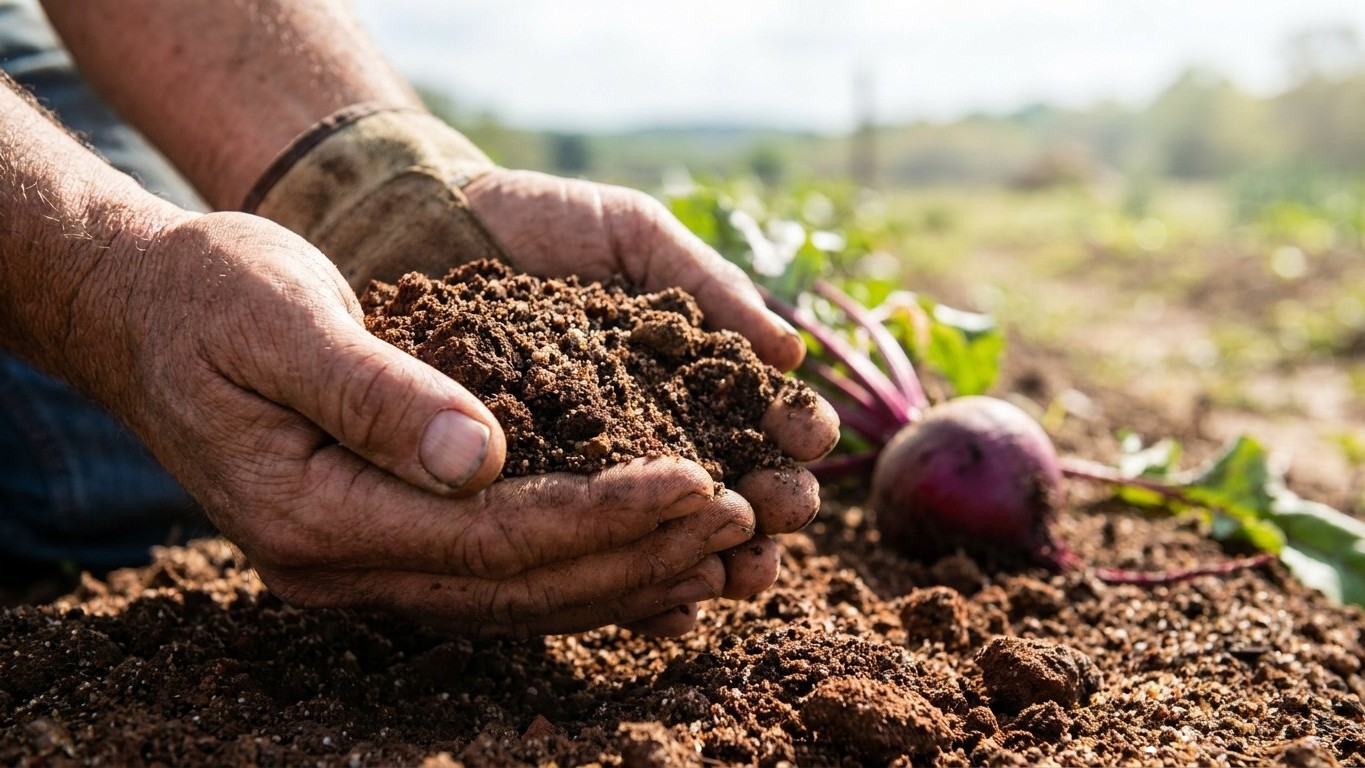

Beet roots dropped into Northwest Territories ground meet a shallow band of thawed soil sitting over permafrost, sandy-to-silt in texture, well drained, and short on almost nothing except growing time. The dirt itself isn’t the main obstacle here. The real hurdle is a spring that can swing from soggy to bone-dry within days, layered on top of a last-frost date that’s really just a coin flip.
The short answer
Across the mapped agricultural ground of the territory, the dominant soil order is a Cryosol, permafrost sitting within the profile itself, showing up on 99 percent of the mapped surface, with Regosolic soils making up most of the rest. That single fact changes how a beet behaves more than any texture number does: the ground doesn’t just drain, it thaws a little each summer and refreezes, so the usable root zone is whatever depth the active layer reaches that season, not the depth of soil on paper.
Texture-wise, the mapped surface horizons average 55 percent sand, 6 percent clay and 39 percent silt, putting it in loam to silt loam territory, with organic matter around 2.4 percent and a well-drained rating overall. That’s a workable starting texture for a root crop. Beets want deep, sandy, well-drained ground rich in organic matter, and this soil’s sand fraction and drainage class both point the right direction. The catch is the ceiling underneath it. A beet doesn’t care that the soil above the frost line is loose and sandy if that soil is only eight or ten inches deep before the permafrost table stops it cold.
No median pH is published for this mapped surface, so nothing here should be treated as the reader’s number. Organic matter at 2.4 percent sits below where a hungry root vegetable would like it, and Utah State University Extension’s guidance caps the fix at no more than 1 inch of composted organic matter per 100 square feet worked into the top layer, rather than piling it on.
On the heat side, no figure for days per year above 90 F is published in the sources behind this page, so that number simply isn’t stated here. What can be said plainly is that woodiness in beets comes from heat above 85 F arriving on top of water stress, according to Utah State University Extension, and that this territory’s short, cool-summer growing season makes prolonged stretches above that threshold uncommon compared with a mid-latitude state. The bigger risk this far north runs the other direction, toward cold and drought stress early, not heat stress late.
None of this should be read as a verdict on any one backyard. A province spans hundreds of individual soil series, and a garden bed near a river flat, a patch of muskeg, or ground a builder has scraped and filled can differ completely from the mapped average above. Treat these numbers as the region’s tendency, then confirm the actual number with a soil test on the bed itself.
The six weeks that decide it here
Beets are sown directly in place, never transplanted, and the standard advice is to get seed in the ground 2 to 3 weeks before the last spring frost. in Northwest Territories, the average last spring frost falls on May 25, based on Environment and Climate Change Canada’s Canadian Climate Normals for the period 1981-2010 at the Yellowknife A station. Following the 2-to-3-week window pushes a typical sowing date into early May, which means the first six weeks of that beet’s life, the exact stretch when water stress triggers premature flowering, land squarely in the region’s early-to-mid spring and stretch into the long-daylight run-up to summer solstice.
That May 25 date deserves a plain warning: it’s a mean, not a safe cutoff. In roughly one year out of two, the last frost actually arrives later than that average date. A gardener who sows on the assumption that May 25 is a hard line is playing against fifty-fifty odds, not a guarantee. It’s also worth remembering that this figure comes from a single station near Yellowknife; districts farther north or at higher elevation within the territory run behind it by weeks, not days.
What that spring window tends to bring, mechanically, follows straight from the soil profile above. As the shallow active layer above the permafrost table thaws, meltwater has nowhere to go but through a sandy, well-drained topsoil, so early saturation can give way quickly to a dry surface once the melt finishes and daylight lengthens toward the 24-hour stretch around solstice. That combination, a well-drained sandy-silt topsoil sitting on a thin thawed layer, under long daylight hours that pull moisture out of the top few inches fast, is exactly the setup that produces bolting risk in beets: six weeks of inconsistent moisture right when the young root is deciding whether to flower early instead of bulking up.
The practical takeaway isn’t complicated, even if the mechanism is layered. Sowing on schedule against the 2-to-3-week rule still makes sense, but watering consistency through that first six-week stretch matters more here than in a climate where spring rain can be counted on to fill the gaps.
What goes wrong here
- A shallow active layer perches water, then the topsoil dries fast. Meltwater sits on the frozen layer below before it can escape through the sandy-silt topsoil, then that same well-drained texture lets the surface dry out within days once the thaw finishes. Mound or raise the beet row a few inches so the effective root zone warms and drains a bit ahead of the surrounding ground, and check soil moisture by hand rather than by calendar.
- Bolting from early water stress. Utah State University Extension is clear that water stress in the first six weeks after sowing causes premature flowering in beets, and that six-week window here overlaps the long-daylight run-up to summer, when surface moisture disappears quickly. Keep the bed evenly moist from the day of sowing, using mulch to slow evaporation rather than waiting until the seedlings show stress.
- Low organic matter for a root crop that wants it rich. At roughly 2.4 percent organic matter on the mapped surface, this soil sits under what a hungry beet crop prefers. Work in up to, but no more than, 1 inch of composted organic matter per 100 square feet, since Utah State University Extension warns against exceeding that rate.
- Root depth capped by permafrost, not by choice. A Cryosol’s defining feature is permafrost within the profile, which limits how far any root, beet included, can push down regardless of how loose the topsoil is. Loosen and deepen the bed as far as the thawed layer allows early in the season, and avoid compacting that zone with foot traffic.
- Sowing against a frost date that’s a coin flip. Treating May 25 as a guaranteed safe date ignores that it’s a 1981-2010 average from one station, with frost arriving later in roughly half of all years. Watch the local forecast in the two weeks after sowing and keep row cover on hand rather than trusting the calendar alone.
Common questions
Is Northwest Territories soil naturally good for beets?
The mapped agricultural surface leans sandy-to-silt and well drained, which favors a root crop, but the dominant soil order is a Cryosol, meaning permafrost sits within the profile and limits how deep the thawed, usable layer goes each summer. The texture helps; the shallow active layer works against it.
When should beets go in the ground here?
Beets are sown directly, never transplanted, and the general rule is 2 to 3 weeks before the last spring frost. With the average last frost at Yellowknife A falling on May 25 under the 1981-2010 normals, that points to an early-May sowing window, kept flexible since frost arrives later than that average in about half of all years.
What causes woody beets in this climate?
Woodiness follows heat above 85 F combined with water stress, per Utah State University Extension. No figure for annual days above 90 F is published in the sources behind this page, and the territory’s short, cool growing season makes sustained heat stress less likely than in warmer states, so the greater risk here runs toward early bolting rather than late-season woodiness.
How much compost should I add before sowing?
Utah State University Extension caps the amendment at no more than 1 inch of composted organic matter per 100 square feet. Given that the mapped surface here runs around 2.4 percent organic matter, a modest addition at that rate is reasonable, but a soil test on the actual bed is the only way to know the real starting point.