
Search the documented record for Northwest Territories and you won’t find a named list of carrot-eating insects, no province-wide survey ties a specific bug to this crop here. What is documented is the ground itself: shallow, permafrost-affected soil and a growing season so short that timing, not treatment, decides whether a carrot patch survives. Protecting the row at seeding matters more than identifying a pest, because there’s no local insect data to target in the first place.
Which pests attack carrot in Northwest Territories

The sourced record behind this page names no carrot-specific insect for Northwest Territories. That’s worth stating plainly rather than glossing over. Surveys that track named pests, aphid counts, root maggot flights, wireworm damage, get built around commercial vegetable acreage, and Northwest Territories has very little of it. What the record does document is the ground carrots would grow in here.
According to the Canadian Soil Information Service, the mapped agricultural soil across the territory is a Cryosol on 99 percent of the surveyed surface, a soil order defined by permafrost sitting within the profile, with only a shallow active layer thawing each summer before the ground refreezes from below. The remaining 1 percent is Regosolic, young soil with little profile development, typical of disturbed or eroded ground. Texture across the mapped components runs 55 percent sand, 39 percent silt, and 6 percent clay, loam to silt, with organic matter around 2.4 percent and good drainage overall.
None of that is pest data, but it explains why pest data is thin. A permafrost-limited season restricts what gets planted, restricts how long insects have to build a population, and restricts the incentive to fund a territory-wide insect survey on a crop grown mostly in home gardens. A state with a commercial carrot industry gets root maggot flights tracked by degree-day and reported county by county; that infrastructure doesn’t show up in the sourced record here.
This isn’t the same as saying carrots grown in Northwest Territories face no insect pressure at all. It means this page has nothing documented to sort through, no list to trim down by ruling out species that don’t belong on a vegetable crop. If something did turn up in a home garden, it would belong to the same general families that show up wherever carrots grow in cold soil, but naming one specifically without a survey behind it would be a guess dressed up as fact. The honest move is to say so, lean on what’s documented, soil and growing conditions, and point toward a local agricultural contact for anything insect-specific.
When each one shows up, and what it does first
No frost-free window is published in the sourced record for Northwest Territories, so this page won’t invent one. What is documented is the seeding-to-harvest math for carrots themselves, and in a place with a season this short, that math does most of the calendar work.
Clemson Cooperative Extension puts carrot harvest at 65 to 75 days after planting, and Utah State University Extension frames the fuller window at 70 to 100 days, counted from seeding since carrots are sown directly in the ground and never transplanted. In a territory where the season itself is the limiting factor, that stretch gets squeezed against both ends of summer. Whatever pressure a carrot patch faces here, insect, drought, or a cold snap, it has to happen inside that window or not at all.
Without a named pest to hang symptoms on, the practical approach is to watch the plant’s stage rather than a calendar month. Early growth, the first few weeks after seeding, is when a thin stand or uneven germination shows up first, and that’s more often soil crusting or cold soil than insect feeding. Once the root starts sizing up, past the midpoint of the seeding-to-harvest window, is when forking, cracking, or chewed foliage become visible enough to notice, simply because there’s more plant there to show damage.
In warmer provinces the same crop reliably sees two waves of pressure: early leaf feeding within the first few weeks, then root-level damage as the root swells later on. Nothing in the record ties that second wave to Northwest Territories specifically, but the biology of the crop doesn’t change with the border, only the length of season available for it to play out. A shorter season likely compresses those waves closer together rather than removing either one, which argues for inspecting early and often instead of waiting for one expected date.
Telling the damage apart from everything else
Without a documented insect list for this territory, the more useful skill is ruling things out. Most of what looks like pest damage on a Northwest Territories carrot bed traces back to soil or water, not to a bug.
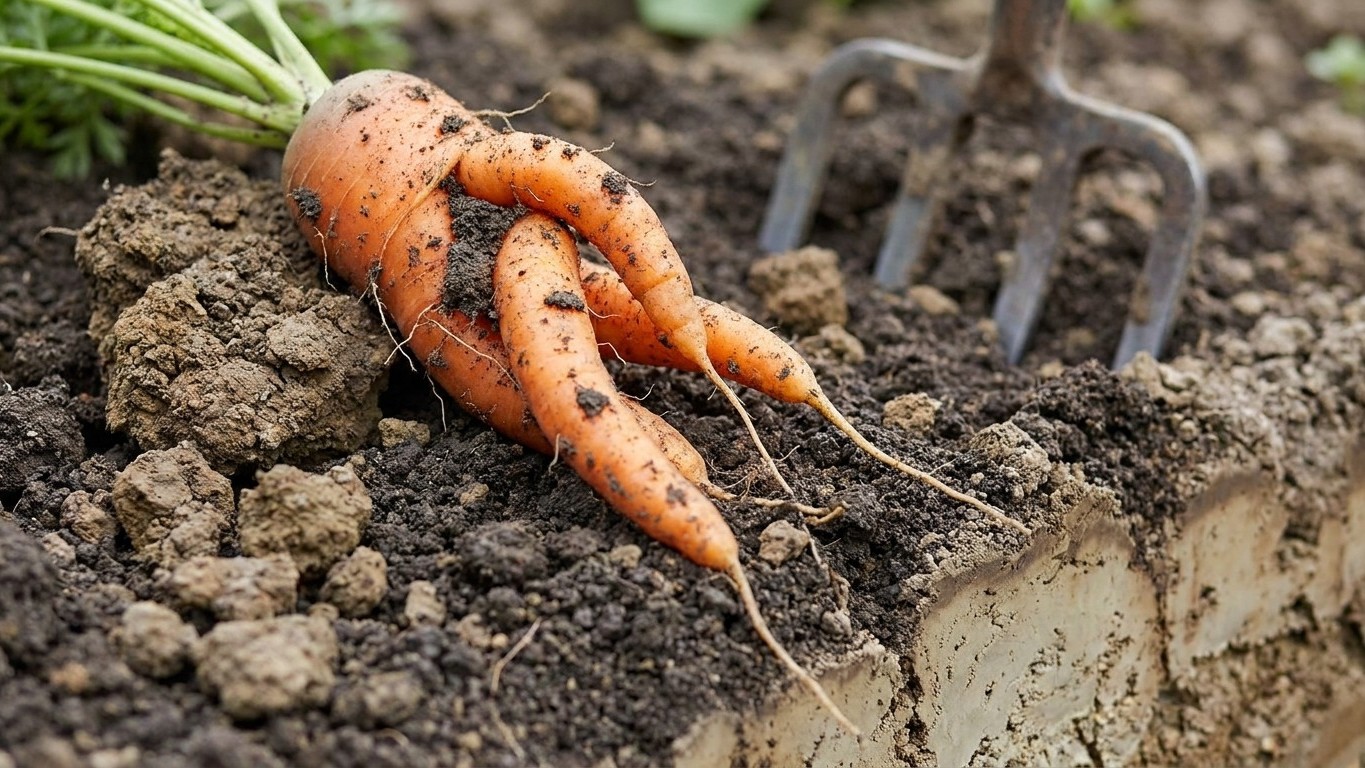
Forking is the clearest example, and it’s a soil problem, not an insect problem. Utah State University Extension is direct about the cause: carrots want deep, sandy, well-drained soil rich in organic matter, and heavy or rocky soil makes the root fork. With only 6 percent clay in the territory’s mapped soil texture, most gardens here aren’t fighting heavy clay the way a claypan soil elsewhere would, but any compacted or rocky pocket in a home bed produces the same fork regardless of latitude.
| Symptom | Likely cause | What settles it |
|---|---|---|
| Forked or split root | Compacted, rocky, or heavy soil | Dig up one root; compaction or stones are visible by hand |
| Wilted tops in warm weather | Drought stress or uneven watering | Check soil moisture at root depth, not just the surface |
| Chewed or ragged foliage | Insect feeding (unconfirmed species here) or mechanical damage | Look for feeding along leaf edges versus one torn spot from a tool |
| Small, pale, slow-growing plants | Nutrient deficiency or a shallow, cold-thawed soil layer | A soil test separates nutrient gaps from cold-soil stunting |
| Rot at the shoulder of the root | Disease or excess standing moisture | Cut the root; disease shows discoloration inside, moisture damage does not |
Drainage plays a role most gardeners overlook. The territory’s mapped soil is described as well drained, which lowers the odds of rot from standing water, but a bed built on fill or squeezed into a low, shaded corner of a lot won’t share that drainage rating just because the regional survey does. None of this table replaces a local diagnosis; treat it as a sorting tool and bring the plant itself, or a clear photo, to a local agricultural contact rather than guessing from a symptom alone.
What actually works here, and what is a waste of time
With no named pest and a compressed growing season, the practical priorities in Northwest Territories are timing and soil, not treatment. A physical barrier placed over the row at seeding, before any damage appears, does more good here than any response applied after the fact, because a short season leaves little time to recover from a setback partway through.
Soil correction is the other lever this page can responsibly recommend, since it’s documented. Given the territory’s texture, loam to silt with just 6 percent clay, most home gardens aren’t fighting heavy clay, but any compacted, rocky, or poorly worked bed still produces forked roots. Utah State University Extension’s fix for heavy or rocky ground is compost worked in generously, plus double digging to loosen the profile deeper than a single pass with a shovel reaches. That work happens before seeding, not after a problem shows up, which fits a season with no time to fix soil structure mid-summer.
What doesn’t help: reaching for a treatment aimed at a named insect that isn’t documented as present here in the first place. Applying anything to solve a problem that hasn’t been identified wastes a short season, and it risks masking a soil or water problem the treatment was never going to fix. This page names no product and no active ingredient on purpose: what’s registered and appropriate in one territory is decided by the local agriculture authority, not a gardening article, and skipping that check is its own kind of waste. Crop rotation and cleaning up old plant debris at season’s end cost nothing and carry no downside, worth doing even without a confirmed pest to justify them.
Where to check this for your own county
Northwest Territories doesn’t run the same county-by-county extension network that many U.S. states do, part of why a species-level pest list doesn’t exist in the sourced record for this page. The rule that holds regardless of that gap: a territory-wide soil survey never tells you what’s happening in one specific garden. The Cryosol figures cited above cover 99 percent of the mapped agricultural surface, not any single yard, and a garden built on fill, on a south-facing slope, or in a raised bed will thaw, drain, and behave differently than the surveyed average.
For anything specific to a home garden, chewed leaves, a forked root, an unfamiliar insect, the better move is a direct question to the territorial department of agriculture or a local agricultural or horticultural society, rather than searching online for a name to match a symptom. Bring a sample if possible; a clear photo or the root itself settles in minutes what a written description can leave open for weeks.
It’s worth checking back on the source material periodically, too. Soil surveys and extension guidance get updated, and a page built on the Canadian Soil Information Service’s Soil Name Table and Soil Layer Table reflects a snapshot, not a permanent fact. A garden amended over several seasons, with compost worked in and drainage improved, may no longer match the texture and organic matter figures cited here at all, which is a good outcome, not a contradiction.
The next useful step for anyone growing carrots in Northwest Territories isn’t a pest search. It’s a soil test, and a call to whoever handles agricultural questions locally, before the next seeding window opens.
Common questions
Does Northwest Territories have a documented carrot pest list?
Not in the sourced record behind this page. No territory-wide insect survey ties a specific species to carrots grown here, which is different from saying no insect pressure exists; it means the data to name one hasn’t been published in the sources used for this page.
Why does soil matter more than pests on this page?
Because it’s the one dataset that’s actually documented for Northwest Territories: a Cryosol on 99 percent of the mapped agricultural surface, loam to silt in texture, well drained, with about 2.4 percent organic matter.
How long do carrots take to reach harvest here?
The same as anywhere: 65 to 75 days after planting per Clemson Cooperative Extension, or 70 to 100 days per Utah State University Extension, counted from seeding since carrots aren’t transplanted. No territory-specific adjustment to that figure is published.
What should I do if I find an insect on my carrots?
Photograph it or collect a sample and contact the territorial department of agriculture or a local agricultural society rather than matching it to a name found online. Local identification beats a guess every time.