
The short answer for the Northwest Territories: sow hardy roots such as turnip, rutabaga and kohlrabi once the soil can be worked and has begun to warm, and give celeriac an indoor head start. Plan on one sowing, not several. The only frost figures this page can verify come from Yellowknife, so they describe one town, not a territory that spans more than a thousand miles.
When the soil is warm enough in Northwest Territories
The last spring frost at the Yellowknife A station falls, on average, on May 25. That figure comes from Environment and Climate Change Canada’s Canadian Climate Normals for 1981-2010. It is a mean, so the midpoint of a window and not a safe date: in about one year out of two, the last frost lands later than May 25. Say it once and plan accordingly. Northern and upland districts run weeks behind this station, and the normals cover an older period than the 1991-2020 figures used for US pages on this site.
Now the part that matters more. Frost is a proxy. Turnip, rutabaga, kohlrabi, celeriac, horseradish and Jerusalem artichoke are waiting for warm soil, and soil warms after the frost risk ends, not on the same day. Air temperature swings by the hour. Ground holds its chill, especially in a place where winter frost goes deep and a cold lake or a shaded north-facing bed can keep a plot cold well into June.
A soil thermometer settles the argument. Push it to planting depth in the morning, when the ground is at its coldest, and wait for readings that hold steady over several days instead of one warm afternoon. The sowing threshold for each crop is on the seed packet, or you can ask the territorial agriculture office. This page doesn’t print one because it can’t source one.
The crops differ in how much they care. Turnips, rutabagas and kohlrabi tolerate cool ground and a light frost better than the others, so they can go in as soon as the bed is workable and the soil has lost its deep chill. Celeriac is the fussy one. A cold snap after transplanting can push it toward bolting, which wastes the whole season. Horseradish is planted as root pieces or crowns and tolerates cool soil well, though it won’t do much until the ground wakes up.
Raised beds help here, and not just for drainage. A bed lifted above the surrounding ground, filled with a dark, loose mix, warms days ahead of the native soil. Clear plastic laid over a bed for a week or two before sowing does the same job. Both are practical ways to buy time in a short season, and neither depends on a variety name.
One note on varieties: this page names none. The kinds that have been trialled in the territory are the only recommendations worth following, and the territorial agriculture office is where that knowledge lives (more on that at the end).
How long the season lasts here
The first fall frost at Yellowknife A arrives, on average, on September 18, from the same ECCC normals. Count from the average last spring frost on May 25 to that date and you get 116 days. That is the frost-free window at this station, on average, and it is the ceiling, not the working length. Half the years the fall frost comes earlier than the 18th, and the gardening season does not begin on May 25 anyway, since the soil is still catching up.
What does 116 days allow? Not much slack. In a long-season state, a gardener sows turnips in spring and again in midsummer for a fall crop, and the second sowing finishes comfortably. In a window like this one, the first sowing is effectively the only sowing for anything slow. A late second sowing of a quick type might squeeze in if the summer cooperates, but it is a gamble, and the succession sowing guide on this site shows how to space those sowings and where the risk lies.
The short window also changes the transplanting question. Root crops resent disturbance, which is why most are sown where they will grow. Celeriac and, in some gardens, kohlrabi are exceptions because a transplant skips the slowest weeks. In a long season, you can skip the transplant and avoid the root check entirely. Here, the arithmetic reverses for celeriac: it needs weeks of indoor growing before it goes out, or it will not have time to size up. Handle the seedlings by the leaves, keep the root ball intact, and harden them off before setting them out after the soil has warmed.
For turnips, rutabagas and horseradish, direct sowing or planting stays the better choice. They don’t need the head start, and the roots stay undisturbed.
It helps to see how different this arithmetic looks elsewhere. Growing Unusual Root Crops in Nunavut deals with a far tighter squeeze, while Growing Unusual Root Crops in Colorado works with room for a second sowing. For plain crop profiles without the territory-by-territory calculation, Celeriac, Kohlrabi, Horseradish and Jerusalem Artichokes is the general reference.
Heat and water in Northwest Territories
This page carries no verified count of days above 90 °F (32 °C) for the territory, and no verified summer rainfall figure. Rather than invent either, the honest position is to say heat is not what limits roots here. Where hot days are few, the problems of a hot climate (scorched shoulders, woody roots, bolting under heat) are a minor worry. The risks of a cool, damp stretch are the ones to prepare for: mildew on foliage, slow ripening and root rots in beds that stay wet.
A cool wet summer also slows everything down, and in a window of 116 days, slow is expensive. Give plants airflow by thinning to the spacing on the packet, water in the morning so foliage dries during the day, and keep beds well drained. Raised beds earn their keep again.
Two facts, then, govern this group of crops in the territory. The first is the season length: with 116 days between average frosts at Yellowknife A, celeriac, the long one, is the marginal crop. It can work with an early indoor start and a warm bed. In a cold summer it may stay small. If you try it, treat it as an experiment.
The second is the winter low. The mean daily minimum of the coldest month at Yellowknife is -29.5 °C (-21.1 °F), and Natural Resources Canada places the city in Canadian hardiness zone 1b. That is Canada’s system, built on seven climate variables, and it does not convert to a USDA zone, so don’t read it against US numbers. What it tells you is that winter is severe. Whether anything survives in the ground comes down to snow cover and mulch as much as the average, and bare ground is a very different proposition from a bed under a deep blanket.
For the perennials, horseradish and Jerusalem artichoke, leaving them in place under a thick mulch is the usual approach, and both are generally hardy plants. Check with the territorial agriculture office on how they have wintered locally. For turnip, rutabaga, kohlrabi and celeriac, lift them before the soil freezes. Their job is to be harvested, not to overwinter.
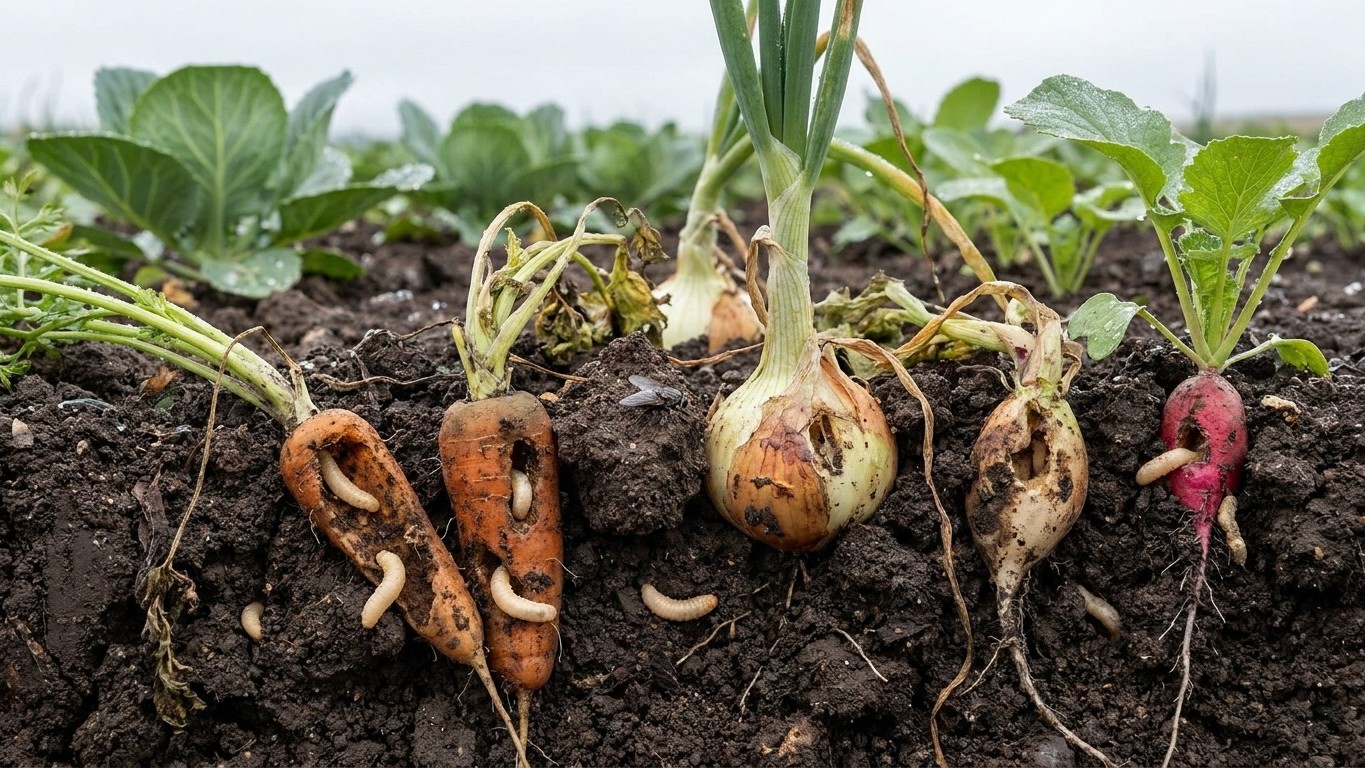
Storage is a food safety matter, so inspect before you trust. Look over every root: a soft patch, a weeping spot or a moldy crown means that root is finished, and it should not be eaten or kept with the others. A root that looks sound is not therefore safe, and no storage duration can be promised from this page. Remove any suspect root promptly, since rot spreads.
Which these root crops suit Northwest Territories
The choice follows the facts. A window of 116 days at Yellowknife A favours the earliest types: quick-maturing turnips, small-rooted kohlrabi and the shorter rutabaga types, over anything bred for size and long maturity. A cool, damp summer makes disease resistance the first criterion on a seed label, ahead of flavor or storage claims. Heat tolerance is the lowest priority.
Turnip and rutabaga are brassicas, and so is kohlrabi. They share their pests and diseases with cabbage, kale and mustard, including clubroot, so a gardener who rotates them into a cabbage bed has rotated nothing. The rotation page on this site explains how to plan the sequence. Celeriac is not a brassica, so it can follow them.
Jerusalem artichoke deserves its own warning before any growing advice. Once planted, it is effectively permanent. Every fragment of tuber left in the ground regrows, and digging it out rarely finds them all. Site it where it can stay: a corner you are happy to give up, ideally bordered by a path, a lawn edge you mow, or a bed with a hard barrier. It is the single most regretted planting in a vegetable garden. Many people also get digestive discomfort from it, because the tubers store inulin instead of starch. Start with a small first portion to find out how you react.
Horseradish is the other perennial to place carefully, since pieces of root left behind will also resprout, though it is easier to manage than Jerusalem artichoke. Preparation needs care: grating a fresh root releases compounds that burn the eyes and airways. Work in a well-ventilated room, keep your face away from the bowl, and don’t treat it casually.
On varieties, this page names none, and that is deliberate. The varieties that perform in the Northwest Territories are the ones trialled in the territory, and this page has no trial data to draw on. A name pulled from a catalog or from another climate would be a guess presented as advice. Northwest Territories Industry, Tourism and Investment runs the territory’s agriculture services and is the place to ask which types have done well near you, since conditions north of Yellowknife can differ by weeks.
Common questions
Is May 25 a safe planting date in the Northwest Territories?
No. May 25 is the average last spring frost at Yellowknife A, so in about half of years the last frost comes later. It is also a frost date, not a soil date. Wait for steady soil warmth at planting depth, and expect northern districts to run later than Yellowknife.
Can celeriac finish in this climate?
It is the marginal crop. The average frost-free window at Yellowknife A is 116 days, and celeriac needs an early indoor start and warm soil to use it well. A cool summer can leave it small, so treat it as an experiment and not as the staple of the bed.
Can I leave these roots in the ground over winter?
Horseradish and Jerusalem artichoke are the candidates, under a thick mulch, and local overwintering results are worth checking with the territorial agriculture office. Turnip, rutabaga, kohlrabi and celeriac should be lifted before the soil freezes. Inspect everything you store and discard any root with a soft patch, a weeping spot or a moldy crown.
Does the Yellowknife data apply across the whole territory?
Not exactly. The frost dates and the winter low come from one station, and the hardiness zone of 1b is Canada’s system for one reference city, not a USDA zone. Communities farther north or at higher elevation usually run weeks behind, so treat these numbers as a starting point and adjust with local advice.