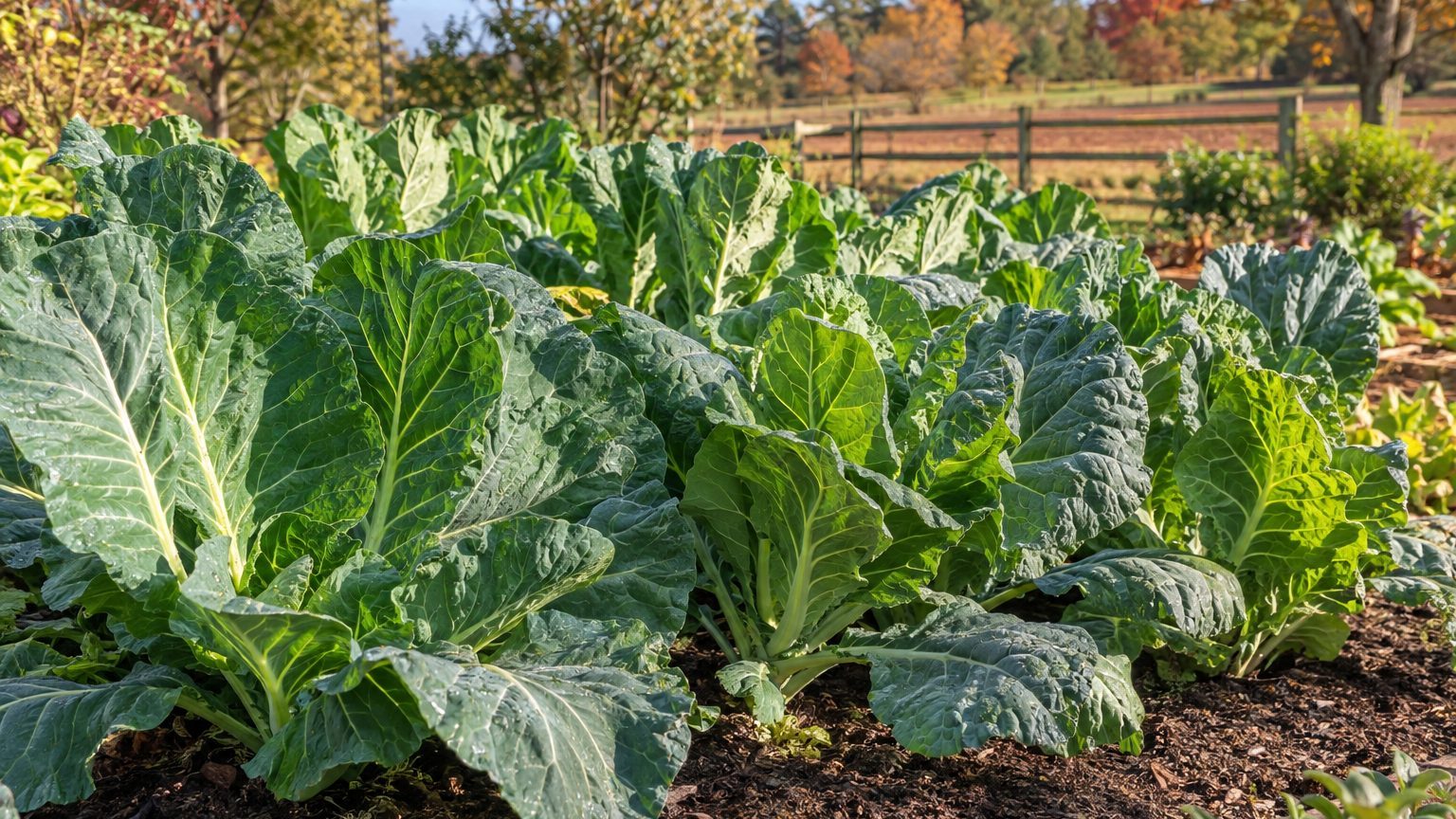

The best collards for Nunavut are the quickest, most compact types, started indoors and set into a sheltered raised bed or greenhouse. Where the growing season runs this short, faster greens such as kale, mustard and turnip greens often outperform them. Collards can still earn a spot, but only if the variety fits the weeks actually available.
The short answer for Nunavut
Pick by type, not by name: an early, compact, non-heading collard for the main bed, and one or two fast leaf greens as insurance. Slow, tall Southern-style collards are the wrong choice for a territory where the frost-free window is measured in weeks.
The numbers explain why. At Rankin Inlet A, the reference station in Environment and Climate Change Canada’s 1981-2010 normals, the last spring frost falls on average on June 19 and the first fall frost on average on September 13. That leaves 86 days between the two mean dates. Both are midpoints, though. In one year out of two the last frost comes later than June 19, and in one year out of two the first frost arrives before September 13, so the dependable frost-free stretch is shorter than 86 days, and in some years much shorter. Northern and upland districts run weeks behind this station.
Collards help here because they shrug off light frost and get sweeter after it, which lets a crop start under cover a little before the average last frost and keep going a little after the average first one. Packet maturity dates for transplanted collards vary, so check the days to maturity on your packet against your local frost dates. Young leaves can be picked well before full size.
Here is how the types sort out:
- Compact, early collards: the main choice. Short plants, quick to produce usable leaves, and easier to shelter under a low cover or in a greenhouse.
- Tall, late Southern collards: a poor fit. They are bred for long, warm seasons and rarely reach full size before cold returns.
- Fast leaf greens (kale, mustard, turnip greens): the safety net. Several are ready as baby leaves in a fraction of the time, and kale in particular tolerates cold well.
With a mean daily minimum of -34.3 °C (-29.8 °F) in the coldest month, nothing here overwinters outdoors, so every collard plant is an annual crop. For community-level timing, see When to Plant Collards in Nunavut.
What will not work here
Sowing collard seed straight into the ground and hoping is the first plan to drop. Cold soil slows germination, and the 86 days between the mean frost dates are already spoken for before a direct-sown seedling has put on a true leaf. Where permafrost lies below the surface, in-ground beds stay cold well into summer. Raised beds filled with imported soil warm much faster.
Long-season varieties come next. A slow collard cannot be set out on June 19 and finish before the September 13 average frost, and that is the average. Half the years end sooner. The same math sinks any crop that depends on a second, late planting, because a July start leaves only a few weeks of real growth.
Treating June 19 as a safe planting date is a quieter mistake. It is a midpoint, so in about half of all years a frost still arrives after it. Transplants set out on that date with no cover are gambling on the favorable half of the distribution. Collards are forgiving, but a hard freeze on a tender transplant still sets it back by weeks, and weeks are what the season does not have.
Holding transplants indoors too long also backfires. Brassicas that are large and then hit by an extended cold spell can bolt in their first year, sending up a flower stalk instead of leaves. A small, sturdy transplant set out under protection does better than an oversized one that has been waiting on the weather. Seedlings starved of light indoors turn leggy and weak, which is a separate failure that hits just when the plants need to be strongest.
Wind is the last hazard that shows up in Nunavut’s open sites. Broad collard leaves tatter and dry out on exposed coastal ground and open tundra, even when temperatures are fine. A windbreak, a low frame or a spot against a south-facing wall changes the outcome more than the choice of cultivar.
And overwintering is off the table. A coldest-month mean minimum of -34.3 °C (-29.8 °F) kills any collard plant left in the ground. The biennial habit that lets collards survive winters in milder places does not apply here. For a full walkthrough, read Growing Collards in Nunavut.
What changes across Nunavut
Nunavut is not one garden. It stretches from the Hudson Bay coast and its islands up through Baffin Island and into the High Arctic, so no single answer fits every community. The hardiness zone figure shows how limited the reference point is: Rankin Inlet sits in zone 0a in Canada’s plant hardiness system. That is a Canadian zone, built from seven climate variables, and it does not convert to a USDA zone. Natural Resources Canada itself says there are no simple conversions between the two systems, and Canadian zone 4a alone overlaps nine different USDA zones. Treat the 0a figure as describing one reference community, not the territory.
Several things shift as the location changes. Coastal communities are cooled by sea ice and open water well into summer, while inland communities often run warmer on summer afternoons but colder in winter. A reader in the north should assume a later start, an earlier end and fewer days of harvest than the Rankin Inlet means suggest. For northern and High Arctic communities, collards make sense mainly in a greenhouse or indoor setup. Outdoors, fast greens usually make more sense.
Readers in the milder southern parts of the territory can attempt the compact collards outdoors under row cover, but the margin is still thin. Altitude and exposure inside a single community matter as well: a bed beside a heated building or against a south-facing wall can behave like a different climate from a bed 50 feet away in the open.
To find the zone for a specific community, use the map on Canada’s Plant Hardiness Site rather than assuming. Read it as a guide to relative cold, then adjust for wind and shelter.
Where to check this for your own county
Nunavut does not have counties or a state extension network, so the closest equivalents are federal and territorial agriculture offices and local growing groups. Agriculture and Agri-Food Canada is the federal starting point, and the territorial government’s agriculture and food programs and local hamlet offices can point to community greenhouses and gardening groups.
Two things are worth looking for. The first is a local planting calendar for short-season brassicas, ideally written for a community near your own and not for the territory as a whole. The second is any record of varieties trialled in cold, short-season conditions, including greenhouse trials. A variety that has already grown in a nearby community under similar light, wind and soil conditions is worth more than any list drawn from distant places.
A recommendation from your own community beats a territory-wide one, every time. Territory-wide guidance is a starting point: it sets the type of collard, the sensible window and the main risks. Local growers know which beds stay frozen late, which sites get wind and which weeks have actually worked. If a neighbor has grown greens successfully, that experience should outrank anything written at the territory level, including the Rankin Inlet frost means.
Checking this against your own garden
Your own observations outrank every date above. Three are worth watching, and none needs equipment.
Soil warmth by feel. Press your hand about 2 inches (5 cm) into the bed. If the soil feels numbingly cold after a minute, it is too early for transplants. If it feels cool but tolerable, collards can go in under cover. Compare the bed against the surrounding ground: a bed that warms days before its neighbors has a good microclimate.
The first male catkins on willows. Where dwarf willows grow near you, the first male catkins releasing pollen mark a real turn in the season. If they open early near your site, the spot is sheltered and warms sooner. If they lag, plan on a later start.
The first true leaves on seedlings. The seed leaves come first, and the true leaves, which are the ones with the familiar collard shape, follow. If they appear quickly and the seedlings stay stocky, your light is adequate. If the seedlings stretch and the true leaves stall, they need more light before going outside.
Common questions
Can collards grow in Nunavut at all?
Yes, with short-season handling: compact varieties, transplants started indoors, and a raised bed, cover or greenhouse. Success depends heavily on the community and the site.
Which greens are faster than collards?
Kale, mustard greens and turnip greens usually reach harvest sooner, and all can be picked as baby leaves. Kale tolerates cold especially well.
Will collards survive the winter outdoors?
No. The mean daily minimum of the coldest month is -34.3 °C (-29.8 °F), far below what a collard plant can handle, so plant them fresh each year.
Is June 19 a safe date to transplant?
No. It is the average last spring frost at Rankin Inlet A, so in one year out of two frost comes later. Transplant under cover and keep a spare layer of fabric within reach, because those 1981-2010 normals are only a midpoint.