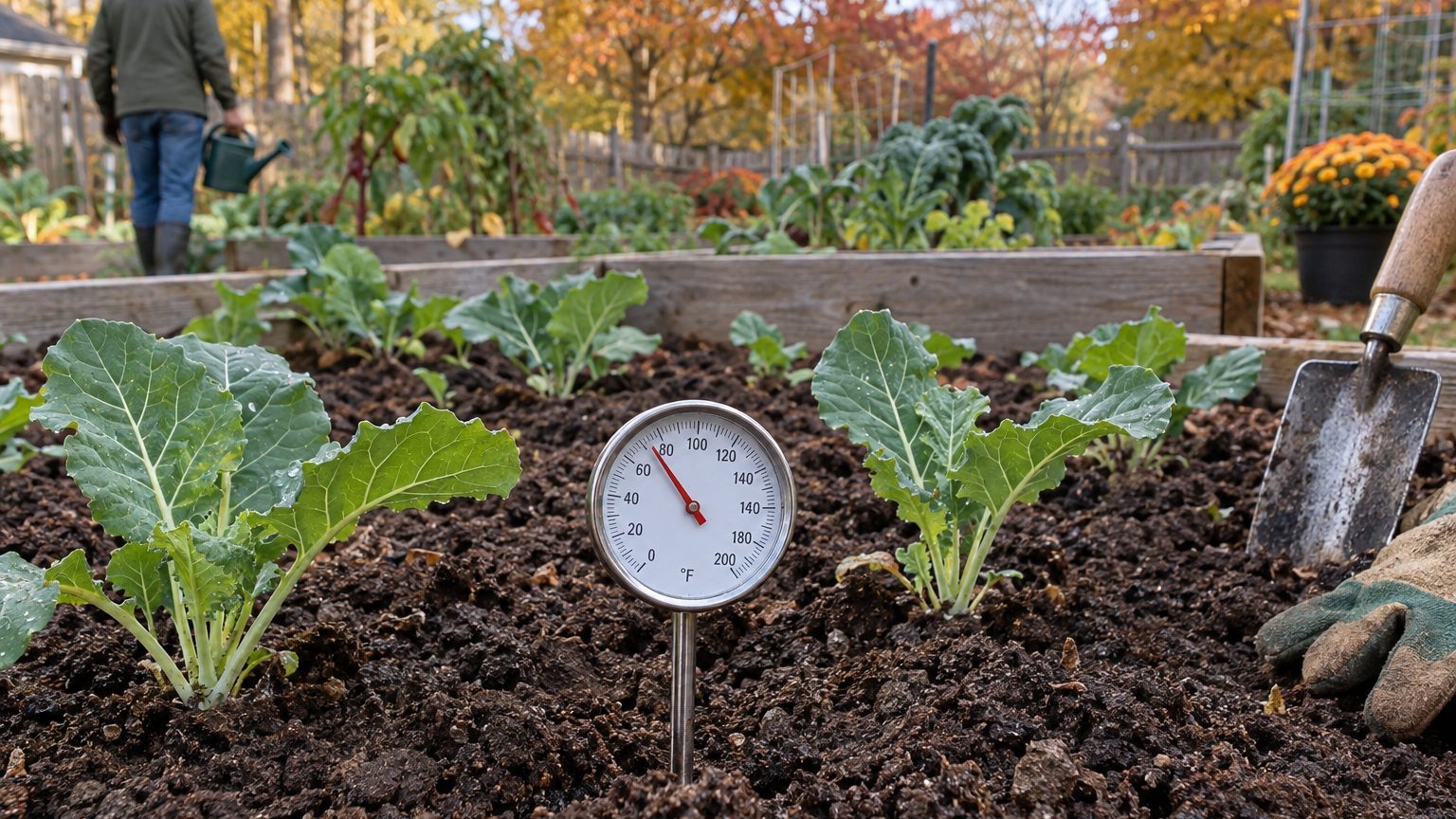

Collards can be grown in Nunavut, but only inside a narrow summer window: sow once the soil has warmed past mid-June, harvest everything before the first hard frost around mid-September, and drop any idea of a standing winter crop outdoors. A zone 0a winter makes that the only workable model here. What follows walks through the dates, the length of that window, and the type of collard suited to it.
When the soil is warm enough in Nunavut

The average last spring frost at Rankin Inlet A, the Environment and Climate Change Canada station used for this territory, falls on June 19 (1981-2010 normals). That date is a mean, not a promise. In roughly half the years on record, frost arrived later than that, sometimes by weeks. Treat it as the midpoint of a window, never as a green light to plant.
Frost is only a stand-in for the number that actually matters, which is soil temperature. Collards germinate and root when the ground itself has warmed, and soil lags behind the air for days or weeks depending on how it drains, what covers it, and how wet it stays through spring breakup. Across much of Nunavut, permafrost sits close enough to the surface that a bed can stay cold and waterlogged well after the calendar clears frost risk. Raised beds, dark mulch, or a cold frame move that working date forward faster than waiting on the calendar ever will.
Natural Resources Canada rates the reference community at hardiness zone 0a, a Canadian classification built on seven climate variables rather than the single-variable USDA scale used for American territories on this site. Zone 0a sits near the cold end of that scale, and it’s the reason nothing here is planted with an eye toward surviving the winter outdoors.
Collards belong to the brassica family, alongside cabbage, kale, mustard, turnip, and rutabaga. Pests and disease from any of those crops carry over in the soil, so a bed that grew cabbage the year before isn’t a fresh start for collards this year, it’s a continuation of the same trouble. Before storing any harvest, check leaves for a soft patch, a weeping cut, or a moldy crown. Any one of those ends the question, regardless of how sound the rest of the plant looks. For the broader practices behind timing an outdoor sowing anywhere, the full collards growing guide covers the decision-making that applies well beyond this one territory.
How long the season lasts here
Subtract the last spring frost (June 19) from the first fall frost (September 13) and the frost-free window at Rankin Inlet A comes to roughly 86 days. That span is the entire growing season available to collards here, and it shapes nearly every other decision about how the crop gets managed.
An 86-day window doesn’t leave room for a second sowing. Farther south, a gardener might get a spring crop and a fall crop out of the same bed, spaced through a succession schedule. Here, the frost-free period barely covers one planting from seed to harvest, so the first sowing is effectively the only sowing of the year.
That reality also settles the transplanting question. Where the season runs long, starting seedlings indoors is a convenience, not a necessity. Where it runs under three months, transplanting stops being optional. Direct-seeded collards often can’t reach usable leaf size before the first fall frost shuts the door, so seedlings started early indoors and moved out once the soil has warmed are the more reliable path to an actual harvest.
For contrast, a territory with a much longer, milder frost-free period changes that math entirely. The guide to growing collards in Delaware covers a season long enough to allow two plantings from the same bed, a luxury an 86-day window here simply doesn’t offer.
Heat and water in Nunavut

There’s no meaningful count of days above 90°F to report for this territory, and the absence itself is telling: summer air at Rankin Inlet almost never approaches a threshold that troubles collards farther south. The heat stress that limits the crop elsewhere, wilting, bolting, bitter flavor after a run of hot days, simply isn’t a factor here. What limits the crop instead runs the opposite direction: short, cool, damp summers that slow ripening and give mildew and other leaf disease more time to settle into a crowded planting.
Specific summer rainfall totals for Rankin Inlet aren’t part of the record behind this page, but the general pattern in the territory runs damp rather than dry, with fog and cool rain more common than drought stress during the growing months. That dampness favors wider spacing between plants than a hot, dry climate would need, so air can move through the bed and dry leaves off between showers rather than staying wet and inviting fungal trouble.
The figure that actually decides how this bed gets planned is the winter one. The mean daily minimum of the coldest month at the reference station comes to -34.3°C, a depth of cold that puts any standing winter crop out of the question. Where winters stay mild, collards become a crop picked leaf by leaf from November into March. In Nunavut, the ground locks up long before that’s possible, so collards here run strictly as an autumn crop: sown once, grown fast through the short warm stretch, and cleared from the bed before the first hard freeze ends the season for good.
Which collards suit Nunavut
An 86-day frost-free window leaves no room for slow-maturing types bred for regions with months of growing season to spare. The first criterion here is speed: earliest-maturing types, chosen specifically for a short window, not the longer-season kinds that dominate catalogs written for milder climates. A planting that needs more time than the season allows simply won’t finish, however well it’s tended.
Heat tolerance buys nothing in this territory, since the crop never faces the high summer temperatures that trait is bred to handle. What the short, damp summer does reward is disease resistance, because cool humid conditions and closely spaced plants are exactly the setup mildew and leaf spot need to take hold before harvest day arrives.
None of that adds up to a cultivar name on this page, and that’s deliberate. The specific varieties trialled and recommended shift from one growing zone to the next, and naming one here, without local trial data behind it, would be a guess dressed up as advice. The useful next step is contacting Agriculture and Agri-Food Canada, which can point toward types actually tested under short-season, cold-climate conditions comparable to Nunavut’s.
Because transplanting is close to mandatory in this window, the real question becomes which early types handle a transplant well and shrug off cool soil at planting time, and that’s local trial knowledge no general page can replace. For a sense of how the same reasoning plays out in a similarly cold, similarly short-season territory, the guide to growing collards in the Northwest Territories covers ground close to Nunavut’s own.