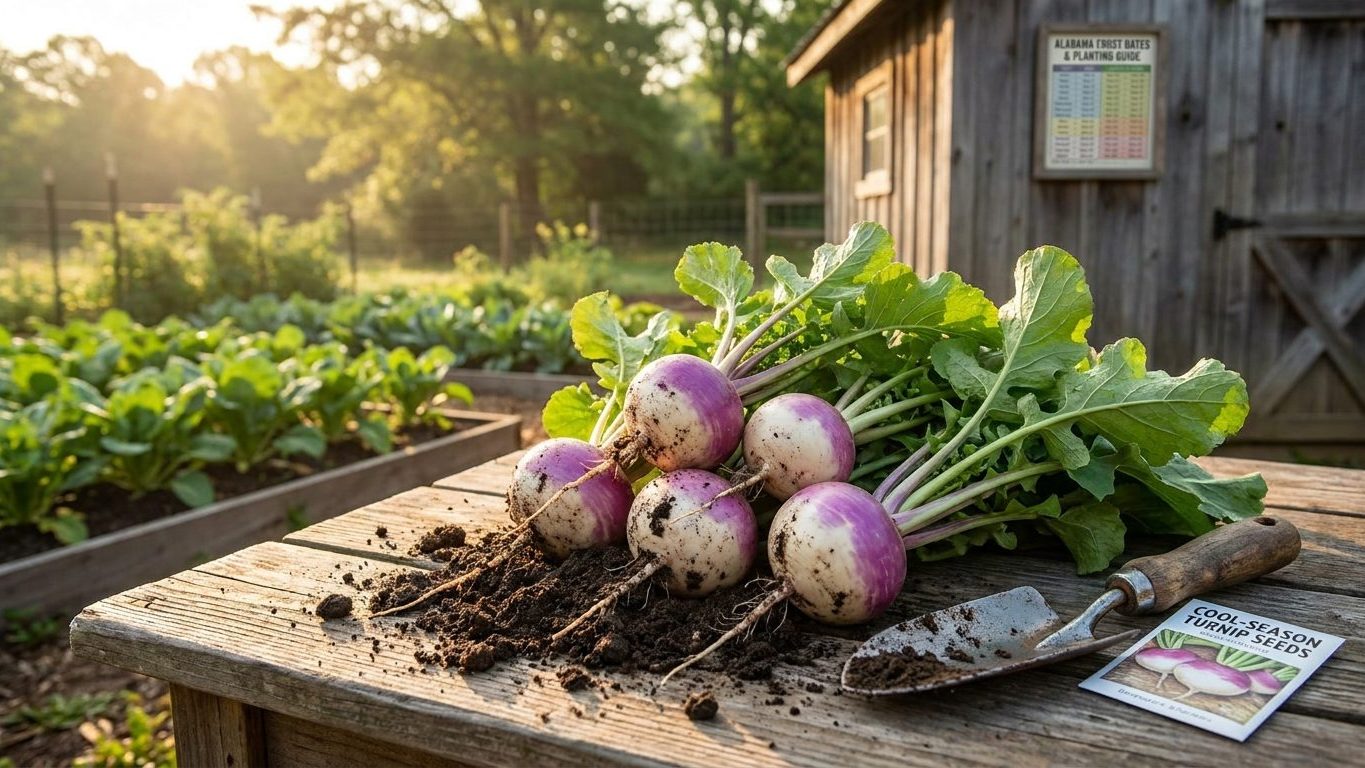

The short version: with a mean last spring frost on June 19 and a mean first fall frost on September 13, Nunavut gardeners are working with an average frost-free window of roughly 86 days, and that number is a midpoint, not a guarantee. Everything below explains what that window actually allows, and what it rules out.
The short answer for Nunavut
Sow turnip seed directly into the ground as soon as the soil can be worked after the average last spring frost date of June 19, and plan to have the crop out of the ground well before the average first fall frost of September 13. Those two dates come from Environment and Climate Change Canada’s 1981-2010 climate normals for the Rankin Inlet A station, and they are means, not safe boundaries. In roughly one year out of two, the last spring frost at that station falls later than June 19, and the first fall frost can arrive earlier than September 13 just as often as later. Treat both dates as the middle of a range you cannot see in advance, never as a calendar you can rely on.
What the 86-day window means for turnips
An 86-day average frost-free season is short by any national standard. Fast turnip varieties bred for baby roots or greens, the kind that mature in 35 to 45 days, fit comfortably inside that window with room to spare for a slow spring or an early fall chill. Standard slicing turnips that need 55 to 60 days to reach full size are workable, but only if seed goes in within the first week or two after the ground opens up. There is no room in this calendar for waiting until the soil “feels” warm enough by southern standards, because by the time a Nunavut garden reaches that point, a meaningful share of the season may already be gone.
The practical takeaway is to have seed on hand and ground prepared before June 19 arrives, so sowing can happen the moment frost risk visibly clears, rather than after it.
What will not work here

Rutabaga is the crop this calendar quietly eliminates for most Nunavut gardens. Rutabaga typically needs 90 to 100 days to size up properly, which is longer than the entire average frost-free season here, before any allowance for a late spring or an early fall. Even in a generous year, a gardener sowing rutabaga on June 19 is racing a season that averages out shorter than the crop needs. This is not a matter of technique or soil fertility. It is a mismatch between how long the plant takes and how long the ground stays workable.
Winter survival is not part of the plan
The mean daily minimum temperature of the coldest month at the reference station is -34.3 °C (about -29.8 °F). That figure is not the record low, it is the average low across the coldest month, which is a far more brutal number for anything left in the ground. No turnip or rutabaga root, and no seed, survives a winter with that kind of cold as its normal baseline. These crops have to be grown, harvested, and stored indoors as annuals in a single compressed season. Any planting strategy built around overwintering roots in the ground, a technique that works in milder Canadian regions, simply does not apply here.
Weekly watering schedules built for warmer, drier provinces also fail differently here: with a short, cooler growing season, the risk usually runs toward roots staying too wet in low-drainage soil rather than drying out, so a rigid southern watering routine can do more harm than good.
What changes across Nunavut
Nunavut is not one climate, and the numbers above come from a single station, Rankin Inlet. The Canadian Plant Hardiness Zone for that reference location is 0a, calculated by Natural Resources Canada from seven climate variables under the 1991-2020 normals. Zone 0a already sits at the extreme cold end of the entire Canadian hardiness scale, and Nunavut’s territory stretches from the mainland coast to islands well north of Rankin Inlet, plus wide swings in elevation and exposure. There is no single hardiness zone for Nunavut as a whole, and the spread across the territory can run colder than 0a in its more northern and exposed districts.
Why the Canadian zone number cannot be compared directly
The Canadian system is not built the same way as the USDA system used on American gardening sites, and Natural Resources Canada is explicit that there is no simple conversion between the two. A Canadian zone number should never be read on the same scale as a USDA zone quoted elsewhere. For Nunavut gardeners, the practical point is narrower: the 0a figure describes Rankin Inlet specifically, not every community in the territory, and a garden further north or at higher elevation should assume a shorter, colder season than the numbers on this page describe. Anyone unsure where their own community sits should check the official zone map rather than assume Rankin Inlet’s numbers apply directly.
Where to check this for your own county
Nunavut does not use a county system, so the equivalent step here is checking with a regional or community-level agricultural resource, and the place to start is the federal department’s own site. The provincial-level site could not be verified automatically (it returned an HTTP 403 error during checking), so the federal address is the one to use: https://agriculture.canada.ca/en. On that site, look specifically for any planting calendar or growing guide that references northern or Arctic conditions, and for any variety trial information relevant to short-season, cold-climate growing rather than general Canadian advice aimed at temperate provinces.
A recommendation built for a specific community or region will always beat a territory-wide average, because a single station’s data, however carefully measured, cannot capture every microclimate across a landmass this large. This page describes the territory-level picture. It is a starting point, not the final word for any one garden.
Some gardeners also time this by the Moon: when to plant turnips by the moon, as almanac tradition rather than fact.
Checking this against your own garden
No date on this page beats what a gardener can observe directly, and in a climate this variable, direct observation matters more than usual. Three things are worth tracking by hand and eye rather than by calendar.
- Soil warmth by feel: if bare soil at seed depth feels only cold, not icy or frozen, that is a better signal than the June 19 average, since a late or early year can shift the real date by weeks.
- The first true leaves: once seedlings push out their first true leaves (beyond the initial rounded seed leaves), the plant has cleared its most vulnerable stage, and growth rate from that point gives a rough sense of how much of the season is actually left.
- Any sign of bolting or flowering: turnips that flower early are responding to a cold shock or a stress signal specific to that garden’s conditions that particular year, which says more about the immediate microclimate than any territory-wide average can.
Together, these three signs tell a gardener whether their own plot is running ahead of or behind the Rankin Inlet averages, which is the only way to know how much of the short Nunavut season is genuinely available in any given year.