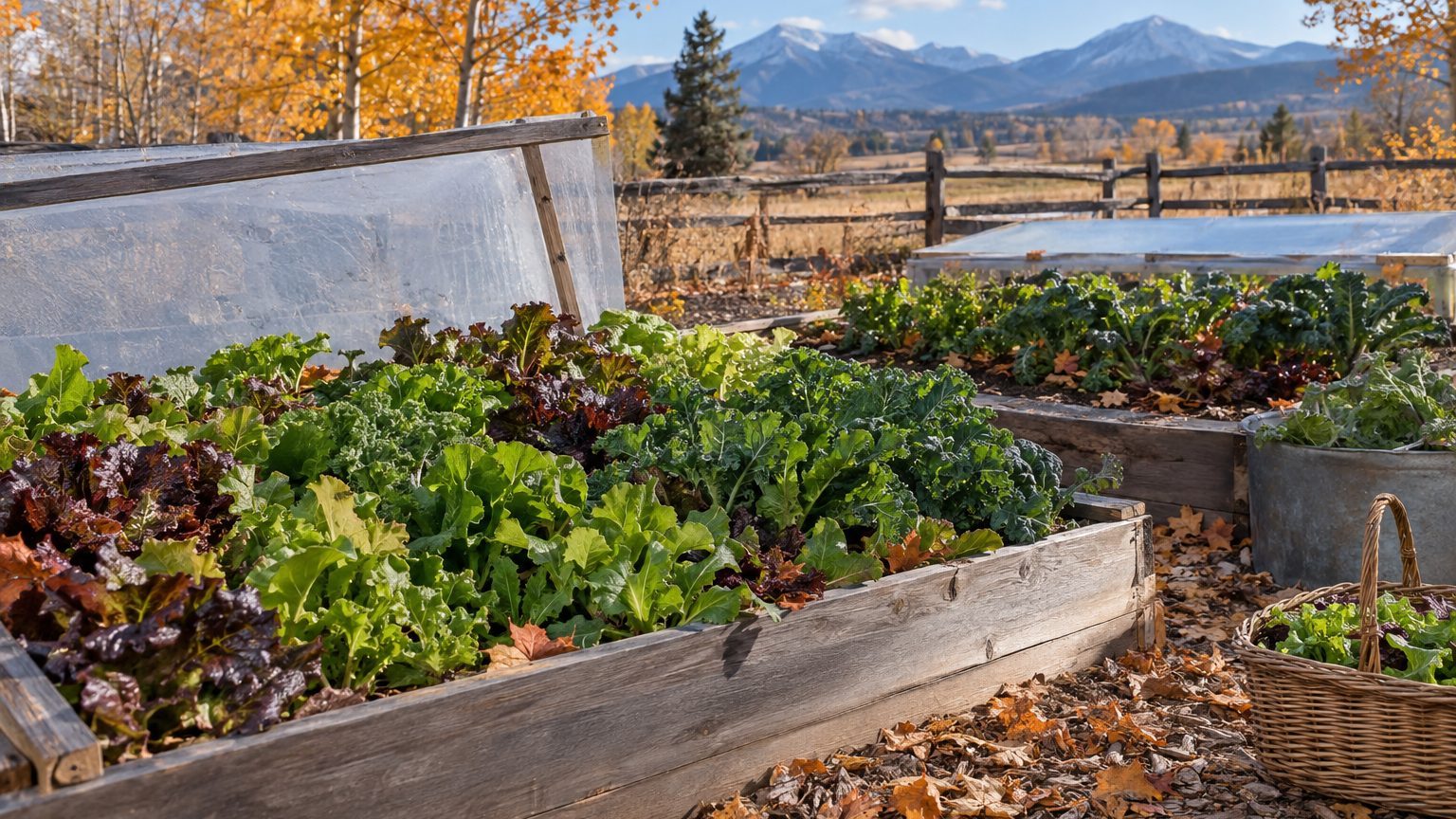

Sow outdoors after the average last frost of June 19 at Rankin Inlet, and only once the soil has actually thawed and warmed. The average first frost of autumn arrives on September 13. In Nunavut, “winter salad” mostly means cool-season greens grown fast in beds, containers or under cover, because nothing leafy stands through a winter this deep.
When the soil is warm enough in Nunavut
Start with the date everyone asks about. At the Rankin Inlet A station (climate ID 2303401), Environment and Climate Change Canada’s 1981-2010 normals put the last spring frost on average at June 19. That is a mean, not a deadline. In one year out of two the last frost falls later, so treat June 19 as the middle of a window rather than a safe date. It is also a single station. Other Nunavut communities will keep their own calendars, and this page carries only Rankin Inlet’s.
Frost is a stand-in for what the gardener really needs, which is warm soil. Seeds do not care when the last freezing night happened. They care what temperature the ground is at the depth where they sit. The soil warms after the frost risk ends, not along with it, and in a place where the ground below stays frozen all year, that lag can be long. Seed sown into cold, wet soil tends to sit there, and some of it rots before it sprouts.
Reading the soil instead of the calendar
A cheap soil thermometer settles the argument better than any normal. Push it a couple of inches down in the morning, when the reading is at its lowest, and compare it with the minimum germination temperature printed on the seed packet. Salad greens are among the cool-season crops, so their minimums are modest, but modest is not zero.
Raised beds and large containers filled with purchased soil warm well ahead of native ground, because they drain, they sit above the cold layer, and their sides take in sun. For that reason most sensible Nunavut salad growing happens off the ground rather than in it. Dark containers and a clear cover over a bed speed things up further.
Which types of greens go in first? Think of the ones sold as cool-season or baby-leaf crops: spinach types, mustard-type greens, corn salad types and loose-leaf lettuce. They accept cool soil far better than warm-season crops do. Which named varieties have been trialled in your region is a question for a local agriculture office, and the last section of this page explains why this one will not guess.
One boundary for the whole site. These pages cover salad grown in beds and containers. Nothing here concerns gathering plants from the land, and nothing should be read as a guide to doing so. For the general method behind cool-season salads, see Winter Salads: What Grows When Lettuce Will Not.
How long the season lasts here
The two mean dates from the Rankin Inlet A station bracket the season: June 19 and September 13. Counting from one to the other gives about 86 days. Both are averages from the 1981-2010 normals, so a given year can run shorter or longer, and the half of years with a late frost in either direction means the real number wobbles.
Eighty-six days sounds like plenty until you remember it starts at the mean last frost, not at the day the soil is ready to sow. Subtract the days that the ground needs to warm, and the working window is shorter than the arithmetic suggests. The fall end is a mean too. A frost that arrives early can finish tender leaves, and half of all autumns bring it before September 13.
What does a window this size allow? Mostly one sowing. A long season lets a gardener sow every couple of weeks and cut from the beds for months. Here the first sowing is close to the only one, and the later ones need to be quick types sown within the first weeks of warm soil, so that they reach cutting size before the light and the temperature drop. The Winter Salads for Northwest Territories Gardens page deals with a similarly northern calendar, and Winter Salads for Delaware Gardens shows how different the same plan looks when the season stretches over most of the year. The succession sowing guide on this site explains the interval logic in detail, and in Nunavut the main lesson from it is to shorten the gaps and favor fast types.
The window also changes the transplanting decision. A transplant has to survive a root check, a pause in growth while the roots recover after being moved. In a long season that pause is a rounding error. In 86 days it is a real cost. Direct sowing into a warm bed avoids it. Starting seedlings indoors in the weeks before the thaw can still pay off, since the plants arrive already leafy, but only if they are handled gently and moved to the bed on the first day the soil allows. Choose one method per bed and stick with it.
Heat and water in Nunavut
Here the usual summer-garden questions flip. This page has no verified count of days above 90 °F (about 32 °C) or of summer rainfall for the Rankin Inlet station, so it prints neither. What can be said honestly is that heat does not decide anything here. A hot-climate paragraph about shade cloth, bolting and midday wilting would be written for a different place. In a cool, damp summer the trouble runs the other way: powdery and downy mildew on leaves that stay wet, slow growth and slow ripening, and rot in crowded, shaded plantings. Airflow, spacing and watering at the base of the plant matter more than any attempt to cool the bed.
The cold decides the rest. The mean daily minimum of the coldest month at Rankin Inlet is -34.3 °C (-29.8 °F, for comparison with US figures), from Environment and Climate Change Canada’s 1981-2010 normals. Natural Resources Canada puts the reference city in zone 0a of the Canadian plant hardiness system, based on 1991-2020 normals. That is a Canadian zone, built from seven climate variables, and it cannot be converted into a USDA zone. Do not compare it with US zone numbers on other pages of this site.
Against that winter minimum, salad crops fall into three groups:
- Stand uncovered: none. No salad green is going to survive a winter outdoors at this temperature, however hardy its reputation farther south.
- Need a cover to stay edible: only in the shoulder weeks. A low tunnel or cold frame keeps leaves usable through a hard autumn night, but it will not carry a crop through a Nunavut winter, because an unheated cover follows the air temperature down.
- Cannot manage at all: every outdoor planting left in place once the freeze settles. For salad in the dark months, the options are a heated greenhouse or an indoor setup with lights, treated as a different project from the outdoor season.
The first fall frost, on average September 13, sets the other limit: how late a sowing can still reach a size worth cutting. A bed sown in the middle of July has far more weeks to grow than one sown in August, and in autumn the light fails as quickly as the temperature does. Baby-leaf cutting at a small size suits that short run better than waiting for full heads.
Which winter salads suit Nunavut
The choice here is by type, and the facts point the same way every time. A season of about 86 days between mean frosts favors the earliest and fastest types: baby-leaf mustards, spinach types, loose-leaf lettuces cut young, and corn salad. These can be cut a few weeks after sowing and regrow if cut above the growing point, which stretches a single sowing across more of the short summer. Heading lettuces and anything slow to mature are a gamble.
Heat is not the issue, so shade at the root and heat-tolerant types do not need to be a criterion. A cool, damp summer shifts the first criterion to disease resistance, which means looking for types and seed lines described as resistant to mildew, and growing them with generous spacing and a breeze across the bed. Containers drain faster than flat ground, and a bed that dries between waterings stays healthier.
This page names no varieties, and that is deliberate. Variety recommendations only mean something when someone has grown the varieties locally, in the same soil, light and cold, and written down the results. This page does not have those trials. Seed catalogues sell many names for milder places, and a name that thrives in a southern garden says little about a bed on Hudson Bay. Nunavut has no US-style state extension service, so the nearest national authority is Agriculture and Agri-Food Canada, which can point to territorial and regional sources for what has been trialled in the North.
Local knowledge counts too. Community greenhouse groups and neighbors who have grown salad in the same wind and light know which sowing dates held up, and that kind of word of mouth is worth more than any list of seed names.
Common questions
Can salad greens survive a Nunavut winter outdoors?
No. The mean daily minimum of the coldest month at Rankin Inlet is -34.3 °C, and no salad crop is rated for that without heat. Winter salad here means growing indoors under lights or in a heated greenhouse.
When should I sow my first salad greens?
Wait for warm soil, not just the date. The average last spring frost at Rankin Inlet A is June 19, and in one year out of two it falls later. The soil then needs time to warm, so check it with a thermometer before sowing.
Is zone 0a the same as a USDA zone?
No. Zone 0a is from the Canadian hardiness system, which uses seven climate variables. Natural Resources Canada states that there are no simple conversions between the Canadian and USDA systems, so never read it as a US zone number.
Do these dates apply to every community in Nunavut?
No. Both frost dates come from the Rankin Inlet A station and from the 1981-2010 normals. Other communities will have different dates, so use these as a reference point and compare against your own observations.