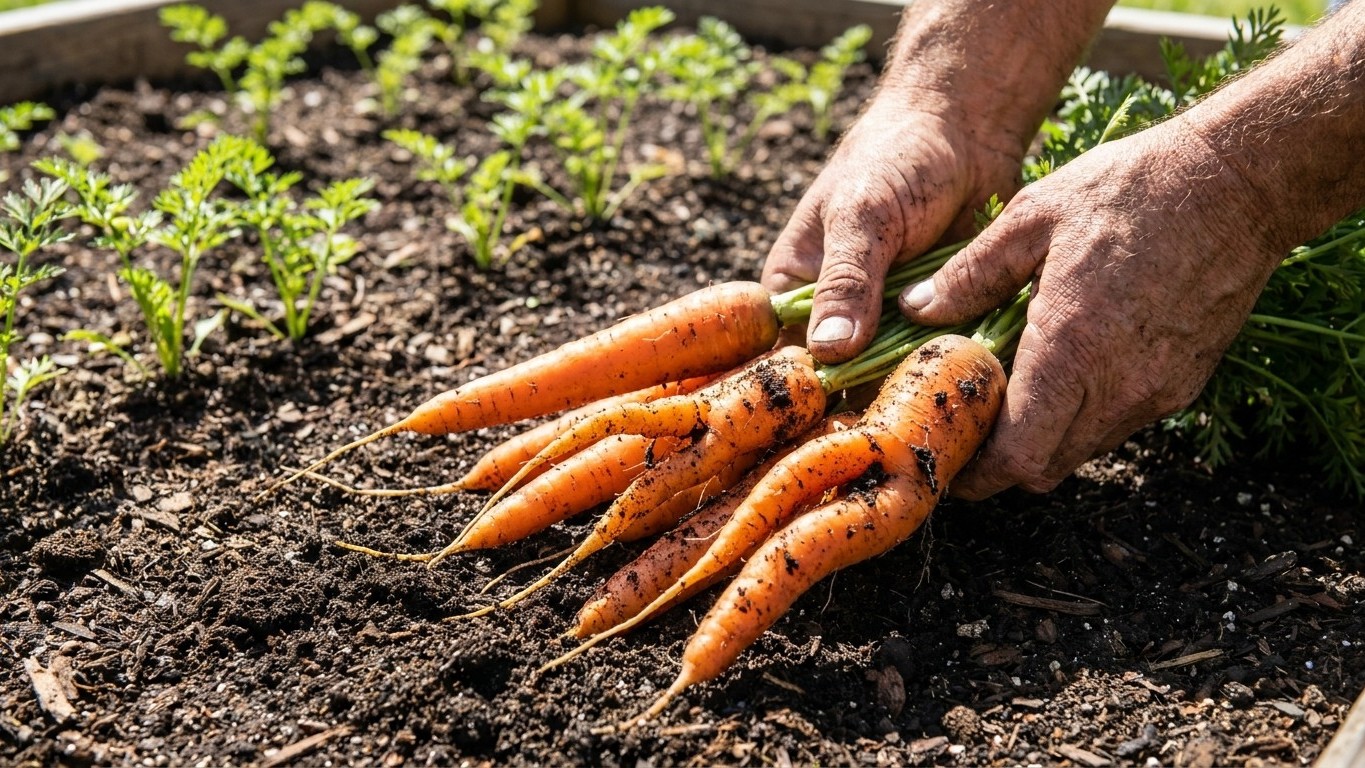

The direct answer for Oklahoma gardeners is that carrots go into the ground directly, sown in place, well ahead of the last spring frost, since this root crop never transplants. But the calendar matters less than what’s under your boots. Oklahoma’s official state soil carries enough clay and silt to make a straight carrot root work for it, and knowing that changes how you prep the bed, not just when you drop the seed.
The short answer
Oklahoma’s state soil is the Port series, a Mollisol, the deep, dark prairie soil that built the Corn Belt and that Oklahoma law named the official state soil in 1987 under the USDA NRCS State Soils program. Where it’s mapped, the surface horizon runs about 12 percent sand, 19 percent clay and 69 percent silt, which puts it in loam-to-silt territory rather than heavy clay. Surface pH sits near neutral, about 7.0, organic matter runs around 2.0 percent, and drainage is classed as well drained.
What the Port series numbers mean for a carrot
Carrots want deep, sandy, well-drained ground rich in organic matter, according to Utah State University Extension. Heavy or rocky soil forks the root, and the fix for heavy ground is generous compost worked in along with double digging to loosen the profile below the topsoil. Port series ground, with clay under 20 percent and good natural drainage, leans closer to what a carrot wants than a true clay soil does. That said, 69 percent silt is not nothing. Silt compacts under foot traffic and machinery, and a worked garden bed with a compacted layer a few inches down will fork roots just as effectively as clay will. The practical move is the same either way: loosen deep, add compost, and don’t skip the step just because the texture reads favorably on paper.
This is a starting point, not your soil test
Oklahoma spans hundreds of mapped soil series, and the Port series describes a representative prairie soil, not the dirt in every backyard. A lot has changed by the time soil sits under a suburban lawn or a lot a builder graded and filled. River bottoms run sandier, hill country runs rockier and thinner, and any yard that’s been scraped for a foundation may have topsoil that no longer resembles what NRCS mapped underneath it. Treat the Port series figures as a sense of what the region’s ground tends to do, hold water, run close to neutral, resist rapid drainage problems, and then go find out what your own bed is actually doing. If the ground under your carrot bed turns out heavier and shallower than this, a raised bed solves what double digging can’t reach.
The test that settles it in your own garden
No state figure replaces a look at your own bed. These four checks take less than half an hour and tell you more about whether a carrot will grow straight than any soil series name will.
- Dig a hole where the carrots will grow. Go as deep as a shovel comfortably reaches. Note what you hit: solid clay, a rock layer, a compacted band, or roots from something else. A carrot root needs that whole column open and loose.
- Check the depth and look for stones. Crumble the dug soil in your hand and pick out anything hard. Rocks and clumps in the top several inches are exactly what makes a root split around an obstacle instead of growing straight down.
- Feel the texture. Wet a handful and squeeze it. Soil that ribbons out smoothly between your fingers is heavy on clay. Soil that won’t hold together at all is sandy. Soil that forms a loose clump and then crumbles when you poke it is closer to a workable loam.
- Watch how water drains. Fill the hole with water and see how long standing water sits on the surface before it disappears. Water that lingers for hours points to a drainage problem that compost and raised beds address; water that vanishes quickly tells you drainage isn’t your issue.
None of this requires lab equipment. It requires a shovel, a bucket of water and twenty minutes, and it tells you something the state soil profile simply can’t: what’s actually in your bed.
What goes wrong here
Where the failures come from
Most carrot problems in Oklahoma gardens trace back to one of three things: the ground itself, a hot stretch at the wrong moment, or watering that swings between too little and too much.
- Forking in heavy ground. Any bed running heavier on clay than the Port series average, or one with a compacted layer from foot traffic or construction fill, splits the taproot into a fork or a claw shape as it hits resistance. Utah State University Extension points to the remedy directly: work in plenty of compost and double dig the bed before sowing, or build a raised bed filled with looser soil if the native ground can’t be reasonably loosened.
- Poor germination during a hot spell. Carrot seed is tiny and sits just under the surface, and that top inch of soil dries and heats fast during an Oklahoma warm snap. Seed that dries out even once during germination often just stops. Keep the surface consistently damp with light, frequent watering rather than one heavy soak, and consider a thin layer of mulch or a shade cloth over the row until seedlings are up.
- Splitting from uneven water. A root that grows through a dry stretch and then gets hit with a heavy rain or a deep watering session tends to crack along its length as it swells suddenly after slow growth. A steady watering schedule, rather than feast-or-famine, keeps the root growing at an even pace.
Common questions
Can I sow carrots directly into Oklahoma’s clay soil without amending it?
If your bed runs heavier on clay than a loam, plan on it forking without help. Compost and double digging loosen the profile enough for a straight root; if the clay layer runs deep and heavy, a raised bed filled with looser soil sidesteps the problem entirely.
Does the state soil’s pH matter for my carrots?
The Port series surface runs near neutral, about 7.0, but that’s a mapped representative value for one series, not a reading of your garden. The only way to know your bed’s actual pH is a soil test on your own soil, not a figure borrowed from a state soil profile.
What’s the real difference between the state soil and my backyard dirt?
The Port series describes a natural prairie soil profile as NRCS mapped it. A backyard that’s been graded, filled, or built on can carry topsoil that no longer matches that profile at all, especially in newer subdivisions or anywhere near a creek bottom or rocky hillside.
Since carrots don’t transplant, does soil texture matter for germination too, not just root growth?
It does, and more so. The seed germinates and the young root pushes down in the exact spot it was sown, so a crusted or compacted surface inch can block germination before the root ever has a chance to fork or split later on.