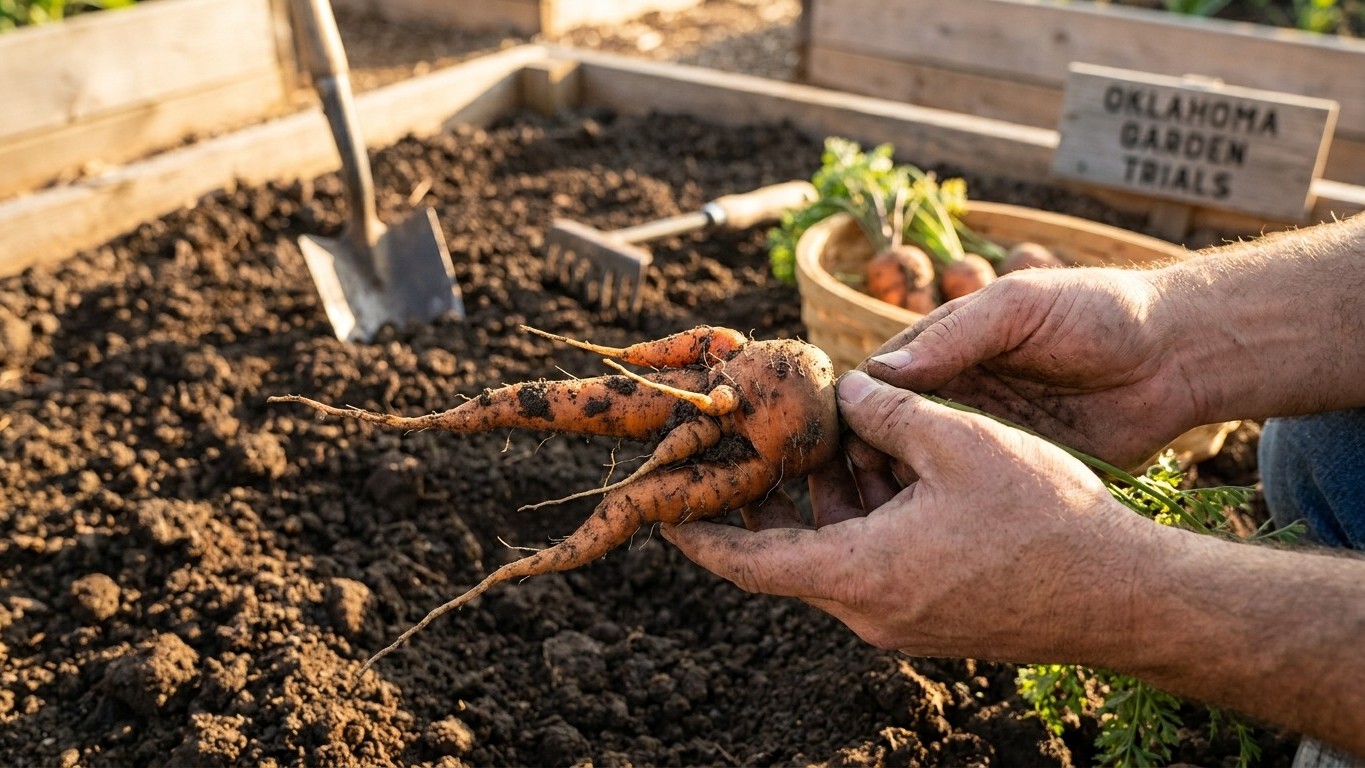

Oklahoma carrots can grow long and straight, or they can twist into forked, stubby roots, and the difference usually comes down to what’s under your boots. The state’s official soil leans heavy and fine grained, the kind of ground that resists a taproot pushing straight down. That does not rule carrots out. It just means most Oklahoma gardeners need to loosen, amend or raise their bed before they drop a single seed.
The short answer
Oklahoma’s lawmakers named an official state soil back in 1987: the Port series, a Mollisol, the deep, dark prairie soil that also built the Corn Belt further north. USDA soil survey records put the surface horizon of the Port series at about 12 percent sand, 19 percent clay and 69 percent silt, a texture that lands squarely in loam-to-silt-loam territory, with a surface pH near neutral (about 7.0), organic matter around 2.0 percent, and good, well drained structure.
That last part is the good news. Drainage is not the problem here. The texture is. Utah State University Extension is blunt about what carrots want: deep, sandy, well-drained soil rich in organic matter. Heavy or rocky ground makes the root fork instead of running straight. A soil that’s 69 percent silt and 19 percent clay is nowhere near “sandy,” so on paper, ground that resembles the Port series will tend to produce forked, stubby or twisted carrots unless something changes before sowing, which raises the question of Will Carrots Fork in Oklahoma Soil? Getting the soil right matters as much as timing, so it’s worth checking When to Sow Carrots in Oklahoma before you plan your planting schedule.
Utah State’s fix for heavy soil is straightforward: plenty of compost worked in, plus double digging, loosening the bed well past the top few inches so the root has a clear, soft path to follow. Where the ground is especially heavy, compacted, or full of buried rock and construction fill, skipping the fight altogether and building a raised bed filled with a loose, compost-heavy mix is often the simpler route.
None of this means every Oklahoma garden matches the Port series. A single state spans hundreds of mapped soil series, and the figures above describe the representative surface horizon of a mapped, undisturbed soil, not a measurement of any particular worked garden bed. River bottoms, hill country, and any yard a builder has graded or filled can differ completely from the state soil. Treat the Port series as a starting point for what the region’s ground tends to do, not a diagnosis of your own row.
The test that settles it in your own garden
The state soil tells you what to expect in general. Your own bed tells you what’s actually there. A short afternoon with a shovel answers the question the map cannot.
- Dig a test hole. Pick the spot where you plan to sow and dig straight down at least 12 inches. Look at the profile as you go: does the color and texture change partway down, and do you hit a hard, compacted layer or a shelf of rock before you reach that depth?
- Check for stones and resistance. Push a spade or a length of rebar straight down. If it meets firm resistance well before 12 inches, that’s a hardpan or dense clay lens, and it’s exactly the kind of obstacle that splits a taproot into two forked legs.
- Feel the texture. Take a handful of moist soil from the hole and rub it between your fingers. Gritty means sand. A smooth, almost floury feel means silt. If it turns sticky and rolls into a ribbon, that’s clay, and clay-heavy ground is the texture most likely to fork a carrot.
- Watch how it drains. Refill the hole with water and check back over the next several hours. Water that sits on the surface long after a rain, or a hole that stays full well after you’d expect it to soak in, points to poor drainage. Water that disappears quickly and evenly suggests the ground is already close to what a carrot wants.
Run this test in more than one spot if your yard has any slope or a spot that’s been disturbed by construction. Two beds ten feet apart can behave completely differently.
When to sow here
Carrots are sown directly into the ground, never transplanted, so every date and every day-count for this crop runs from the seed hitting the soil, not from any later step.
- Start with soil temperature, not the calendar. Carrot seed needs the ground to reach at least 40 F before it will germinate at all. Anything colder and the seed simply waits, sometimes for weeks, without rotting but without sprouting either.
- Know your frost window. For the reference weather station used in NOAA’s 1991-2020 climate normals, the last spring freeze falls somewhere between March 28 and April 10. Gardens outside town, especially in low spots or at any elevation, often see their own last frost run one to two weeks later than that station’s date, so treat this as a reference point and confirm it against your own county’s typical pattern before you commit.
- Sow 2 to 3 weeks ahead of that last frost. Carrots tolerate a light frost once they’re up, so gardeners typically get seed in the ground 2 to 3 weeks before the expected last freeze rather than waiting for it to pass. Counting back from the March 28 to April 10 window puts that sowing stretch roughly in the middle of March, sliding a little earlier or later depending on where your own last frost actually lands.
- Aim for the germination sweet spot. Carrot seed comes up fastest and most evenly when soil sits between 55 and 65 F. Seed sown right at the 40 F minimum will germinate, just slowly and unevenly; many gardeners split the difference, sowing an early batch on the cool end of the window and a second batch a couple of weeks later once the soil has warmed further into that 55-65 F range.
What goes wrong here
- Forking in heavy, silty ground. A bed that mirrors the state’s Port-series texture (roughly 69 percent silt, 19 percent clay) is exactly the fork-prone profile Utah State University Extension warns against. The fix is the same one covered above: double dig 12 to 14 inches deep, work in a generous amount of compost, or bypass the native soil entirely with a raised bed filled with a loose growing mix.
- Poor germination during a hot spell. Carrot seed germinates best between 55 and 65 F. A sudden warm stretch that pushes soil temperature well above that range can stall germination or thin out a stand badly. Keeping the seedbed consistently moist and, if a heat spike hits right after sowing, shading the row lightly for a few days helps the seed come through instead of sitting and drying out.
- Splitting from uneven watering. Roots that dry out for a stretch and then get soaked all at once, whether from a skipped watering followed by a heavy rain, tend to split along the root. A layer of mulch to even out soil moisture, paired with a regular watering schedule instead of watering only when the ground visibly cracks, keeps growth steady enough to avoid it.
Checking this against your own county
Everything above comes from statewide records and a single reference weather station. Neither one knows your actual yard. Oklahoma State University Extension, the state’s land-grant extension service, keeps county-level staff who can talk through your local frost dates, point you toward a soil test for your own bed’s pH and nutrient levels, and flag anything specific to your part of the state, from red clay hill country to sandy river-bottom ground.
Their statewide site is extension.okstate.edu, and it links out to the office serving your own county. A soil test through that office will give you an actual pH and nutrient reading for your bed, numbers the state soil figures above were never meant to substitute for.
Common questions
Does Oklahoma’s state soil mean my garden will have forked carrots?
Not necessarily. The Port series describes a representative mapped soil for the state, not your specific yard. Dig your own test hole and check the texture before assuming anything about your bed.
Can I sow carrots as soon as the soil hits 40 F?
Yes, seed will germinate at that temperature, just slowly. Germination speeds up and becomes more even once soil warms into the 55 to 65 F range.
Is a raised bed necessary if my soil is heavy?
No. Double digging and heavy compost amendment can loosen native ground enough for straight roots. A raised bed is simply the faster fix when the native soil is especially compacted or full of debris.
How early before the last frost should I sow?
Generally 2 to 3 weeks before the expected last spring frost, since young carrot seedlings tolerate a light freeze. Confirm your own local last-frost date with your county extension office rather than relying only on a single reference station.