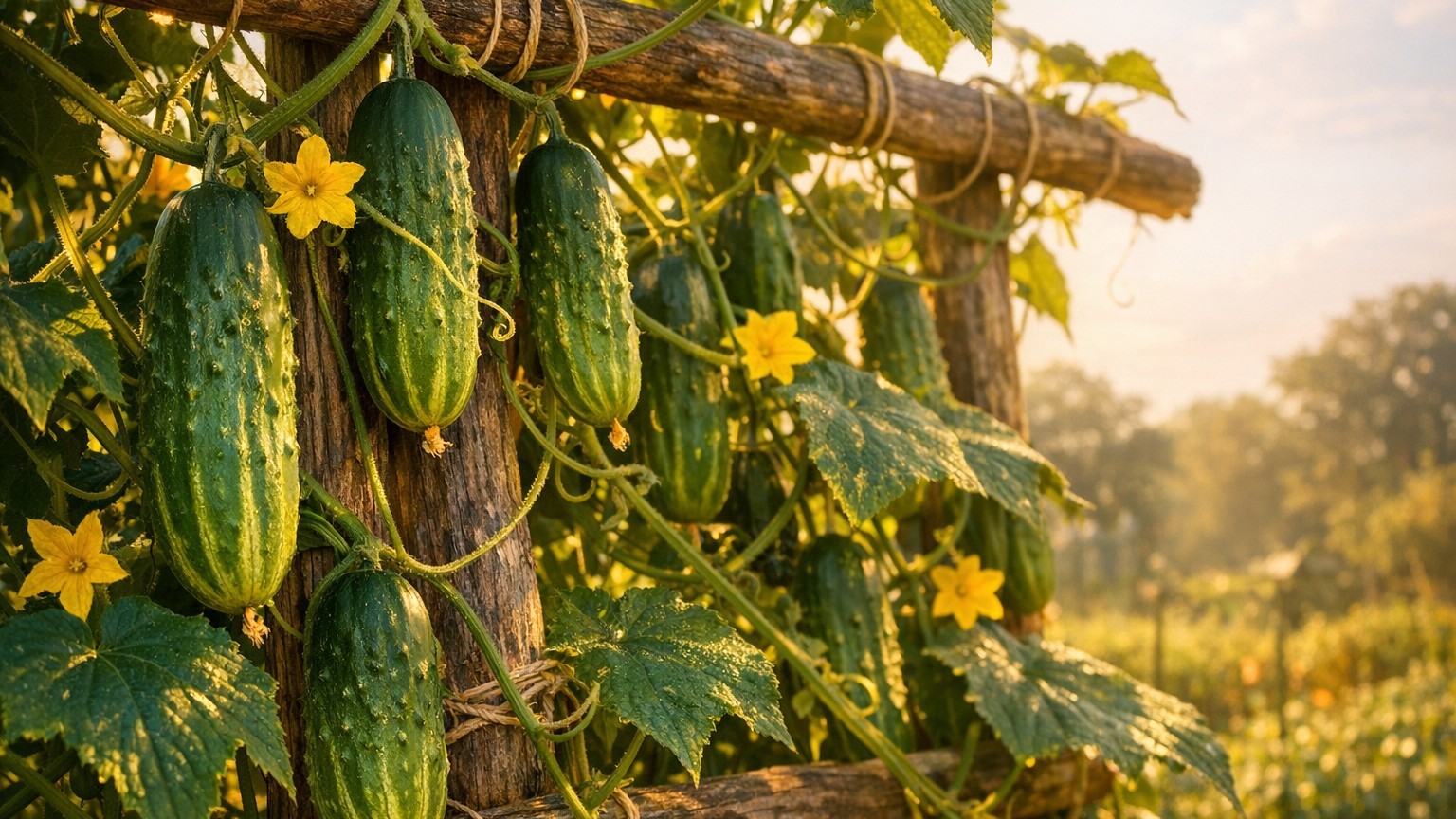

Oklahoma’s long, hot growing season favors nearly every cucumber type, but the state’s 70.7 average days above 90F each year makes heat tolerance the deciding factor. Pickling types, burpless slicers, and parthenocarpic varieties bred to set fruit without pollinators all have an edge here. Bush types work in containers; vining types need the longest stretch of season the calendar allows.
The short answer for Oklahoma
Start with the calendar. At the reference station used for these normals, the last spring frost falls between March 28 and April 10, and the first fall frost arrives between October 29 and November 8. That’s a growing season stretching roughly 200 to 225 days, which is long by national standards and leaves room for any cucumber type, from quick pickling varieties to slow, sprawling vining slicers that need the whole summer to finish.
Length of season isn’t the limiting factor in Oklahoma. Heat is. The state averages 70.7 days a year at or above 90F, and cucumbers are notoriously touchy once temperatures climb past the mid-90s: pollen becomes less viable, blossoms drop before they set fruit, and bees simply retreat to the shade during the worst of the afternoon. That single fact should shape variety choice more than anything else.
By type, here’s how that plays out:
- Pickling cucumbers tend to mature fast and set fruit in flushes, which lets a gardener catch a harvest before the worst heat of July settles in.
- Burpless slicing types generally hold up well to heat stress and keep producing longer into a hot summer than older, thin-skinned slicing types.
- Parthenocarpic varieties, which set fruit without needing pollination at all, sidestep the problem of inactive bees during heat spikes entirely. They’re worth considering for a gardener who has struggled with blossom drop in past summers.
- Bush types suit raised beds, containers, and smaller lots, though they’ll need closer attention to watering since their root systems are shallower.
- Vining types reward the long Oklahoma season with heavier total production, provided they get consistent moisture and something to climb.
None of this replaces a real cultivar name. Oklahoma State University’s Cooperative Extension trials specific varieties for the state’s conditions, county by county, and that’s the list worth checking before buying seed.
What will not work here

The failure most Oklahoma gardeners report isn’t a slow-maturing variety running out of season, since the season here is generous. It’s heat collapse in mid-summer. With 70.7 days a year above 90F, and many of those clustered in July and August, a cucumber planted only once in spring often stalls out for weeks precisely when the garden should be peaking. Growers who plant a single spring crop and expect it to carry them through Labor Day are usually disappointed by August.
Watering on a weekly schedule is the second common failure. Summer rainfall averages only about 11.7 inches across June, July, and August, with July, the hottest stretch, delivering just 3.59 inches. That’s not a drought by national standards, but paired with 70.7 days of heat driving evaporation, it’s not enough to carry a cucumber crop on rainfall alone. Cucumbers are roughly 95% water by weight, and shallow watering once a week leaves roots dry by day four or five in a hot stretch. A single thunderstorm delivering an inch of rain in twenty minutes mostly runs off rather than soaking into the root zone, which means the seasonal rainfall total overstates how much water actually reaches the plant.
Dense planting on the ground
Cucumbers sprawled directly on soil, spaced tightly the way a shorter, cooler season might tolerate, run into trouble here for a different reason. When Oklahoma’s summer thunderstorms leave foliage wet and it doesn’t dry quickly in dense, low plantings, powdery mildew and downy mildew move in fast. Vertical training on a trellis or cage, with real airflow between plants, does more to prevent this than any spray schedule. It’s a simple fix, but skipping it is probably the single most common mistake made in home gardens across the state.
Containers without irrigation support are a third weak point. Bush varieties in small pots heat up faster than garden soil during a 90-plus-degree afternoon, and the root zone can climb well past what the plant tolerates. A container crop needs either daily attention in peak summer or a slow-drip setup; hand-watering once a day in a heat wave often still isn’t enough for a small pot in full sun.
What changes across Oklahoma
Oklahoma is not one climate. The USDA Plant Hardiness Zone Map, built from 1991-2020 average annual extreme minimum temperatures, places the state across a wide 6a-8a range. That’s a genuinely large spread for a single state: it covers a swing in extreme winter minimum temperature of up to 20 degrees Fahrenheit or more between the coldest corner and the mildest.
Practically, that means a gardener in the Panhandle or the northern tier, sitting closer to zone 6a, is working with a shorter frost-free window and a colder late-winter baseline than a gardener in southeastern Oklahoma near zone 8a. The reference-station frost dates used above (late March into early April for last spring frost, late October into early November for first fall frost) come from one location. Elevation, latitude, and even how far a garden sits from the moderating effect of a lake or river all push those dates earlier or later locally.
There is no single frost date or heat-day count that applies evenly across a state this size. A gardener at higher elevation in the western part of the state should expect a shorter window than the reference dates suggest, and should plan for the possibility of a frost showing up a week or two earlier in fall, or lingering a week or two later in spring, than the numbers above indicate.
Where to check this for your own county
Oklahoma State University’s Cooperative Extension Service, at extension.okstate.edu, is the source built specifically for county-level answers that a statewide page like this one can’t provide. It’s run by the state’s land-grant university system, and its recommendations are grounded in actual trial data from Oklahoma soils and Oklahoma summers, not national averages.
Two things are worth pulling up there before planting. First, the local planting calendar for the specific county, which adjusts for the fact that a garden in the Panhandle and one in the southeast simply don’t share a spring. Second, and more useful, the list of cucumber varieties actually trialled and recommended for Oklahoma conditions, by name. That’s the piece missing from any state-level overview: a real cultivar, tested under real Oklahoma heat and humidity, with a track record extension agents can point to.
A county recommendation will always beat a state one, because it accounts for local soil type, local microclimate, and local pest pressure in a way a statewide page never can. The reasoning by cucumber type is tied to the state’s frost dates, heat load, and rainfall pattern. The county extension office, or its published fact sheets, is where that reasoning turns into an actual variety name to buy. Many county offices also take phone calls or emails directly, which is worth using if the published material doesn’t cover a specific situation, like a raised bed on unusually sandy soil or a garden at higher elevation than the rest of the county.
Checking this against your own garden
Every date here is a normal, averaged over thirty years at one weather station. A gardener’s own observations, made right on the plot where the cucumbers are going in, outrank all of it. Three things are worth watching before trusting a calendar over what’s actually happening in the yard.
Soil warmth by feel comes first. Cucumber seed germinates poorly in cold soil, and a hand pressed into the top few inches of bed in mid-morning gives a rough but useful read: soil that still feels cold and damp, even after a week of warm air temperatures, means the ground is lagging behind the calendar, often because of heavy clay, shade, or a low spot that holds moisture.
The first flush of male flowers is the next signal. Cucumbers typically produce several rounds of male flowers before the female flowers, the ones with a small swelling at the base that will become fruit, show up. Seeing only male flowers for a week or two is normal, not a failure, but a long stretch with no female flowers at all during a heat spike is a sign the plant has shifted into heat-stress survival mode rather than fruit production.
The first true leaves, the ones that appear after the two rounded seed leaves, tell a gardener how the plant is handling its actual microclimate. Slow, pale, or stunted true-leaf growth in a spot that should be warm enough by the calendar usually points to a local factor the state averages can’t see, like compacted soil, root competition from a nearby tree, or a cold pocket where air drains and settles overnight even after the official frost date has passed.