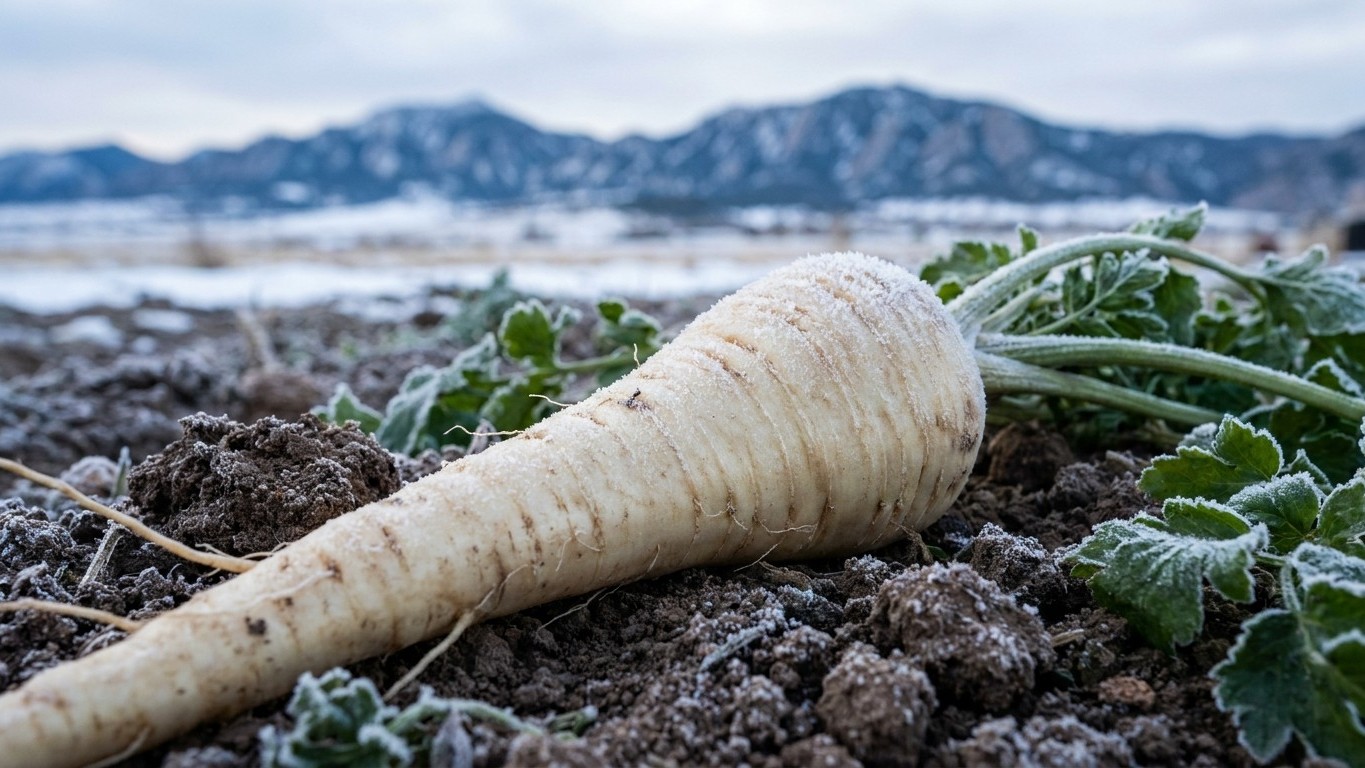

Four insects showing up in Oklahoma parsnip rows do real damage: blister beetles, grasshoppers, green peach aphid, and spider mites. All four are generalist feeders documented in the state by Oklahoma State University Extension, and each one arrives on its own schedule tied to how far the parsnip crop has grown since seeding, not to a calendar month.
Which pests attack parsnip in Oklahoma
Oklahoma State University Extension documents ten insect and mite pests on the state’s vegetable crops overall: blister beetles, Colorado potato beetle, corn earworm, cucumber beetles, grasshoppers, green peach aphid, harlequin bug, spider mites, squash bug, and stink bugs and leaffooted bugs. That’s the full list this service tracks for garden vegetables generally, not a list built for parsnip specifically, and most of it doesn’t belong anywhere near a parsnip bed.
Six of those ten have no business in the row. Colorado potato beetle feeds on nightshade-family foliage (potato, tomato, eggplant), and parsnip’s ferny, carrot-like top growth simply isn’t on its menu. Cucumber beetles and squash bug both specialize on cucurbits, cucumbers, squash, melons, and skip past root vegetables entirely. Harlequin bug sticks to cabbage-family crops. Corn earworm targets corn ears and tomato fruit, and a root crop like parsnip never produces anything resembling a fruit before you dig it. Stink bugs and leaffooted bugs pierce fruit and seed pods with their mouthparts, and a crop harvested for its root before it ever flowers gives them little to work with.
The four that actually feed here
That leaves four generalist feeders that will land on a parsnip planting because they aren’t picky about which vegetable they eat: blister beetles chew ragged holes in foliage and tend to move in groups; grasshoppers do the same on a larger scale once their numbers build; green peach aphid clusters on the undersides of leaves and stunts new growth; spider mites show up in hot, dry stretches and stipple the foliage pale. None of the four attacks the root itself the way a below-ground pest would. All four work on the leafy top, which matters, because parsnip needs that foliage healthy and intact for the full 100 to 120 days it takes to size up a root worth eating.
When each one shows up, and what it does first
Parsnip seed goes straight into the garden bed, no transplanting, sown about two to three weeks before the last frost. At the Oklahoma City reference station, that last spring frost falls somewhere between March 28 and April 10, though a garden outside the city, especially at higher elevation or in a low spot, often sees frost linger a week or two past that. Germination is slow: 14 to 21 days is normal for parsnip seed, so a bare-looking row at day ten hasn’t failed, it just hasn’t finished waking up yet.
Once seedlings are up and the first true leaves unfold, green peach aphid is usually the earliest visitor. It favors the cooler stretch of spring growth, and a gardener typically notices it first as leaves that curl inward and feel tacky, with new growth that looks stunted compared to the rest of the row. As the plants bulk up their foliage through late spring into the warmer weeks, blister beetles tend to arrive next, often in a sudden cluster rather than one or two at a time, stripping leaf tissue down to the veins on a few plants while leaving neighbors untouched.
Spider mites become the concern during the hottest, driest stretch of the frost-free season, when foliage that was green and full starts to look dusty and pale, almost bronzed, especially on plants under any drought stress. Grasshoppers build through the season and peak later, since their populations grow generation over generation as summer wears on, and by the time they’re doing visible damage, the parsnip crop is usually well into its long root-development stretch. With the first fall frost landing between October 29 and November 8 at that same reference station, a crop seeded on schedule is often approaching harvest just as grasshopper pressure is at its highest.
Telling the damage apart from everything else
A parsnip bed can look damaged without a single insect involved, and mistaking one cause for another usually means treating the wrong problem. The forked or split root has two separate possible causes here, and they aren’t the same fix: heavy or stony ground that deflects the taproot as it grows, or overwatering that encourages the root to branch instead of driving straight down. Neither one is an insect problem, and neither responds to anything aimed at a pest.
| What you see | Likely cause | What tells it apart |
|---|---|---|
| Ragged, chewed leaves in clusters | Blister beetles | Beetles visible feeding in groups on a few plants, damage patchy rather than even across the row |
| Curled, sticky leaves, stunted new growth | Green peach aphid | Small soft-bodied insects on leaf undersides, honeydew residue, sometimes sooty mold |
| Pale, bronzed, stippled foliage in hot weather | Spider mites | Fine webbing on leaf undersides, worse under drought stress |
| Skeletonized leaves, large numbers late in the season | Grasshoppers | Insects visibly jumping when the row is disturbed |
| Forked or split root at harvest | Heavy/stony soil, or overwatering | Check soil texture and watering history, not the plant’s top growth |
| Root that tastes bland or starchy even after frost | Not enough exposure to frost, not a hardiness issue | Roots need several weeks of frosty weather to convert starch to sugar; a mild stretch means a fine-looking but flat-tasting root |
| No seedlings visible 10 days after sowing | Normal germination lag | Parsnip seed takes 14 to 21 days; wait before assuming a failed sowing |
If none of these signs match what’s showing up, that’s the point to stop guessing and get a local look at it rather than treating for the wrong thing.
What actually works here, and what is a waste of time
On a crop with a short window and a long, slow root-fill period, timing beats intervention almost every time. A lightweight physical cover set over the row right after sowing, before the seedlings even break ground, keeps blister beetles and early aphids off the most vulnerable growth without anyone needing to identify anything. That cover has to come off before the row gets crowded or before hot weather sets in, since parsnip foliage needs full airflow through the stretch when spider mites become the concern. Handpicking blister beetles works, but they secrete a substance that blisters skin on contact, so it means gloves, not bare hands.
Mowing or clearing weedy edges around the garden ahead of the grasshopper build-up does more than most people expect, since a lot of grasshopper pressure moves in from untended grass nearby rather than starting inside the vegetable bed itself.
What’s a waste of time: spraying anything to fix a root that never developed flavor, or to fix forking. Neither is a pest problem, and no treatment aimed at an insect changes soil texture, watering habits, or how many frosty weeks a root has been exposed to. Treating the foliage late in the season, right before harvest, also does little, since the sweetening that makes parsnip worth growing happens in the ground during cold weather, not on the leaves. For anything beyond covers, hand removal, and weedy-edge cleanup, a specific product recommendation isn’t something to guess at here.
Where to check this for your own county
Everything above comes from Oklahoma State University Extension’s statewide pest documentation, and a statewide list doesn’t tell you what’s actually present in one particular garden. Pest pressure varies from county to county, and even from one side of a yard to the other depending on nearby weeds, past crops, and soil conditions. A grasshopper outbreak two counties over doesn’t mean one is building in a specific backyard.
The next step is a call or visit to the local county office of Oklahoma State University Extension, which can confirm what’s actually showing up in the area this season and roughly when, based on local reports rather than a state-level average. County offices also know what’s legally available for home use in Oklahoma, which matters more than anything a general gardening article can responsibly say.
Bring a photo or a sample if something in the row doesn’t match the descriptions above. That’s a faster path to an answer than working through a list of possibilities alone.
Common questions
Do parsnips need any pollinator protection from row covers?
No. Parsnip is grown for its root and is dug up before it flowers, so covering the row for pest protection doesn’t interfere with pollination the way it would on a fruiting crop.
Can parsnip roots stay in the ground through an Oklahoma winter?
The coldest month at the Oklahoma City reference station averages a daily minimum of 27.0 degrees Fahrenheit, which isn’t harsh enough to rule out leaving roots in place under a layer of mulch, though a hard freeze deeper into the soil in a colder pocket of the state is worth checking locally before relying on it.
Note that this figure describes average conditions, not a guarantee for every yard, and it says nothing about how sweet the roots will taste, only whether they’ll survive.
Does a warmer winter zone mean parsnips won’t sweeten?
A mild winter and a comfortable hardiness zone aren’t the same thing as several weeks of frosty weather. Parsnip sweetening comes specifically from exposure to frost converting stored starch to sugar, not from surviving in a given zone, so a garden that never gets consistently frosty weather can grow a healthy-looking parsnip that stays bland.
Why does the seed row still look empty after a week?
Parsnip seed germinates slowly, typically 14 to 21 days, according to Utah State University Extension. A bare-looking row at seven or ten days hasn’t failed, and re-sowing that early usually just means thinning a doubled-up row later.