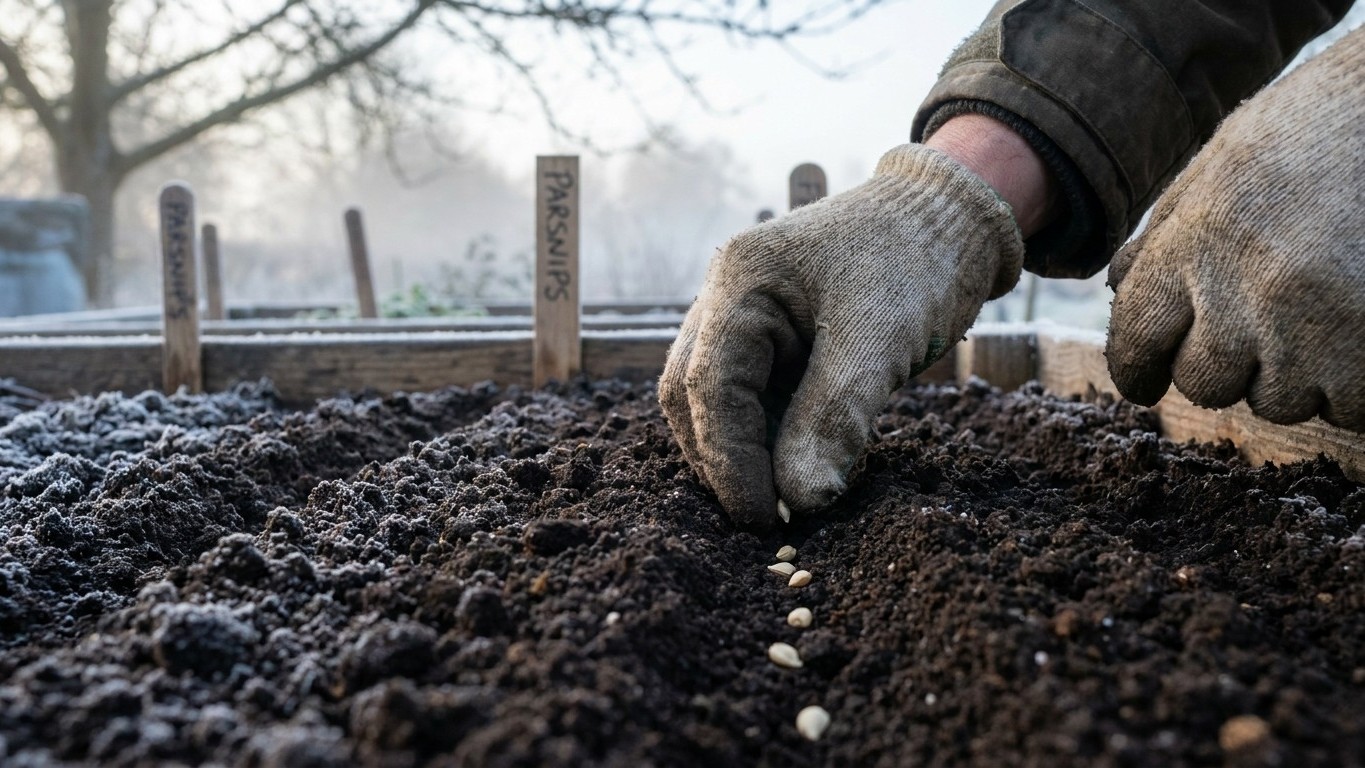

Sow parsnip seed directly in the ground two to three weeks before Oklahoma’s last spring frost, which falls between March 28 and April 10 across most of the state. That puts the sowing window in the first half of March for many gardens, shifting a few days later at higher elevation or in northern counties. Because parsnips are always direct-seeded, never transplanted, this timing decides whether the roots reach full size before summer heat and whether they get the frosty stretch they need to turn sweet.
The short answer
Sowing dates matter, but a parsnip’s flavor comes down to a different question: how cold does winter actually get here. The mean daily minimum temperature in Oklahoma’s coldest month, using Oklahoma City as the reference station, sits at 27°F, according to NOAA NCEI Climate Normals for 1991-2020. That figure isn’t a record low and it isn’t a monthly average. It’s the typical overnight low the region reaches night after night through the coldest stretch of winter, and it tells you something a hardiness zone map never will: whether the ground, and the roots sitting in it, gets cold enough, often enough, to trigger the starch-to-sugar conversion parsnips are grown for.
A mean minimum of 27°F means nights well below freezing are routine, not occasional, through the heart of winter. That’s the kind of sustained cold Utah State University Extension points to when it notes that parsnips taste best after several weeks of cool, frosty weather. One or two overnight dips near freezing won’t do it. What sweetens a parsnip is repeated exposure over an extended stretch, and a coldest-month average minimum in the upper 20s tells you Oklahoma gardens get that stretch most winters.
This is worth separating from the hardiness zone conversation entirely. A hardiness zone describes the coldest temperature a perennial needs to survive winter dormancy. It says nothing about how many frosty weeks a biennial root vegetable actually experiences while sitting in the ground converting starch to sugar. Two gardens can share a hardiness zone and see very different winter patterns depending on how consistently the temperature dips below freezing. In Oklahoma’s case, the coldest-month figure answers the sweetening question directly: yes, a parsnip left in Oklahoma soil through winter gets the frost exposure it needs.
None of that erases local variation. The reference station sits near the middle of the state, and mean minimum temperatures shift with elevation and latitude. Panhandle counties tend to run colder in the coldest month; far southeastern counties tend to run milder. A gardener in the far southeast isn’t seeing quite the same winter as one near the Panhandle. But across the range that shift covers, the coldest month’s typical low stays well below freezing statewide, which is the threshold that matters here. Sow with the calendar in mind, but plan to leave roots in the ground into the cold months, because Oklahoma’s winter does the rest.
Does the season fit?
Parsnips need 100 to 120 days from the day seed goes into the ground, not from transplanting, since this crop is always seeded in place. Germination itself is slow, typically 14 to 21 days, so patience early on matters more than it does with faster vegetables. Stack that full timeline against Oklahoma’s frost calendar and the fit becomes clear.
- Start with the sowing window. Two to three weeks before the last spring frost puts seed in the ground roughly between March 7 and March 27 for gardens near the reference station, where the last spring frost falls between March 28 and April 10.
- Add germination time. Sown March 7 to March 27, seedlings won’t reliably emerge until late March into mid-April, since parsnip seed is slow and often uneven to sprout.
- Count the full 100 to 120 days from the seeding date, not from emergence. A March 7 sowing reaches 100 days around mid-June and 120 days around early July. A March 27 sowing reaches 100 days around early July and 120 days around late July.
- Compare that to the first fall frost, which falls between October 29 and November 8. Even the latest maturity date in this range, late July, leaves roughly three full months before the ground sees its first freeze.
- Read that gap as slack, not wasted time. Parsnips left in the ground past maturity keep gaining size and, more importantly, sit through the cool weeks of fall and the frosty stretch of winter that convert their starch to sugar. Oklahoma’s season doesn’t just meet the 100-to-120-day requirement; it leaves room for the crop to sit through the sweetening period without any risk of the ground locking up before harvest.
The only real tightening happens at the sowing end, not the harvest end. Sow later than the recommended window and the whole timeline shifts later without any extra cushion in the fall, since frost dates don’t move to compensate. Sow on schedule and Oklahoma’s growing season holds more slack than a lot of parsnip-growing regions ever get.
What goes wrong here
- Forked, stubby roots in heavy or stony ground. Oklahoma’s clay-heavy soils, especially in the eastern half of the state, resist the long, straight taproot a parsnip wants to send down. The root hits compacted clay or buried rock and splits into two or three stubby forks instead of one long taproot. Utah State University Extension recommends deep sandy soil for parsnips, and where that isn’t the native condition, double digging the bed a foot or more deep and clearing out stones gives the taproot a clear path.
- Forked roots from overwatering or uneven moisture, which is a separate cause from soil texture and shows up even in loose, sandy beds. Heavy, irregular watering, soaking the bed and then letting it dry out, encourages the same splitting that compacted soil does. Even, steady moisture through the season, rather than deep watering on an irregular schedule, keeps the taproot growing straight.
- A season that runs out before the crop matures. Sowing late, after the two-to-three-week window ahead of the last spring frost has already passed, pushes the maturity date later without adding any extra room at the fall end, since the fall frost date doesn’t shift to accommodate a late start. Sowing on schedule keeps the full 100-to-120-day season available.
- Harvesting before the frost has done its work. Oklahoma’s coldest-month temperatures run cold enough to sweeten parsnips, but only for roots left in the ground through that cold stretch. Digging the crop as soon as it reaches size, before the frosty weeks of late fall and winter arrive, produces a fine-looking parsnip that never converts its starch to sugar. Leaving mature roots in place into the cold months, rather than harvesting strictly by the calendar, is what actually delivers the flavor this crop is grown for.
Common questions
Can I start parsnip seed indoors and transplant it in Oklahoma?
No. Utah State University Extension is clear that parsnips are a direct-seeded crop. The taproot doesn’t tolerate the disturbance of transplanting, and starting indoors offers no real advantage since the 100-to-120-day clock only counts from the day seed goes into its permanent spot in the garden.
My county isn’t Oklahoma City. Do these frost dates still apply?
Treat them as a starting point, not a guarantee. These figures come from the Oklahoma City-area reference station, and suburban and rural gardens elsewhere in the state often see the last spring frost later and the first fall frost earlier than this, sometimes by one to two weeks, more at higher elevation. Check local records before locking in a sowing date.
Should I dig parsnips right after the first fall frost or wait?
Wait. A single frost isn’t what sweetens the crop; it’s several weeks of sustained cold exposure that converts starch to sugar. Oklahoma’s coldest-month temperatures reliably deliver that stretch, so roots left in the ground through the cold months come out sweeter than roots dug right after the first freeze.
What if my garden is mostly heavy clay?
Double dig the bed to loosen soil well below a foot deep, and clear out rocks along the row before sowing. Utah State University Extension points to deep sandy soil as the ideal, and heavy clay is exactly the condition that pushes gardeners toward that extra soil prep to avoid forked, stubby roots.