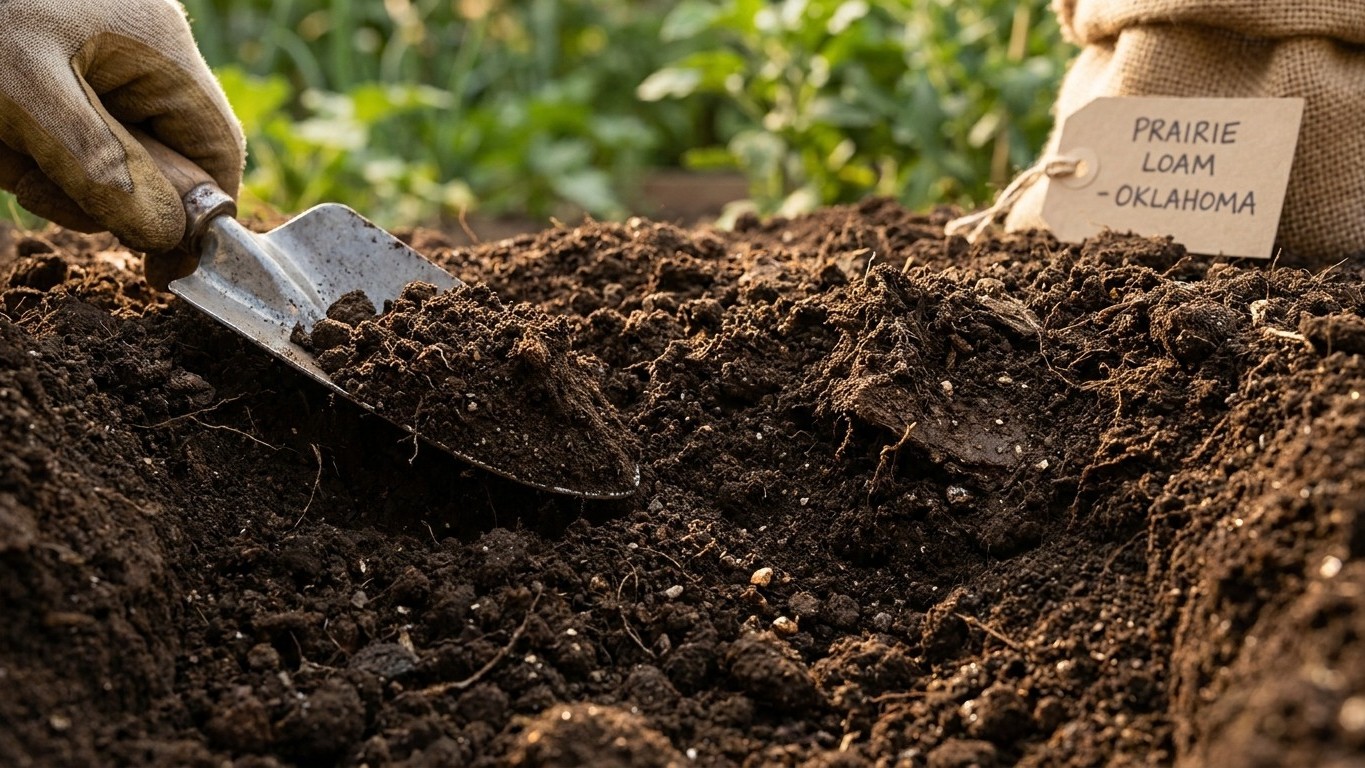

Oklahoma soil mostly means one thing agronomically: a deep, dark, near-neutral prairie loam that drains well and holds its own, at least where the ground hasn’t been graded, filled, or stripped by a bulldozer. That’s the state soil. Your actual backyard is a different question, and you can answer it yourself.
What is under your garden

Oklahoma’s official state soil is the Port series, a Mollisol, the same broad family of deep, dark, humus-rich soils that built the Corn Belt. The Oklahoma legislature named it the state soil in 1987, and USDA NRCS keeps it as the representative profile for the region under its State Soils program. In practical terms, Port soil is what you’d want if you were designing a soil from scratch for row crops or a vegetable garden: it’s deep, it doesn’t fight you on pH, and it drains instead of sitting soggy.
Here are the measured values USDA NRCS records for the surface horizon of the series’ major components, based on 93 sampled components in the Soil Survey Geographic Database:
| Property | Value |
|---|---|
| Surface pH | about 7.0 (near neutral) |
| Sand | 12 percent |
| Clay | 19 percent |
| Silt | 69 percent |
| Organic matter | about 2.0 percent |
| Drainage class | well drained |
That texture breakdown puts Port soil in the loam-to-silt-loam range, dominated by silt rather than sand or clay. It’s the kind of ground that crumbles rather than cracks, and holds moisture without turning to soup.
Now the honest part. Port series is the soil chosen to represent Oklahoma, not the soil sitting under every homeowner’s tomato bed. The state covers hundreds of mapped soil series, and river-bottom ground, hill country, and anything a builder has scraped, graded, or filled will behave nothing like this profile. If your subdivision sits on compacted subsoil from construction, the Port numbers above are irrelevant to your dirt, they describe a natural, undisturbed surface horizon, not a worked bed.
Read your own dirt in five minutes
Grab a handful of moist soil and squeeze it between your thumb and forefinger, pushing it upward into a ribbon. If it won’t ribbon at all and feels grainy, you’re leaning sandy. A ribbon that holds an inch or two before breaking suggests loam. A ribbon that keeps going, shiny and pliable, means you’ve got clay. For a second read, fill a clear jar a third full of soil, top it with water, shake it hard, and let it sit overnight. Sand drops out within minutes, silt settles by a few hours, and clay stays suspended or forms the thin top layer by morning. The bands you see are literally your soil’s mix, sitting in front of you.
Testing before you amend
Dumping lime or sulfur on a guess is one of the more common ways gardeners waste money and time. A soil test measures what your eyes can’t: exact pH, phosphorus and potassium levels, and often organic matter percentage. Given that the region’s benchmark soil runs close to neutral, you can reasonably expect your ground to land somewhere near pH 7, but expecting isn’t knowing, and plenty of yards run acidic or alkaline depending on what’s been added, removed, or built nearby over the decades.
Taking a sample correctly matters more than most people assume. One scoop from one spot tells you about that one spot, not your garden.
- Pick 8 to 10 spots scattered across the bed or lawn area you’re testing, avoiding low spots, compost piles, and anywhere fertilizer was recently dumped.
- At each spot, dig a small core down to about 6 inches, roughly the depth where most vegetable and lawn roots actually feed.
- Drop all the cores into a clean bucket and mix them together thoroughly.
- Pull about two cups of the mixed soil, let it air-dry on a tray or newspaper, and bag it for the lab.
- Label the bag with the bed name and submit it through your county extension office.
When results come back, the pH number tells you which direction to move (if at all), the phosphorus and potassium readings tell you whether you actually need a fertilizer with those nutrients, and organic matter tells you how much your soil resembles that 2.0 percent Port benchmark or falls short of it. Skipping this step means every amendment afterward is a guess dressed up as a plan.
Amending it
The right correction depends entirely on what your own test shows, not on what the state soil profile says in general. Because the Port series benchmark sits close to neutral at pH 7.0, plenty of Oklahoma gardens will come back near that number and need almost no pH correction at all. But real yards vary, and the amendment path splits hard depending on which side of neutral you land.
Lime for acid ground
If your test comes back below about 5.5, lime is the tool, not sulfur. Acid soil locks up phosphorus so plants can’t use it even when it’s present, and it punishes brassicas like broccoli and cabbage particularly hard, stunting growth and inviting clubroot disease. Apply ground limestone according to the rate your test report specifies, and expect it to take one to two full seasons to shift pH meaningfully, since lime reacts slowly as it dissolves through the root zone. Don’t expect results in weeks.
Sulfur for alkaline ground
If your number comes back above about 7.3, lime should never touch that soil, it would push an already alkaline problem in the wrong direction. Elemental sulfur, worked in gradually along with regular additions of organic matter, is the slow but honest fix. High pH is also exactly why iron becomes unavailable to plants even when it’s present in the soil; if you’re seeing yellow leaves with the veins still green (classic iron chlorosis), alkaline pH is very often the actual cause, not a fertilizer deficiency.
Organic matter for the silt loam texture
Port series clocks in at 19 percent clay and 69 percent silt, a texture that holds moisture reasonably well but can compact into a crust if worked wet or walked on repeatedly. Digging in compost, aged manure, or leaf mold every season pushes organic matter up from that 2.0 percent baseline, improving structure and workability regardless of what your pH turns out to be.
Heavy clay ground
If your particular yard runs heavier in clay than the Port benchmark, organic matter is still the answer, never sand, which combines with clay to form something closer to concrete than soil. Never work clay while it’s wet, either; doing so destroys structure that takes years to rebuild.
Sandy ground
Where sand dominates, organic matter helps again, but expect to water shorter and more often, since sandy ground simply won’t hold moisture the way loam does. Texture fixes here take three seasons or more of steady organic matter additions; pH fixes, by contrast, can show real movement within one growing season once lime or sulfur is applied at the right rate.
Drainage and compaction
Port series carries a well drained rating, meaning water that falls on it moves through the profile at a workable pace instead of pooling. Standing water in a garden bed a full day after rain usually signals compacted or heavier soil than the state benchmark, not normal behavior for this region’s representative ground.
You can check your own drainage with a simple percolation test: dig a hole about a foot deep and a foot wide, fill it completely with water, let it drain once, then fill it again and time how fast the second fill drops. More than 2 inches per hour draining that fast usually means sandy, fast-draining ground. Under half an inch per hour points to compacted soil or heavy clay that needs real intervention, not just an amendment schedule.
Foot traffic and heavy equipment compact soil by squeezing out the air pockets that roots and water both depend on, and double digging as a fix has fallen out of favor because it disrupts soil biology and structure more than it helps, while offering only temporary relief. In many cases, especially on ground where drainage tests come back slow and compaction runs deep, a raised bed built with brought-in soil is simply the better bet over spending three seasons fighting native ground that resists every amendment.
- Do: work compost into the top few inches regularly rather than deep-tilling once a year.
- Do: keep foot traffic on dedicated paths, not planting beds.
- Avoid: tilling or digging when soil is wet enough to form a ribbon that holds its shape.
- Consider raised beds for: areas where percolation tests come back under half an inch per hour after repeated tries.
Local help
The Oklahoma State University Extension service runs soil testing for homeowners through county offices statewide. Submit a sample as described above, and staff there will walk through the results with you, translating the numbers into an actual amendment plan for your specific bed rather than a general guess based on the state soil profile.
Common questions
Is my soil the same as the official Oklahoma state soil?
Probably not exactly. The Port series represents the state for USDA’s program, but your yard could sit on entirely different mapped soil, especially if it’s been graded or filled during construction. A soil test is the only way to know your actual numbers.
How often should I retest my soil?
Every two to three years for an established garden bed is reasonable, or sooner after a major amendment like a heavy lime or sulfur application, so you can confirm the correction actually moved the pH as expected.
Can I skip testing and just add compost every year?
Adding organic matter is rarely wrong and helps almost any soil type, but it won’t fix a pH problem on its own, and guessing at fertilizer needs without a test risks over-applying nutrients your soil already has plenty of.
Why does my soil turn hard and crusty after rain?
That’s usually a sign of compaction or a texture heavier in clay than the well-drained Port benchmark. Working in organic matter over multiple seasons and keeping foot traffic off planting beds both help loosen that crust over time.
Related guides
- Kansas Soil: What You Are Digging Into, and How to Improve It
- Missouri Soil: What You Are Digging Into, and How to Improve It
- Oregon Soil: What You Are Digging Into, and How to Improve It
- North Carolina Soil: What You Are Digging Into, and How to Improve It
- Georgia Soil: What You Are Digging Into, and How to Improve It