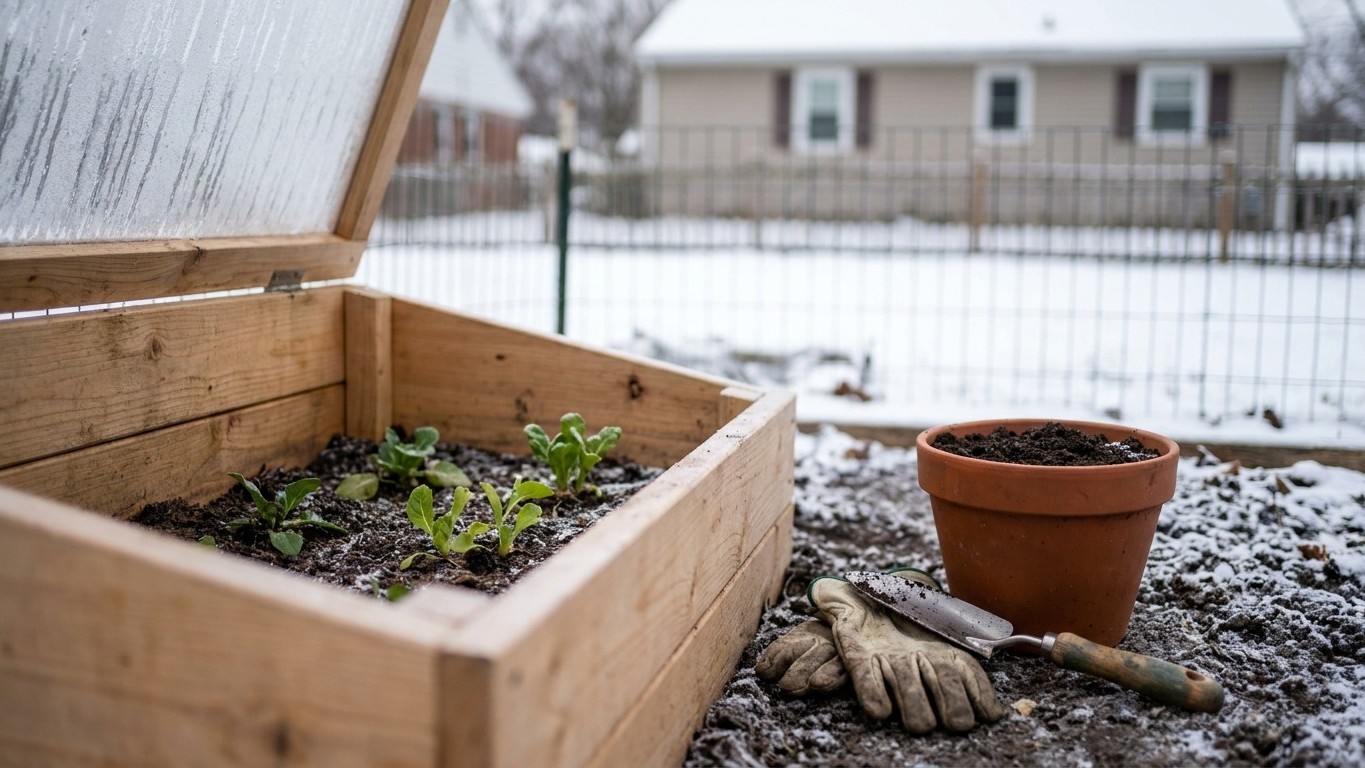

January in Oklahoma keeps the vegetable garden closed to almost everything except garlic and shallots already tucked into workable soil, plus whatever survives under a cold frame or low tunnel. Oklahoma sits in USDA zones 6a to 8a, and the last spring frost at the Oklahoma City reference station runs March 28 to April 10, so the open ground stays off-limits for another two months. That doesn’t mean the garden goes idle. It means the work shifts indoors, into cold frames, and onto the calendar.
What goes in the ground in January
Nothing new goes into bare open soil this month in most of Oklahoma, and pretending otherwise sets a gardener up to lose seed and money. The soil sits cold and often waterlogged after winter rain or snowmelt, and any tender root or seedling set out now simply rots or freezes before it can establish. That’s the honest starting point.
What does still work is narrower but real. Garlic and shallot cloves planted the previous fall can still go in during January if a stretch of open, workable ground shows up between freezes, particularly in the southern tier of the state where soil rarely locks up hard. Bare-root fruit trees, brambles, and grapevines, sold dormant through winter, can be planted whenever the ground isn’t frozen or saturated, since they aren’t actively growing and won’t be shocked by cold snaps the way a leafy transplant would.
Cold frames and low tunnels change the math
Under a cold frame or low tunnel, the picture opens up. Hardy greens like spinach, mache, and claytonia can be direct-sown under cover, since the added protection can push the effective growing zone up by a full step or more. Overwintering onion sets, already started the previous fall, keep growing slowly under this kind of cover rather than being planted fresh now.
Indoors, this is also the month for forcing crops that don’t need sunlight to produce a harvest. Belgian endive roots dug the previous fall can be forced in a dark, cool space to produce pale chicons in a few weeks. Rhubarb crowns can be lifted and forced indoors the same way, giving an early, tender harvest well before anything stirs outside. Neither needs open ground, and both reward the patience this month otherwise demands.
What to start under cover
Seed starting indoors this month works backward from the frost window, not forward from the date on the calendar. With the last spring frost falling between March 28 and April 10 at the reference station, a gardener counts back the number of weeks a given crop needs before it’s ready to move outside, then lands on a start date. Onions and leeks, which need 10 to 12 weeks of indoor growth before transplant, are the earliest candidates and often go under lights this month across much of the state.
Peppers follow close behind, needing 8 to 10 weeks and benefiting from the head start since they’re slow to germinate in cool soil later. Starting too early is the first failure mode: a pepper or tomato seedling begun too soon becomes rootbound and leggy under indoor lights long before the ground outside is warm enough to take it, and a stressed, overgrown transplant rarely outperforms one started on time.
The second failure mode runs the other direction. Waiting too long to start slow crops like onions or celery means they never bulk up enough by transplant time, and the harvest window that follows gets compressed or lost entirely. The fix in both cases is the same: work backward from the frost range for the specific crop, not from a fixed date that ignores what that crop actually needs. A kitchen windowsill or a basic grow light setup is enough for this stage; the goal is sturdy, stocky seedlings, not fast ones.
What is ready to pick
Little comes out of an open Oklahoma garden this month, and that’s worth saying plainly rather than stretching a thin list. What does keep producing is anything left standing under snow or frost cover from fall: kale, collards, and leeks in particular turn sweeter after hard freezes, since the plant converts starches to sugars as a natural antifreeze. A leek left in the ground under mulch can still be dug as needed, and kale leaves picked after a freeze often taste better than they did in fall.
Cold frames extend this further, holding spinach, lettuce, and mache in a harvestable state through most of the winter in milder stretches of weather. Indoors, sprouts and microgreens fill the gap for anyone wanting fresh greens on a shorter cycle: a jar of sprouting seeds or a tray of microgreens on a windowsill produces a harvest in a week to ten days, no outdoor conditions required.
Stored crops need attention now too. Squash, potatoes, and onions put up in fall should get checked monthly: a soft spot on a squash, a sprouting potato eye, or a soft neck on an onion all signal that piece needs to be used first, before it spreads rot to the rest of the bin. Catching one bad squash early can save a whole crate.
The jobs that matter this month
This is the month dormant pruning pays off. Apple and pear trees, along with grapevines and bramble canes, are cut back while they’re fully dormant and the branch structure is visible without leaves in the way. Pruning now, before buds swell, directs the plant’s energy into the branches left behind rather than wasting it on wood that’s about to be removed anyway. Wait too long and the plant has already spent resources on growth that gets cut away.
Seed ordering belongs here too, and the deadline is real even if it doesn’t feel like it. Popular varieties, especially heirloom tomatoes and specific pepper cultivars, sell out from seed catalogs by late winter, and a gardener who waits until March to order is choosing from what’s left rather than what was wanted.
Soil work fills the rest of the month. Testing soil now, through the state extension service, gives results back in time to amend before spring planting, and turning compost piles keeps the decomposition process active even in cold weather rather than letting it stall. Beds and fencing damaged by winter weather get repaired now, while nothing is growing and access is easy. Tools get the same treatment: pruners and shears cleaned and sharpened now cut cleanly come spring instead of tearing plant tissue and inviting disease.
None of this is filler work. A rotation plan sketched out this month, mapping which family of crops goes where, prevents the soil-borne disease buildup that comes from planting the same crop family in the same spot year after year. Skip the planning now, and that decision gets made by default in spring, usually poorly.
What not to do in January
The most common mistake this month is reading a warm afternoon as a signal to plant. A 65-degree day in January doesn’t move the soil temperature enough to matter, and any warm-season seed or transplant put into ground that’s still fundamentally cold sits and rots rather than germinating. The air lies; the soil tells the truth, and only a soil thermometer settles the question.
A related error follows any mild stretch: uncovering cold frames or removing mulch too early because the weather felt like spring. Oklahoma’s frost window runs into April at the earliest per the reference-station data, and a hard freeze after an early uncovering can undo weeks of protected growth in a single night. The safer habit is venting cold frames on warm days without fully removing the cover, then closing them back up as temperatures drop in the evening.
Fertilizing is the third trap. Feeding nitrogen to dormant fruit trees or perennial beds this month does nothing for a plant that isn’t actively growing, and in a mild spell it can actually push premature soft growth that then gets killed by the next freeze. Nitrogen belongs later, once real growth resumes and the plant can use it. Right now, the better move is a soil test to know what’s actually needed, rather than feeding on a guess.
Checking this against your own county
The frost windows and zone range given here come from one reference station and one statewide USDA designation, and Oklahoma is too large and too varied in elevation for either to apply evenly. The Panhandle sits colder and drier than the southeastern corner of the state, and a garden at higher elevation can run one to two weeks behind a low-lying spot not far away. Suburban and rural gardens also tend to see later last-spring frosts and earlier first-fall frosts than an airport weather station reports, sometimes by a week or two.
For a planting window matched to a specific county, the Oklahoma State University Extension Service publishes localized planting calendars and takes soil test submissions: https://extension.okstate.edu/. That’s the better source once the general picture here has answered the broader question.
Common questions
Can garlic still be planted in January in Oklahoma?
Yes, if the ground is workable and not frozen or waterlogged. Garlic planted in fall continues developing roots through winter, and cloves can still go in during January in a pinch, particularly in the southern part of the state.
Is it too early to start tomato seeds indoors in January?
For most of Oklahoma, yes. Tomatoes typically need 6 to 8 weeks indoors before transplanting, and with the last frost falling between March 28 and April 10, starting in January usually produces leggy, rootbound plants well before it’s safe to move them outside.
What can be harvested from an Oklahoma garden in January?
Mostly what survived under cover: kale, collards, and leeks left in the ground, along with anything growing in a cold frame, such as spinach or mache. Indoors, sprouts and microgreens fill the gap on a short growing cycle.
Why shouldn’t nitrogen fertilizer be applied to fruit trees in January?
Dormant trees aren’t actively growing and can’t use the nitrogen, and in a warm spell it risks pushing soft new growth that a subsequent freeze then kills. Fertilizing is better timed to when real spring growth resumes.