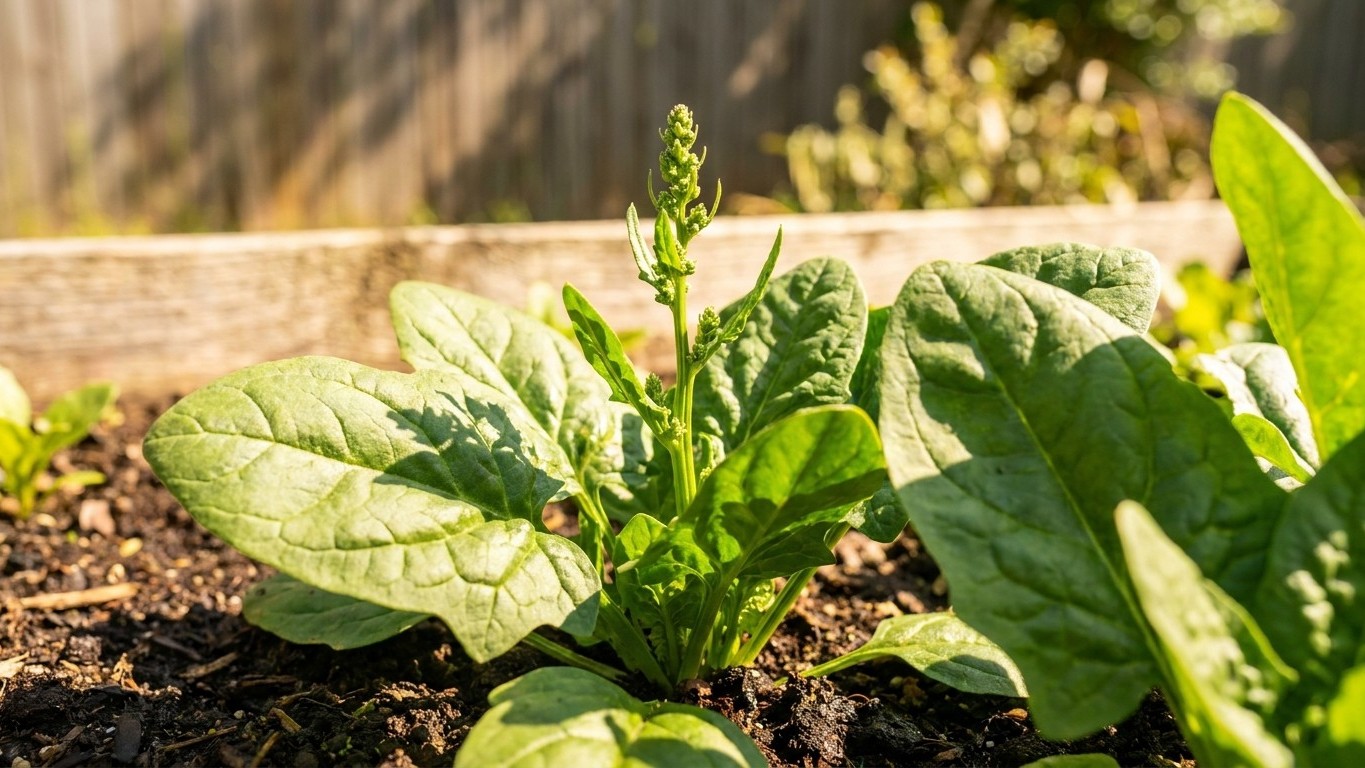

In Oklahoma, spinach bolts early because both triggers line up against it: the summer day length crosses the flowering threshold well before summer heat even builds, and once the heat does arrive, it locks in the bitterness that bolting causes. The growing window here is short on both ends, spring and fall, and the reasons are different each time.
The short answer
On the longest day of the year, the Oklahoma City area gets 14 hours and 24 minutes of daylight. That number matters more than most gardeners expect, because spinach is a long-day plant when it comes to flowering: once days stretch past a certain length, the plant reads that signal and shifts from making leaves to making a seed stalk. A cool summer does not cancel that signal. Day length is day length, regardless of whether the thermometer cooperates or not.
That’s the first mechanism working against Oklahoma gardeners, and it would matter even in a state with mild summers. But Oklahoma doesn’t have mild summers. The reference station near Oklahoma City averages 70.7 days a year at 90 F or hotter, which is a serious heat load by any regional comparison. Spinach grows best where temperatures stay under 75 F, and above that ceiling two things happen at once: growth slows and quality drops, with leaves turning sharp and bitter well before the plant actually sends up a flower stalk. So the limit in Oklahoma isn’t day length alone, and it isn’t heat alone. It’s both, arriving close together, each one closing the door a little further.
Think of it as two separate clocks ticking at the same time. The day-length clock runs on its own schedule no matter what the weather does, and it doesn’t care whether the sky is cloudy or the season feels cool. The heat clock runs on however hot the actual weather gets, and in Oklahoma that clock runs fast starting in May. By the time both clocks reach their limit, spinach has usually already started bolting, sometimes before a gardener even notices the first flower stalk poking up from the center of the plant.
What this means practically: Oklahoma gardeners aren’t fighting one problem, they’re fighting a combination. Waiting for a cooler week won’t help if the days are already long enough to trigger flowering. And even if a plant somehow avoided bolting, the leaves would already be turning bitter once temperatures push consistently above 75 F. The workaround isn’t finding a way around either threshold, it’s timing the crop so it grows and finishes before either threshold becomes a problem. That’s what the spring and fall windows below are built around.
How long the spring window really is
Spinach seed should go into the ground 2 to 3 weeks before the last expected spring frost, while soil is still cool and germination is easy. From there, the plant needs to make its full leaf growth before the twin threat of long days and rising heat catches up to it. Here’s how that window plays out around Oklahoma City:
- The reference station’s last spring frost falls between March 28 and April 10, though the caution here matters: that’s an airport-station figure, and suburban or rural gardens in the same county often see frost linger one to two weeks later, especially at higher elevation. Check local conditions before committing to a date.
- Working back 2 to 3 weeks from that last-frost range puts the sowing date somewhere in the second week of March, sometimes earlier in a mild year, sometimes into the very start of April for gardens that run cooler than the station average.
- From that sowing date, the plant has roughly six to eight weeks before the daylight length and rising spring temperatures both start working against it. Given 70.7 days a year already reaching 90 F, Oklahoma’s spring doesn’t stay mild for long. Afternoon highs regularly climb past the 75 F growth ceiling by late April, and the day length keeps stretching every single day regardless of temperature.
- That leaves a realistic harvest window from roughly early April through mid-to-late May, depending on exactly when sowing happened and how quickly that particular spring warms. Some years give a slightly longer stretch; some years cut it shorter if a warm spell arrives early.
- Once the calendar reaches late May, the odds of pushing spinach further without bitterness or bolting drop fast. Most Oklahoma gardeners treat late May as the practical end of the spring crop, not because of a single date but because both thresholds, day length and heat, have usually already been crossed by then.
So the honest answer for spring: about six to eight weeks of good growing, bookended by a frost date that shifts by county and a heat ceiling that Oklahoma reaches earlier than most states farther north.
The autumn crop, and when the soil lets you sow
Fall spinach in Oklahoma runs into a different pair of obstacles than the spring crop does. Instead of racing daylight and heat forward, the fall planting has to wait for the ground to cool down enough to work, then get established before frost shuts things down. Both ends of that window are narrower than they look at first glance.
Soil still too warm to germinate
Utah State University Extension notes that spinach seed germination drops off once soil temperature climbs above 80 F. That’s the real obstacle to an early fall sowing in Oklahoma, not the calendar and not the cold. Late summer soil here, after a stretch that regularly hits 90 F degrees more than 70 times a year, stays warm well past Labor Day in most years. Sowing into soil that’s still sitting above that 80 F mark usually means poor, patchy germination, or none at all. The practical move is to wait until soil has cooled meaningfully, checking it directly rather than guessing from the air temperature alone, since soil lags behind air by days or weeks depending on shade, mulch, and rainfall.
Counting back from first frost
The source Utah State University Extension gives no fixed days-to-maturity number for spinach; instead it recommends planting 50 to 75 days before the date a gardener wants to harvest. The reference station’s first fall frost falls between October 29 and November 8, again with the same caution that outlying gardens often see frost arrive one to two weeks earlier than the airport figure suggests. Using October 29 as a conservative harvest target, counting back 50 to 75 days lands the sowing window somewhere between mid-August and early September. Using the later end of the frost range, November 8, stretches that sowing window a little further into September.
The problem is that this sowing window overlaps directly with the period when soil is often still too warm to germinate well. Mid-August soil in Oklahoma is rarely below 80 F. That squeezes the practical fall window down to a narrow stretch, roughly late August into early September, where soil has finally cooled enough for reliable germination but there’s still enough time left before frost for the plant to size up. Gardeners who sow too early lose the crop to poor germination; those who wait too long risk frost cutting the harvest short. Watching soil temperature directly, rather than relying on the calendar alone, is the more reliable approach here.
Four varieties come up often in spinach discussions, Bloomsdale, Melody, Teton, and Olympia, but no performance data, days-to-maturity figures, or bolt-resistance ratings for any of them are published in the source used for this page. Naming them is useful context; claiming specific results for one over another here would not be.
Common questions
Can shade cloth delay bolting in Oklahoma?
Shade can lower leaf temperature and reduce some heat stress, which may help with the bitterness that comes from crossing the 75 F growth ceiling. It does nothing for day length, though. The flowering trigger runs on daylight hours, not on how much sun actually reaches the leaf, so shade cloth won’t stop bolting once the days have grown long enough.
Does a cooler-than-average Oklahoma summer buy extra weeks for spinach?
Not on its own. Day length and heat are two separate signals. A mild summer might ease the bitterness that comes with high heat, but the day-length trigger for bolting keeps advancing on its own schedule regardless of temperature.
Why does the first fall frost date matter more in rural counties than the station figure suggests?
The station figures come from an airport weather station, and outlying gardens, especially at higher elevation or in low-lying cold-air pockets, often see frost arrive earlier in fall and later in spring than that station records, sometimes by one to two weeks. Treat the published range as a starting point, not a guarantee for a specific yard.
Is there a published days-to-maturity number for spinach that Oklahoma gardeners can rely on?
No fixed days-to-maturity figure appears in the Utah State University Extension source used here. The guidance given instead is to plant 50 to 75 days before the target harvest date, which is the figure used to work out the fall sowing window above.