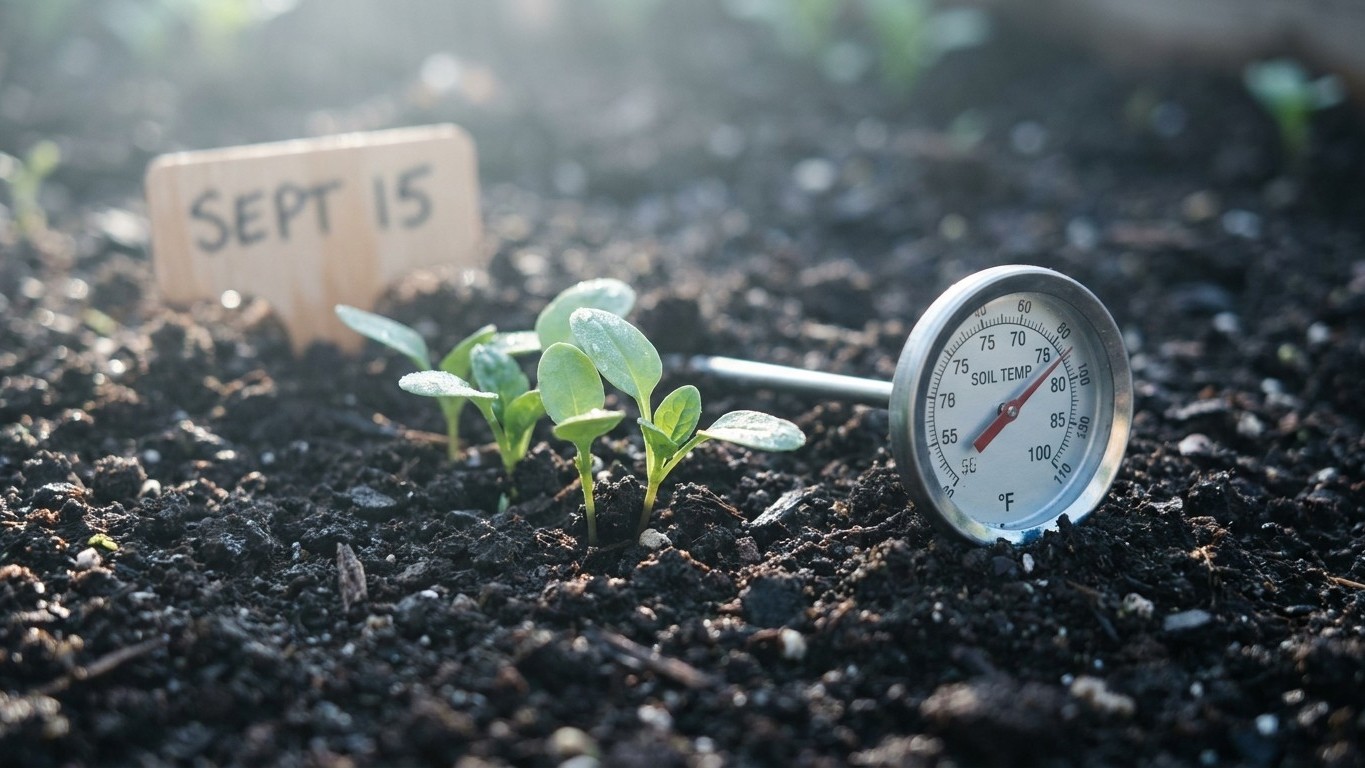

In Oklahoma, autumn spinach goes into the ground roughly from mid-August through late September, once the soil has cooled down from summer’s peak. The exact start depends on how fast your particular patch of ground drops below 80 F, and the exact end depends on how many weeks of growth you need before the first fall frost, expected between October 29 and November 8 at the Oklahoma City reference station.
The short answer
Oklahoma City sees 14 hours and 24 minutes of daylight on the longest day of the year. That number matters more than most gardeners realize, because spinach bolts on long days as reliably as it does on hot ones. A cool, cloudy summer will not buy extra weeks here. Once the days stretch out, the plant reads that signal and starts sending up a seed stalk, regardless of whether the thermometer cooperates.
That puts Oklahoma spinach growers in a squeeze from both directions. Day length pushes the plant toward flowering through late spring and early summer, right as the state’s heat load builds. The reference station logs an average of 70.7 days a year at or above 90 F, a heat tally that outpaces most of the Midwest and nearly all of the upper Great Plains. Spinach grows best below 75 F and starts turning bitter and stalky above it, so by the time day length alone would be a problem, the heat has usually already made the case moot.
So is the limiting factor day length, heat, or both? In Oklahoma, it’s both, and they arrive close together. Spring sowings get a short runway before the combination of lengthening days and rising heat shuts the crop down. Autumn sowings dodge the day-length problem, since days are shortening as the crop matures, but they run straight into a different wall: soil that’s still too warm from summer to let seed germinate well.
This is why fall spinach tends to be the more forgiving crop for Oklahoma gardeners, even though it feels counterintuitive to plant a “spring green” in late summer. The day-length trigger works in your favor come autumn. The heat trigger is the one you have to manage, and that means watching soil temperature rather than the calendar.
Bloomsdale, Melody, Teton, and Olympia are varieties commonly grown by home gardeners in this region, though no maturity or heat-tolerance data for any of them is published by the source used for this guide. Choosing among them comes down to availability and personal preference rather than any documented performance edge for Oklahoma conditions specifically.
How long the spring window really is
Working out the usable spring window in Oklahoma means stacking a few pieces of information on top of each other, in order.
- Start with the last frost. The reference station’s last spring freeze falls between March 28 and April 10. Sowing spinach 2 to 3 weeks ahead of that date puts seed in the ground sometime in mid-to-late March for most Oklahoma gardens, though rural and elevated sites often see frost linger one to two weeks longer, which pushes the sowing date back to match.
- Add the growth ceiling. Spinach performs well only while temperatures stay under 75 F. Oklahoma’s spring doesn’t hold at that level for long. With 70.7 days a year reaching 90 F or better, the state’s warm season builds fast once it gets going, and April afternoons can already flirt with the upper 70s in many years.
- Factor in day length. Even if the heat cooperated, the days are lengthening steadily through April and May, moving toward that 14-hour-24-minute peak. Long days alone are enough to push spinach toward bolting, so the crop is fighting two triggers at once by late spring.
- Net result. The realistic spring window in Oklahoma runs from sowing in mid-to-late March to harvest by late April or very early May. That’s a narrow stretch, often just five to six weeks of usable growth before quality drops and the plants start reaching for a seed stalk.
That narrow window is exactly why so many Oklahoma gardeners shift their attention to the fall planting instead. It sidesteps the double bind of rising heat and lengthening days that makes spring spinach such a race against the calendar here.
The autumn crop, and when the soil lets you sow
Fall spinach in Oklahoma isn’t blocked by cold. It’s blocked by heat still lingering in the ground long after the air has started to feel like autumn.
Soil still too warm to germinate
Spinach seed germinates poorly once soil temperature climbs above 80 F, according to Utah State University Extension. In a state that averages 70.7 days a year at 90 F or hotter, ground temperatures often stay elevated well into late summer, even after daytime air temperatures start to ease. This is the real obstacle to an early fall sowing in Oklahoma: the calendar might say September, but the soil can still be running hot from a summer of sustained heat. Mulched beds, beds under partial afternoon shade, or beds watered consistently in the weeks prior will typically cool faster than bare, sun-baked soil, which matters when you’re trying to time a sowing around a temperature threshold rather than a date.
Racing the first frost
Once the soil has cooled enough to germinate reliably, the other end of the window comes into focus. Utah State University Extension recommends sowing a fall crop 50 to 75 days before the date you want to harvest, and no more specific days-to-maturity figure is published for spinach by that source. Working from Oklahoma’s first fall frost, expected between October 29 and November 8, that guidance points to a sowing window running from roughly mid-August (for the 75-day end of the range, aiming at an early-November harvest) through late September (for the 50-day end, aiming at a late-October harvest).
Put the two obstacles together and the practical Oklahoma fall window sits somewhere in mid-to-late August, once soil temperatures have started to drop from their summer peak, extending through mid-September for a shorter-season harvest before frost arrives. Gardeners in cooler microclimates, at higher elevation, or with well-shaded beds may be able to start a little earlier; those in exposed, heat-holding urban or suburban sites may need to wait toward the back half of that window for the soil to cooperate. Checking soil temperature directly with a simple probe thermometer, rather than guessing from air temperature, is the most reliable way to pick the actual sowing day.
| Season | Limiting factor | Typical Oklahoma window |
|---|---|---|
| Spring | Long days plus rising heat (75 F ceiling) | Sow mid-to-late March; harvest by late April/early May |
| Autumn | Warm soil (above 80 F blocks germination) then first frost | Sow mid-August through mid-September; harvest before Oct 29-Nov 8 |
Common questions
Can spinach handle a light frost in Oklahoma?
Spinach is a cool-season crop and tolerates cold better than heat, but the only frost figures published here for the Oklahoma City reference station cover the standard 32 F freeze date, expected October 29 to November 8. No separate light-frost or hard-freeze threshold is documented in this guide, so treat that window as the practical marker for planning your fall harvest.
Why does my spinach bolt even when the weather isn’t that hot?
Because day length triggers bolting on its own, separate from temperature. Oklahoma City’s longest day runs 14 hours and 24 minutes, and once the days stretch anywhere close to that, spinach can start flowering even during a mild stretch of weather. That’s the mechanism that makes spring sowings so time-limited here.
Does the fall sowing window shift in rural or elevated parts of Oklahoma?
Likely yes. The frost dates used in this guide come from the Oklahoma City airport station; suburban and rural gardens, and anything at higher elevation, tend to see the first fall frost arrive earlier and the last spring frost linger later, often by one to two weeks. Check your own county’s typical frost pattern before locking in a sowing date.
Is there a published days-to-maturity number for spinach varieties like Bloomsdale or Teton?
Not from the source used here. Utah State University Extension names varieties such as Bloomsdale, Melody, Teton, and Olympia without giving maturity data for any of them, and no seed-company figures are used in this guide. The 50-to-75-day rule for counting back from your target harvest date is the only timing guidance available.