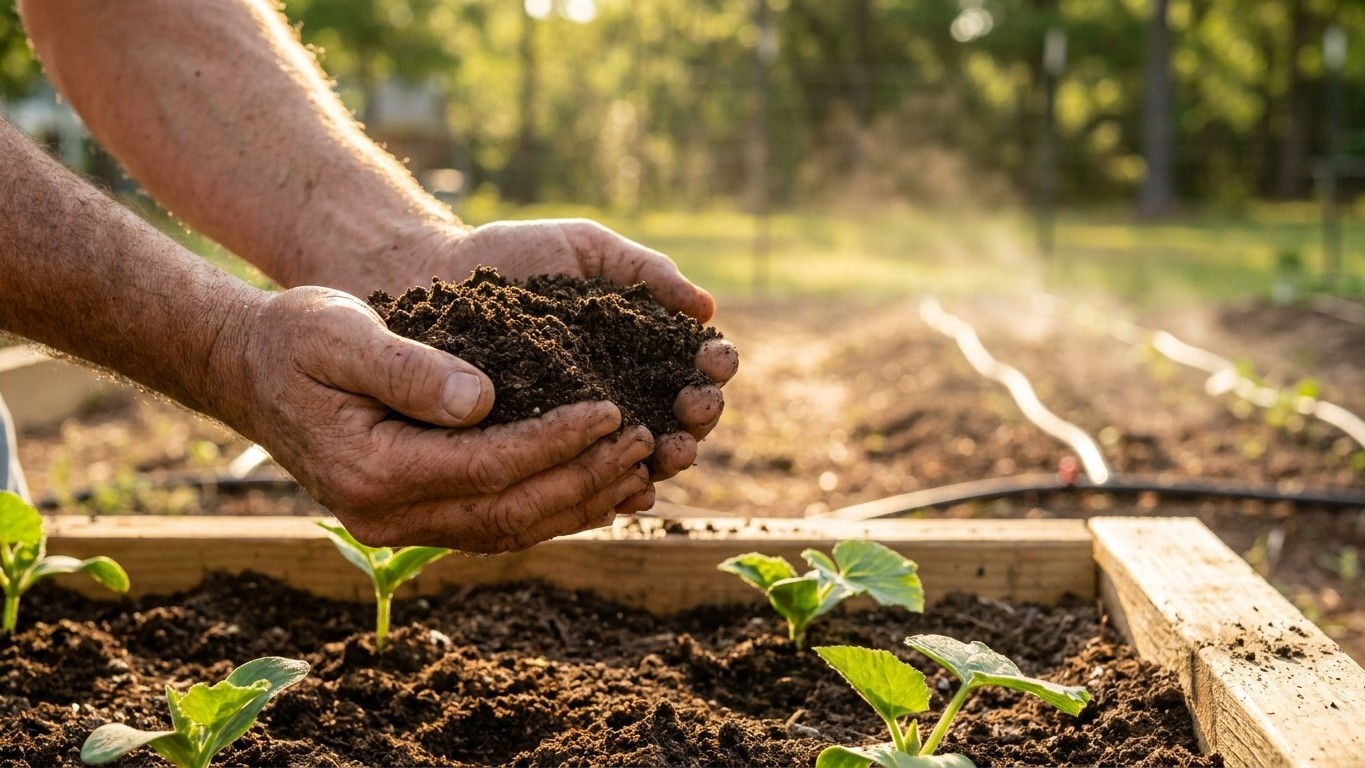

In most of Oklahoma, summer squash goes in the ground once the soil itself has warmed, typically from mid to late April, rather than on a fixed calendar date. The state’s USDA Hardiness Zone spans 6a to 8a, but for this fast-growing, frost-tender crop, the soil thermometer matters more than the zone map ever will.
When the soil is warm enough in Oklahoma
At the Oklahoma City reference station (USW00013967), NOAA’s 1991-2020 Climate Normals put the last spring frost somewhere between March 28 and April 10. That’s a probability window, not a promise: it marks the period when a 32°F freeze has a 30 to 70 percent chance of occurring, which means some years the risk clears earlier, and some years it lingers past April 10.
Frost dates get quoted so often that gardeners start treating them as the answer. They’re really just a proxy. Summer squash doesn’t care about air temperature at 2 a.m.; it cares about soil temperature at seed depth, and soil takes time to catch up once the frost risk fades. A patch of ground can sit at 55°F well after the last freeze has passed, and squash seed sown into cold, damp soil tends to rot before it sprouts rather than get a head start.
The practical move is to let the last-frost window pass, then wait for a stretch of consistently warm days before direct-seeding or setting out transplants. A soil thermometer pushed a few inches into the bed tells you more than any date on a chart. And that suburban or rural garden a few miles outside the reference station? It likely sees frost linger later in spring and arrive earlier in fall than the airport station shows, sometimes by one to two weeks, more at higher elevation. Treat the March 28 to April 10 figure as a starting point for Oklahoma City itself, then check local patterns before committing seed to ground.
Raised beds and black plastic mulch can nudge soil temperature up faster in a slow spring, which matters in a state where a cold snap can follow a warm stretch with little warning. Beyond that, the tools are simple: patience, a thermometer, and a plan for what to do if pests show up once seedlings emerge (row cover over young plants beats reaching for a spray, and it costs nothing to try first). For the varieties actually trialled in Oklahoma conditions, the state’s Cooperative Extension Service keeps current recommendations, and that’s a better source than any general guide.
How long the season lasts here
Put the two NOAA frost windows side by side and Oklahoma’s frost-free season takes shape. The last spring frost falls between March 28 and April 10; the first fall frost arrives between October 29 and November 8. Using the more conservative end of each range (April 10 to October 29), the safe growing window runs about 202 days. Stretch it to the earlier last frost and later first frost (March 28 to November 8), and the window widens to roughly 225 days. Either way, that’s somewhere around six and a half to seven and a half months of frost-free ground.
| Milestone | Date range | Source |
|---|---|---|
| Last spring frost | March 28 – April 10 | NOAA NCEI, station USW00013967 |
| First fall frost | October 29 – November 8 | NOAA NCEI, station USW00013967 |
| Approximate frost-free window | 202 to 225 days | Calculated from the two rows above |
A window that long changes the math on how you grow squash, not just when. It’s generous enough that a single spring planting isn’t the only option. Summer squash matures fast enough that a gardener who sows in late April can often fit in a second sowing in mid to late summer, timed to finish well before the first fall frost arrives. That second round tends to dodge the peak of early-season squash bugs and squash vine borers too, since their populations often build through the first planting.
It also affects the transplant-versus-direct-seed decision. With this much season to work with, there’s little pressure to rush transplants out early just to squeeze in a harvest. Direct-seeding once soil has warmed avoids the root disturbance that summer squash, with its brittle taproot, tends to resent. Where the window were shorter, that calculus would flip toward transplants to bank a few extra weeks. For the specifics of staggering plantings through the season, the succession sowing guide on this site walks through timing a second and even third round.
Heat and water in Oklahoma
The Oklahoma City reference station averages 70.7 days a year at or above 90°F, and that number does more to shape a squash harvest than most gardeners expect. Above the high 90s, squash pollen loses viability fast, flowers open and close without setting fruit, and a plant that looked loaded with blossoms can produce almost nothing during the hottest stretch of July or August. This isn’t a rare edge case in Oklahoma; with over 70 days a year crossing that threshold, it’s a routine mid-summer event across much of the state.
Rainfall doesn’t offset the heat load the way a gardener might hope. Summer rainfall at the same station averages about 11.7 inches across June, July, and August, broken down as 4.49 inches in June, 3.59 in July, and 3.6 in August. July, the driest of the three and often the hottest, is exactly when squash plants need water most. Their leaves are enormous relative to their root systems, a shallow, spreading network that dries out quickly once temperatures climb. Big leaves lose moisture fast; shallow roots can’t keep pace with the demand.
That combination, meaningfully high heat and a summer rainfall total that’s real but unevenly timed, makes irrigation the deciding factor more than the seed packet does. A few practices matter more than any product:
- Deep, infrequent watering that reaches the root zone, rather than light daily sprinkling that only wets the surface
- A layer of mulch to slow evaporation between waterings, especially through July’s dry stretch
- Afternoon shade cloth during the worst heat spikes, which can preserve pollen viability and reduce plant stress without cutting off the light the plant needs earlier in the day
It’s worth remembering that 3.59 inches of July rain rarely arrives as a gentle, soaking week. More often it comes as a thunderstorm or two, dumping heavily and running off rather than soaking in, especially on compacted or clay-heavy soil. A rain gauge on the actual plot tells a gardener more than the monthly average ever will, since a single storm can inflate the number while the soil between storms stays bone dry.
Which summer squash suit Oklahoma
Given a season long enough for two plantings, summer heat that regularly tops 90°F for over ten weeks a year, and rainfall that’s decent on paper but unevenly distributed, three traits matter more than any variety name: earliness, tolerance for heat stress at flowering, and airflow around the plant to limit disease pressure from humid spells after a storm.
Types bred or selected for early maturity make the most of that first spring window before peak heat arrives, often setting a first flush of fruit before the worst of July’s pollen-killing temperatures hit. Bush-type growth habits, as opposed to sprawling vines, tend to handle Oklahoma’s heat better simply because they allow more air movement around the leaves and fruit, which matters after a heavy rain when foliage stays wet longer in still air. And because summer storms can bring a burst of humidity even in a state that isn’t classically humid, types with some resistance to powdery mildew and other common squash diseases hold up better through a long season than those without.
None of that points to a specific variety, and that’s deliberate. Naming one here would mean guessing at what performs well in Tulsa clay versus Panhandle sand, or what a particular seed house happens to be selling this year, neither of which this page can verify. Oklahoma State University’s Cooperative Extension Service (extension.okstate.edu) maintains variety trial data drawn from actual Oklahoma growing conditions, updated as new cultivars come through, and that’s the only recommendation worth trusting for a specific name. A county extension office can also speak to what’s held up locally against squash vine borer and bacterial wilt, two pressures that vary block by block more than any statewide guide can capture.
The type-level decision, then, comes down to matching the plant’s habits to this territory’s particular squeeze: a season that rewards speed, a summer that punishes heat-sensitive flowering, and rainfall that shows up unevenly enough to make disease resistance and airflow worth prioritizing over any other single trait.