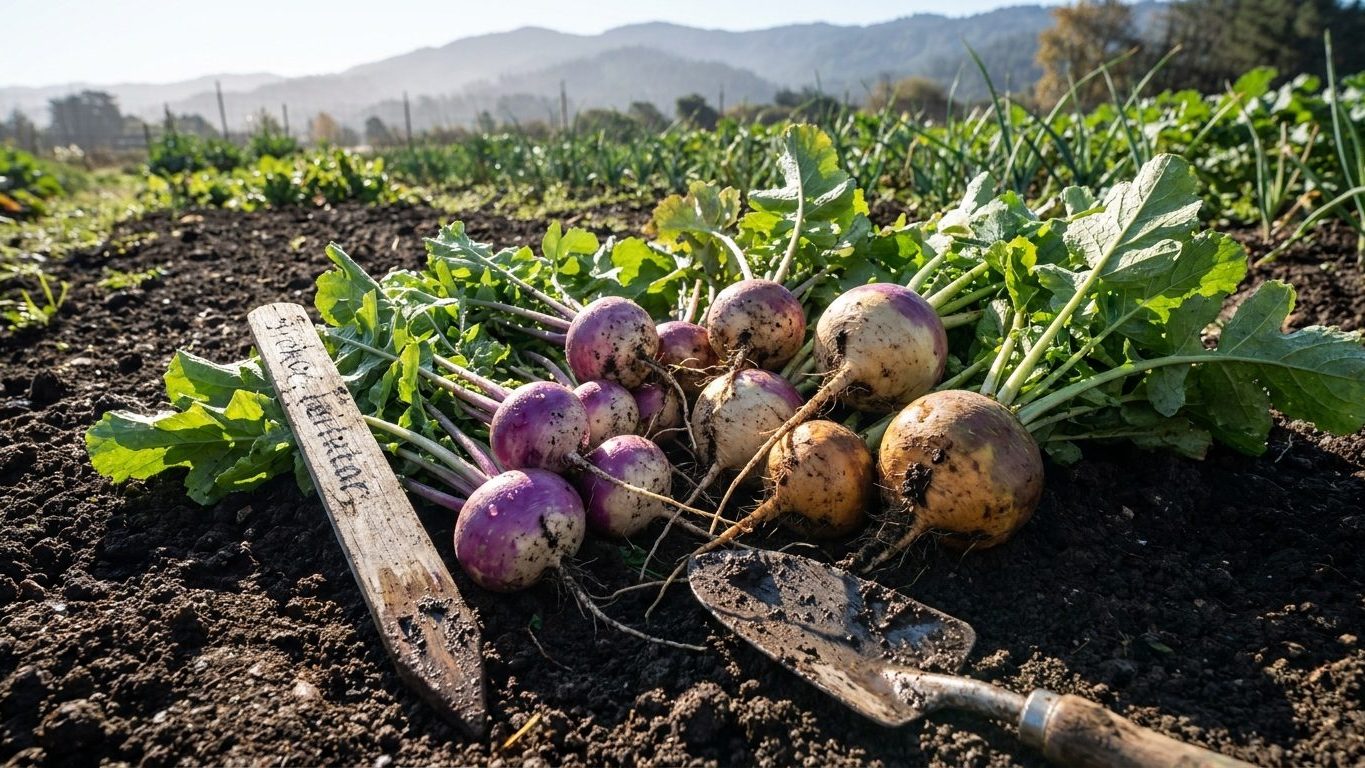

Plant fast-maturing turnips in Oklahoma, and plant them in fall. Treat rutabaga as a fall experiment, not a staple. Summer heat arrives before most spring-sown roots finish sizing up, while autumn cools gradually and the first freeze comes late. This page sorts the varieties by type and says what tends to fail. The full growing guide is Growing Turnips and Rutabaga in Oklahoma.
The short answer for Oklahoma
Choose quick globe turnips and Japanese-style salad turnips first, a leafy greens turnip second, and a early-maturing rutabaga only if you have room to gamble. Fall sowing is the main event for all of them. A spring planting works for the quickest types, but the window closes fast.
The calendar explains why. At the Oklahoma City airport reference station, the last spring frost falls between March 28 and April 10. Those dates mark the band where the chance of a 32°F freeze sits between 30 and 70 percent, based on NOAA’s 1991-2020 normals. They are odds, not a promise. In fall, the same band runs from October 29 to November 8. A garden away from the airport, especially in the suburbs or the country, usually freezes later in spring and earlier in fall, often by one to two weeks. Elevation widens that gap.
Turnips are cool-season roots that shrug off light frost. A late-October or early-November first freeze therefore leaves a long runway for fall crops, and the winter is mild enough that the coldest month averages a daily minimum of 27.0°F at the reference station. Spring offers no such runway. Once warm weather settles in, the roots turn pithy and strong-tasting, and the plants head toward flowering.
Choosing by type
The table sorts common types by what they do well here. The names are examples of widely sold varieties, not a trial result. This page does not have Oklahoma county trial data, which is why the extension step below matters.
| Type | Examples | Role in Oklahoma |
|---|---|---|
| Quick globe turnip | Purple Top White Globe | Best all-round choice; fall crop, short spring window |
| Japanese salad turnip | Hakurei | Fastest to harvest; fits a narrow spring gap or early fall |
| Greens turnip | Seven Top | Grown for leaves; fall sowing, picked into the mild winter |
| Rutabaga | American Purple Top | Fall only, sown as early as heat allows; a gamble |
Exact sowing dates are on the companion page, When to Sow Turnips in Oklahoma. The type you pick matters more than the brand on the seed packet.
What will not work here
Slow rutabaga sown in spring fails first. Rutabaga needs a long stretch of cool weather to bulk up, and Oklahoma’s spring runs out of cool weather quickly. With the last frost as late as April 10 at the reference station (later in many yards), a spring-sown rutabaga has almost no room before heat stalls it. You get a tough, small, bitter root. If you want rutabaga at all, aim for fall and accept that the heat of late summer will make germination and early growth the hard part.
A once-a-week watering habit fails next. Hot, dry stretches are normal here, and turnips punish uneven moisture. A bed that dries out, then gets a soaking, produces split and woody roots, and seedlings in summer-warm soil can crisp up between waterings. Fall sowing helps because the weather cools as the crop grows, but newly sown seed still needs the surface kept evenly damp until it sprouts. Mulch after thinning keeps that moisture steadier.
Close spacing causes trouble in the eastern, more humid part of the state. Crowded foliage stays wet, and fungal leaf problems follow. A hot-and-humid stretch in early fall can turn a thick stand of greens into a mess. Thin to the spacing on the seed packet, even when it feels wasteful.
Sowing too early in spring is another trap. A warm spell in March tempts people to plant, but the frost band runs through April 10 at the reference station. Young turnips tolerate light frost, though a hard cold snap after a mild stretch can push them to bolt, which wastes the whole planting. Sowing in a window where a freeze is still a 30 to 70 percent proposition invites that risk.
Finally, don’t count on the garden as cold storage in every corner of the state. The coldest-month minimum of 27.0°F at the reference station is mild, but it is an average, and the USDA hardiness system measures the extreme low, not the average. Roots left in the ground through a deep freeze can be damaged, so mulch them or pull them before a hard cold snap.
What changes across Oklahoma
Oklahoma is not one garden. The USDA Plant Hardiness Zone Map (2023, built on 1991-2020 normals) places the state in zones 6a through 8a. That is a spread of five half-zone steps, built on a single variable, the average annual extreme minimum temperature. No single answer fits the whole state, and the Oklahoma City figures on this page describe one reference city, not your yard.
Move north and the season tightens. In the northern tier and in the high Panhandle, expect the last spring frost to arrive later and the first fall frost to arrive earlier than the reference dates. A fall crop there should go in sooner, and a spring planting has even less margin. The reference station gives March 28 to April 10 and October 29 to November 8, and a northern or high-elevation garden should read those as optimistic.
Move south and east and the opposite holds. The fall window stretches, so a later sowing still has time to size up, and a winter harvest of greens or roots is more realistic. The cost is more humidity in the east, which is why spacing and airflow matter more there. Rutabaga has its best (still modest) chance in these warmer, longer-fall areas.
Which end of the 6a to 8a range you sit in is a question for the USDA map, not this page. Look up your ZIP code on the official Plant Hardiness Zone Map and use the result to decide how far to shift the reference dates, earlier in the north and higher ground, later in the south.
Where to check this for your own county
Oklahoma State University Extension is the state’s land-grant extension service, and it has county offices. A county recommendation beats a state one, because it accounts for local soil, rainfall, and frost patterns that no statewide page can capture. This page is the state version.
When you check, look for two things. First, a local planting calendar for fall and spring root crops, ideally one tied to your county’s frost dates. Second, any list of varieties that were trialled or recommended in your area. Those trials show which turnips and rutabaga actually performed through Oklahoma heat and dry spells, which a seed catalog cannot tell you.
If a county office has no turnip-specific material, ask which fall root crops its horticulture staff recommend for your soil and what sowing dates they suggest. Their answer outranks the dates here. Frost-date tables also run on a different system than hardiness zones, so check which one a source is using before you copy a date.
Checking this against your own garden
Your own observations beat every date on this page. Three are worth watching, and none needs an instrument.
- Soil warmth by feel. Push a hand into the bed in early fall. If the soil still feels hot, wait; if it feels pleasantly cool, seed will germinate more evenly. A bed in afternoon shade cools sooner than an open one, which tells you which corner to plant first.
- First true leaves. After the rounded seed leaves, the first true leaves signal that the seedling has taken hold. If they appear slowly and the plants look stressed, the bed is too hot or too dry for that sowing.
- Where frost shows up first. Note which part of the yard has frost on the grass first in the fall. Low spots frost earlier and later in spring, so that is where the reference dates are least reliable.
Keep a few notes from one season to the next. A garden’s own pattern, built over two or three fall plantings, will tell you more than any airport reading.
Common questions
Can I grow rutabaga in Oklahoma?
Yes, with caveats. Sow it in fall, as early as the heat allows, and keep it evenly watered. Spring-sown rutabaga usually runs out of cool weather before the roots size up. Treat it as an experiment next to a dependable turnip planting.
Which turnip is best for greens?
A greens-type turnip such as Seven Top is bred for leaves rather than roots. Sow it in fall and harvest leaves through the mild months. Check with your county extension office for what has been trialled locally.
Should I plant turnips in spring or fall?
Fall gives the better result in most of Oklahoma. A spring crop is possible with a fast type like Hakurei, but the window between the last frost (March 28 to April 10 at the reference station) and summer heat is short.
Do turnips survive an Oklahoma winter?
Turnips tolerate light frost, and the reference station’s coldest-month minimum averages 27.0°F. A hard freeze can still damage roots left uncovered, especially in the north. Mulch them or harvest before a deep cold snap.