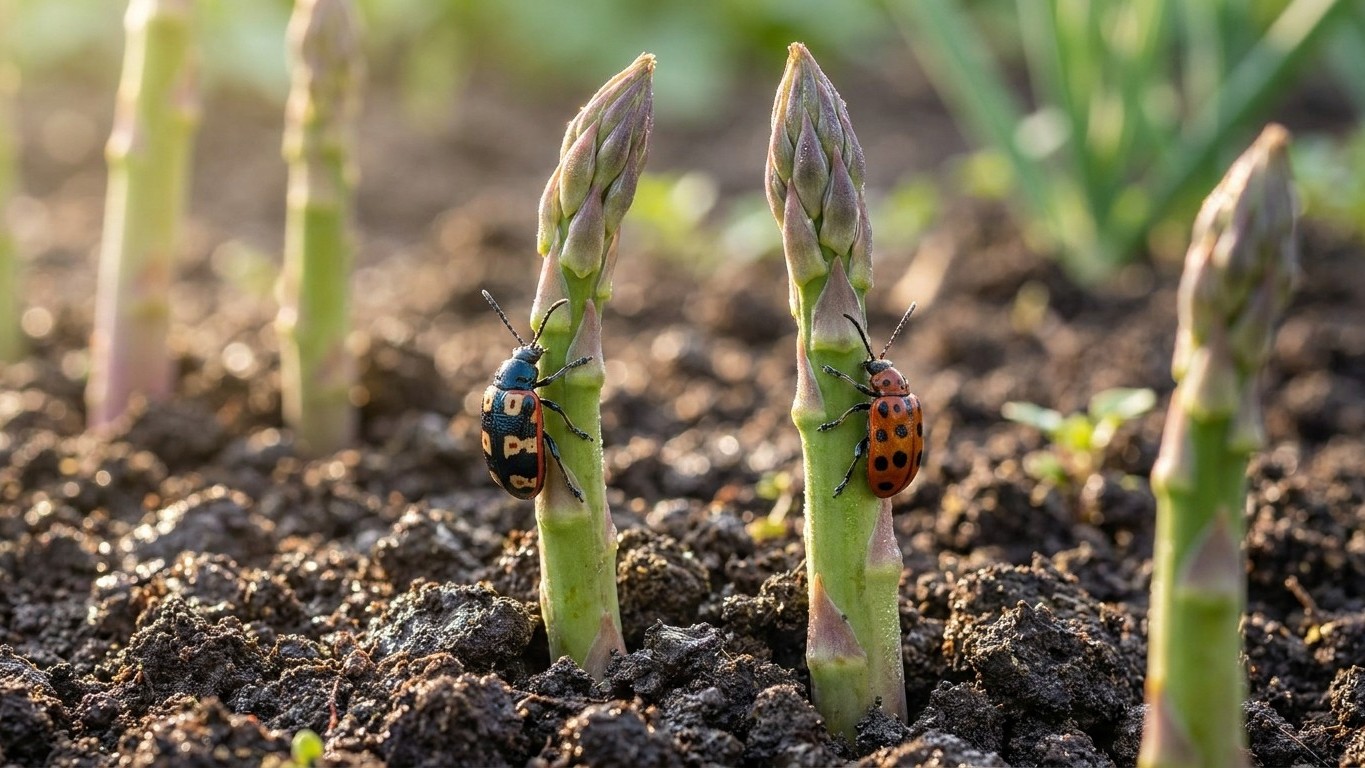

Nothing in the sources behind this page names an insect, a deer or a vole. The only authority here, Utah State University Extension, describes the bed itself: crowns planted in early spring, no harvest until year 3, then 10 to 15 years of spears, on soil that drains. This page covers what decides whether an Ontario bed lasts that long: ground, water and timing. For pest identification, a photo of the damage sent to your local provincial agriculture extension office beats a guess. The wider picture is in Growing Asparagus in Ontario.
The short answer
A tomato bed gets a do-over every April. An asparagus bed does not. Once the crowns are in, that spot is committed for 10 to 15 years, and the source’s only soil requirement is that the ground be well drained. Most soils will do if they are. That makes drainage a one-time decision rather than a yearly nuisance you can amend your way out of.
Ontario’s dominant profile is a good starting point. Among the mapped surface layers in the Canadian Soil Information Service data, the commonest soil order is Luvisol, at 39 percent of the mapped surface, with Gleysolic next. A Luvisol is a forest soil where clay has moved down out of the surface layer, leaving the top lighter and the subsoil denser. The median surface reading is loam to silt: 43 percent sand, 17 percent clay and 41 percent silt, with organic matter around 4.3 percent. The survey classes it as well drained. The median pH is about 6.5, slightly acid, though that describes the province’s surface layers, not your bed, and the asparagus source gives no pH target to compare it against.
So does the typical Ontario soil drain well enough? On the surface, yes. A loam-to-silt top layer with that much sand in it is not the kind of ground that holds a puddle for a week. The thing to check is what sits underneath. A denser subsoil is the Luvisol’s defining trait, and water that cannot move down has to go somewhere. The 8-inch furrow the crowns go into sits within the surface layer, which is the part that behaves well, but you should confirm how it behaves in your own yard.
That matters because the median hides a lot. The survey covers the province’s agricultural regions, so the far north is not represented. River bottoms, muskeg and any lot a builder has scraped, filled or compacted can differ completely from the profile above. Gleysolic soils, the second-commonest order, form under wet conditions, which is a reminder that poor drainage is common enough in Ontario to plan for.
A simple check costs nothing. Dig a hole about as deep as the furrow, fill it with water, and look again the next day. Standing water means the spot fails. The fix is to build the bed up above grade or move it to higher ground, not to dig deeper and hope. Pair that with a soil test for your own numbers, and read Will Ontario Soil Hold an Asparagus Bed for Fifteen Years? before you commit the spot.
Will the summer here water it for you?
Partly. The bed wants 1 to 2 inches (roughly 25 to 50 mm) every other week for the first two years, then every three weeks after that. Ontario’s summer rain gets you some of the way there, and the gaps are where the garden hose comes in.
- Start with what falls. At the Toronto Pearson reference station, June, July and August together bring 226 mm (8.9 inches) of rain, out of 785 mm (30.9 inches) for the whole year. June is the driest of the three at 71 mm (2.81 inches). July runs 2.98 inches and August 3.07. These are normals for one station, drawn from a thirty-year period that ends earlier than the one used for the US figures on this site, so the two are not directly comparable.
- Set that against the target. Spread evenly, a June of 71 mm works out to a little over an inch per fortnight, the low end of what the bed wants. In an average stretch, rain covers the minimum and you add little. In a dry fortnight, you supply the whole 1 to 2 inches.
- Remember that averages do not fall evenly. A single summer thunderstorm can deliver a month’s share in an afternoon, and much of it runs off instead of soaking in. Hot days, especially at or above 90°F, pull the moisture back out through evaporation. A normal summer total can still leave the bed thirsty between storms.
- Read your own soil. The same inch of rain behaves differently on sand and on clay. A sandy surface lets it through within the day, while a clay one holds it for a week. A loam-to-silt top layer sits between the two, but a sandy lot may need water well before the calendar says so.
- Let a rain gauge settle it. Normals describe what a region can usually expect, not your garden. A slope, a city heat island or a lake breeze changes the picture. Put a gauge on the plot, and if it shows less than an inch for the fortnight, add the difference. After two years, make that check every three weeks.
When to put the crowns in
Early spring. That is all Utah State University Extension says about timing, and it gives no calendar date, so the frost record has to anchor it. At the Toronto Pearson station, the last spring frost falls on average around April 30. That is a mean, not a safe date. In roughly one year out of two the last frost comes later, so treat it as the middle of a window. This is also one station. Northern and upland districts run weeks behind it, and a garden near the lake may see something different again.
The crowns go into furrows 8 inches deep. Backfill them gradually over the year, about 2 inches every other month, instead of filling the trench at once. Then comes the hard part: no harvest in years 1 and 2, and none in year 3 either until the bed has earned it. In year 3 the harvest runs 4 weeks, then 6 weeks the next year, then 8 weeks. Do not soften that into “taking a few spears”. The end-of-season rule is an object, not a date: stop cutting when most of the spears are thinner than a pencil.
Variety choice is thinner than nursery catalogues make it look. The source names four and gives only their sex. Jersey Giant and Jersey Knight are all-male. UC 157 F1 and Purple Passion are male/female. No flavour, yield or reason to prefer one is published, so any claim you hear for one over another does not come from this source.
The alternative to crowns is starting from seed. The source covers crowns only and gives no seed timetable, so follow the packet’s own instructions and expect a slower start than buying crowns. Seed or crown, the bed’s timeline for the first cut does not shrink. For month-by-month detail, see When to Plant Asparagus Crowns in Ontario.
Common questions
What eats asparagus in Ontario?
The sources used for this page do not list pests, so none are named here. If you see chewed spears or damaged ferns, bring a photo or sample to your local provincial agriculture extension office for an identification instead of guessing.
When can I first harvest?
Not until year 3. Then the harvest runs 4 weeks, then 6, then 8 in following years. Stop when most spears are thinner than a pencil. The bed then produces for 10 to 15 years.
Does Ontario soil drain well enough for asparagus?
The dominant profile does: it is a well-drained loam to silt at the surface. Your own lot may not match it. A hole filled with water that is still standing the next day means the spot fails, and a raised bed or a different location is the answer.
How do I store spears once I cut them?
The target, per UC Davis Postharvest, is 0°C to 2°C (32°F to 35.6°F) with air at 95 to 100 percent humidity. Both edges bite. Above 10°C (50°F), spears toughen within hours. At -0.6°C (30.9°F) or lower they freeze and go soft. In a home kitchen, stand the cut ends in water, since the spears lose moisture through the cut end faster than anywhere else.