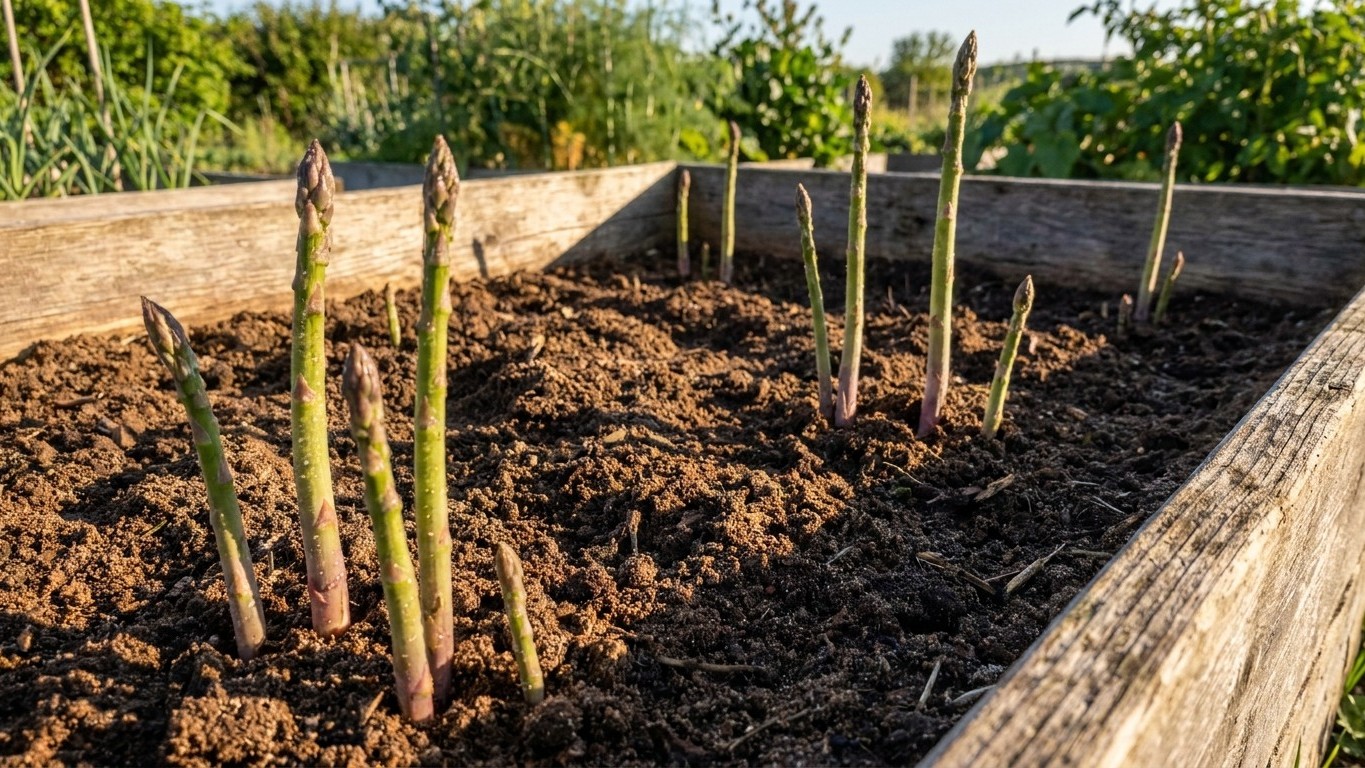

Yes, in most cases, an Ontario garden can carry an asparagus bed for its full ten-to-fifteen-year run, but the deciding factor was never the province’s average soil profile. It’s whether that one patch of ground drains. Asparagus tolerates a wide range of soils, according to Utah State University Extension, on one strict condition: the roots can’t sit in standing water. Ontario’s dominant soil clears that bar on paper. Your own yard still needs its own check.
The short answer
Start with what “fifteen years” actually means for the gardener, not just the calendar. Utah State University Extension is specific: crowns go into 8-inch furrows, and there is no harvest at all in the first two seasons. The plant needs that time to build a root system strong enough to feed a decade and a half of spring cutting. Year three brings the first harvest, and even then it’s brief, about four weeks. Year four stretches to six weeks, year five to eight. After that, the rule for when to stop cutting each spring isn’t a date on a calendar at all: you stop when most of the spears coming up are thinner than a pencil, whatever week that happens to fall in. Once the bed matures, it keeps producing for 10 to 15 years total. That’s the commitment: a spot you can’t rotate to tomatoes next season because the crop didn’t perform.
Against that timeline, the soil requirement Utah State names is almost anticlimactic: most soils will work, provided they’re well drained. Ontario’s most common mapped soil, based on Agriculture and Agri-Food Canada’s Canadian Soil Information Service, is a Luvisol, a forest-formed soil where clay has washed down out of the topsoil layer over time, leaving a lighter surface and a denser subsoil beneath it. It covers 39 percent of the province’s mapped agricultural surface, more than any other order (Gleysolic soils are second). The typical texture runs 43 percent sand, 17 percent clay and 41 percent silt, a loam-to-silt-loam mix, with a median surface pH around 6.5 and organic matter near 4.3 percent. Classified drainage: well drained.
That’s a reasonable starting point for asparagus. It is not a diagnosis of your particular yard. A province spans hundreds of soil types, and the median tells you nothing about a low corner of the lot, a spot near a downspout, or ground a builder filled and compacted during construction. If a test hole fills with water and stays wet for more than a few hours after a hard rain, that’s your answer regardless of what the province-wide numbers say. In that case, the fix isn’t to abandon the crop, it’s to raise the bed, working in enough organic matter and building the row up several inches above grade so the crowns sit above the standing water rather than in it.
Will the summer here water it for you?
- What the establishment years demand: for the first two seasons after planting, Utah State University Extension calls for 1 to 2 inches of water every other week. Stretched across a summer month, that works out to roughly 2 to 4 inches, delivered on a fairly strict schedule rather than whenever rain happens to fall.
- What Ontario’s summer actually delivers: Environment and Climate Change Canada’s 1981-2010 normals for the Toronto Pearson station put summer rainfall at about 8.9 inches across June, July and August combined, roughly 2.81 inches in June, 2.98 in July and 3.07 in August.
- Doing the math: month for month, that’s close to the low end of what a young bed asks for, sometimes slightly under it in June, the driest of the three months and the one that falls squarely in the middle of the growing season. The totals look sufficient on paper, but rain rarely falls in the tidy, evenly spaced doses a new asparagus row wants; a single thunderstorm can dump an inch in an hour and run off before it soaks past the surface, especially on the denser subsoil layer typical of the province’s Luvisols.
- What that means for the first two years: treat the monthly average as a floor, not a guarantee, and keep a rain gauge on the bed itself. If two weeks pass without a soaking rain, add water rather than assuming the season’s numbers will average out in your favor.
- What changes once the bed matures: from year three onward, the requirement drops to 1 to 2 inches every three weeks, a noticeably lighter demand. At that lower rate, an established bed in most Ontario summers will get by on rainfall alone in an ordinary year, with supplemental watering reserved for genuine dry spells rather than a routine chore.
When to put the crowns in
Crowns go into the ground in early spring, and in this part of Ontario that means working around a mean last spring frost date of April 30, drawn from Environment and Climate Change Canada’s 1981-2010 normals for the Toronto Pearson station. That word “mean” matters: it’s the midpoint of a range, not a guaranteed safe date, and by definition frost arrives later than that average in roughly half of all years. Anyone north of the Toronto area, or on higher ground, should expect the window to run later still. Treat late April as a planning anchor, not a date to circle and trust blindly.
The planting mechanics themselves are straightforward but not instant. Crowns are set into furrows about 8 inches deep, and rather than filling that furrow in all at once, Utah State University Extension describes backfilling it gradually over the course of the year, adding roughly 2 inches of soil back into the trench every other month as the young shoots grow. That staged approach protects the emerging crown while still letting it push upward into daylight.
For gardeners who’d rather skip crowns entirely, seed is the alternative route, though the source doesn’t lay out a specific seed-starting calendar, so anyone going that way is better served checking with a local extension office for regional timing than guessing at it. Variety selection is limited to what’s actually published: Utah State University Extension names four, split only by their pollination type, with no comment on flavor, yield, or which performs better in which climate.
| Variety | Type |
|---|---|
| Jersey Giant | All-male |
| Jersey Knight | All-male |
| UC 157 F1 | Male/female |
| Purple Passion | Male/female |
All-male varieties are bred to skip seed production, which some gardeners prefer since the plant puts its energy into spears rather than berries, though the source stops short of stating that as a recommendation. No nursery or supplier is named here; that choice is left to the gardener.
Common questions
Does soil pH matter for asparagus in Ontario?
Ontario’s dominant mapped soil runs a median surface pH of about 6.5, slightly acid. Utah State University Extension’s guidance doesn’t specify a target pH for asparagus, so no pH recommendation is offered here; a standard soil test remains the way to know your own garden’s number.
Can asparagus handle Ontario winters?
The source used for this article is silent on winter chilling requirements for asparagus, and a hardiness zone number isn’t a substitute for a published chilling figure. That detail simply isn’t available here, so it isn’t guessed at.
How long before I get a real harvest?
Not until year three, and even then only a brief four-week window. Cutting extends to six weeks in year four and eight weeks in year five, at which point the bed has reached its mature harvest length for the rest of its productive life.
What if my particular yard doesn’t drain well?
Province-wide, the dominant soil is classified well drained, but that’s a regional tendency, not a guarantee for any one lot, particularly on filled or compacted ground near new construction. If a test hole holds water for hours after rain, building a raised bed with added organic matter solves the problem better than planting into wet ground and hoping.