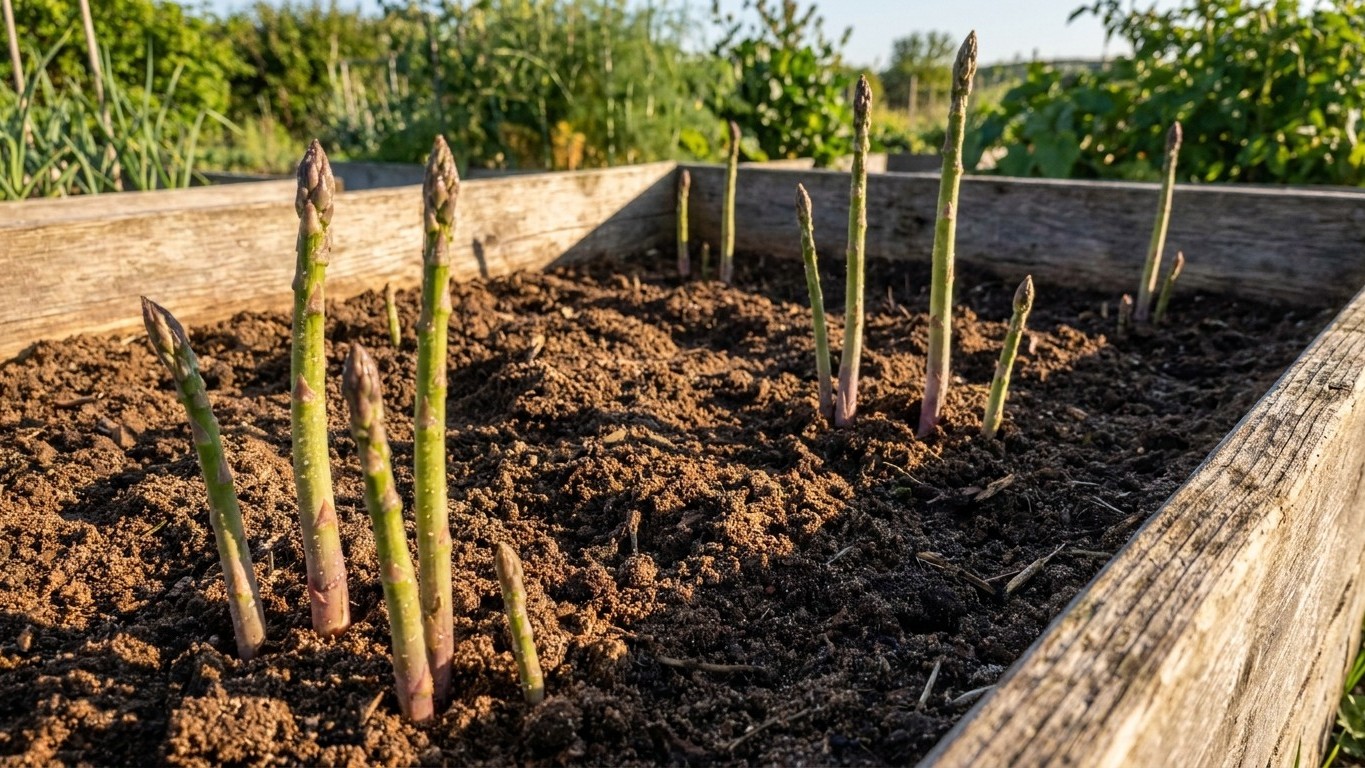

Oregon’s answer is yes, with one condition attached. The state’s official soil, the Jory series, drains well by the book, and drainage is the single soil requirement an asparagus bed asks for before it commits to a decade and a half in one spot. The commitment is real: a bed planted this year won’t give a full harvest until year three, and after that it keeps producing for ten to fifteen years. What decides whether Oregon ground can carry that plan isn’t the calendar. It’s whether water moves through the soil or sits in it.
The short answer
The Jory series is what Oregon law names as the state’s official soil, and it tells a fairly specific story. It’s an Ultisol, meaning it’s old, heavily weathered, and stripped of a lot of its original mineral wealth by centuries of rain moving through it. USDA’s Soil Survey Geographic Database puts its surface texture at 14 percent sand, 34 percent clay, and 52 percent silt, with organic matter running about 5.0 percent and a surface pH near 5.6, slightly on the acid side. Despite the clay content, NRCS classifies it as well drained. That’s the number that matters most here, because a fifteen-year asparagus bed can tolerate a lot of things, but standing water isn’t one of them. Utah State University Extension is blunt about it: most soils will grow asparagus fine, provided they drain.
That “well drained” label describes the Jory series as mapped, not the dirt behind any one house. A state soil is a representative average pulled from 119 sampled components, not a verdict on a backyard. Oregon runs from Willamette Valley clay loams to river-bottom silt to fill dirt behind a newer subdivision, and any of those can behave nothing like the official series. The only way to know a specific garden’s drainage is to dig a hole about a foot deep, fill it with water, and time how long it takes to disappear. Water still standing after several hours is a signal to treat the drainage question seriously before crowns go in the ground.
If the ground doesn’t drain
A gardener working heavier, slower-draining ground doesn’t need to give up on asparagus. Raised beds or mounded rows lift the crowns above the saturation line, and working several inches of compost or coarse organic matter into the planting trench opens up structure without changing the underlying soil. A slightly sloped section of yard also sheds water faster than a low, flat corner. None of this changes the fact that this is a fifteen-year decision. A soil that’s merely inconvenient in a tomato bed, where a gardener amends it fresh every spring, becomes a standing problem in an asparagus bed that can’t be relocated once the crowns settle in. Get the drainage question answered before committing the spot, not after the first wet winter.
The other part of the long commitment is patience on the harvest side. Nothing gets cut in year one or year two. Year three allows about four weeks of cutting, year four stretches to roughly six, and mature beds settle into around eight weeks. The stopping point each season isn’t a date on a calendar; it’s a visual cue, when most of the spears coming up have gone thin, roughly pencil width or less, signaling the plant needs to stop feeding the harvest and start building next year’s root reserves.
Will the summer here water it for you?
Rain alone won’t carry an Oregon asparagus bed through summer, and the NOAA climate normals for the reference station make the gap clear. Here’s how the numbers stack up against what the bed actually needs.
- What the bed asks for, years one and two: 1 to 2 inches of water every other week, which works out to roughly 2 to 4 inches a month during the growing season.
- What June typically delivers: 1.63 inches for the whole month, already short of a single two-week target on its own.
- What July typically delivers: just 0.51 inches, the driest month of the year at this station, and nowhere near a half-month’s requirement.
- What August typically delivers: 0.54 inches, barely different from July.
- The summer total: about 2.7 inches across June, July, and August combined, against a bed that could ask for 6 to 12 inches over that same stretch in its establishment years.
- What that means in practice: a garden hose, drip line, or sprinkler needs to supply the majority of the bed’s water from roughly mid-June through August, particularly through July, when nature contributes almost nothing.
- After year two: the schedule eases to 1 to 2 inches every three weeks, which lowers the total volume needed but doesn’t change the basic pattern, since Oregon’s dry-summer months still won’t supply it.
These are 1991-2020 normals for one reference station, not a promise for any specific yard. A slope, a nearby hill, or simple year-to-year variation shifts the real number. A rain gauge staked next to the bed is the only way to know what a given summer actually delivered, and it’s worth checking against the every-other-week target rather than assuming the sky is handling it.
When to put the crowns in
Crowns go into the ground in early spring, set in furrows about 8 inches deep. Anchored to this region’s frost pattern, that generally means planting around the window when the 32°F freeze risk falls into the 30 to 70 percent range, which NOAA’s climate normals place between roughly March 6 and March 21 at the reference station used for these figures. That’s a mean date, an average built from three decades of records, not a guarantee for any single spring. A late cold snap can still arrive after it, and a mild year can open the ground earlier. Local judgment on the actual soil temperature and forecast still matters more than the calendar date alone.
The furrow itself isn’t filled in all at once. Soil gets pulled back over the crowns gradually, adding roughly two inches every other month across the year rather than burying them the day of planting. That staged backfilling lets the emerging shoots keep reaching sunlight as the trench slowly closes.
Seed is the other route in, for gardeners who’d rather grow their own crowns than buy them. Seed gets started indoors ahead of the outdoor planting window and moved out once frost danger has passed, which adds a full extra season before those plants reach the size of a ready-to-plant crown. Most home gardeners skip that wait and start with crowns instead, simply because it shaves a year off the road to that first small harvest in year three.
Which variety to plant
Utah State University Extension names four varieties, and the only detail it publishes about them is which sex each one is. No flavor comparison, no yield figures, no stated reason to prefer one over another appear in that source, so none is claimed here.
| Variety | Sex type |
|---|---|
| Jersey Giant | All-male |
| Jersey Knight | All-male |
| UC 157 F1 | Male/female |
| Purple Passion | Male/female |
Common questions
Does an asparagus bed need acidic soil to thrive in Oregon?
The source used for this page doesn’t publish a pH requirement for asparagus, and the Jory series’ surface pH of about 5.6 describes the mapped state soil, not any individual garden. A soil test is the only way to know a specific plot’s pH, and no target figure is given here to compare it against.
Can an asparagus bed survive an Oregon winter without special protection?
The Utah State University Extension source is silent on any winter chilling requirement, and hardiness zone alone doesn’t translate into a chilling figure. That detail simply isn’t published in the material this page draws from.
What happens if the harvest continues too far into the season?
Harvest should stop once most emerging spears have gone thin, around pencil width or less, rather than at a fixed week count. Cutting past that point pulls energy the plant needs to rebuild its roots for the following year.
Is drip irrigation necessary, or will hand watering work?
The source specifies an amount and frequency, 1 to 2 inches every other week for the first two years and every three weeks after, but doesn’t specify a delivery method. Drip lines, soaker hoses, or a hose and sprinkler can all meet that target; what matters is tracking the actual inches delivered, since Oregon’s dry summer months supply only a small fraction of it on their own.