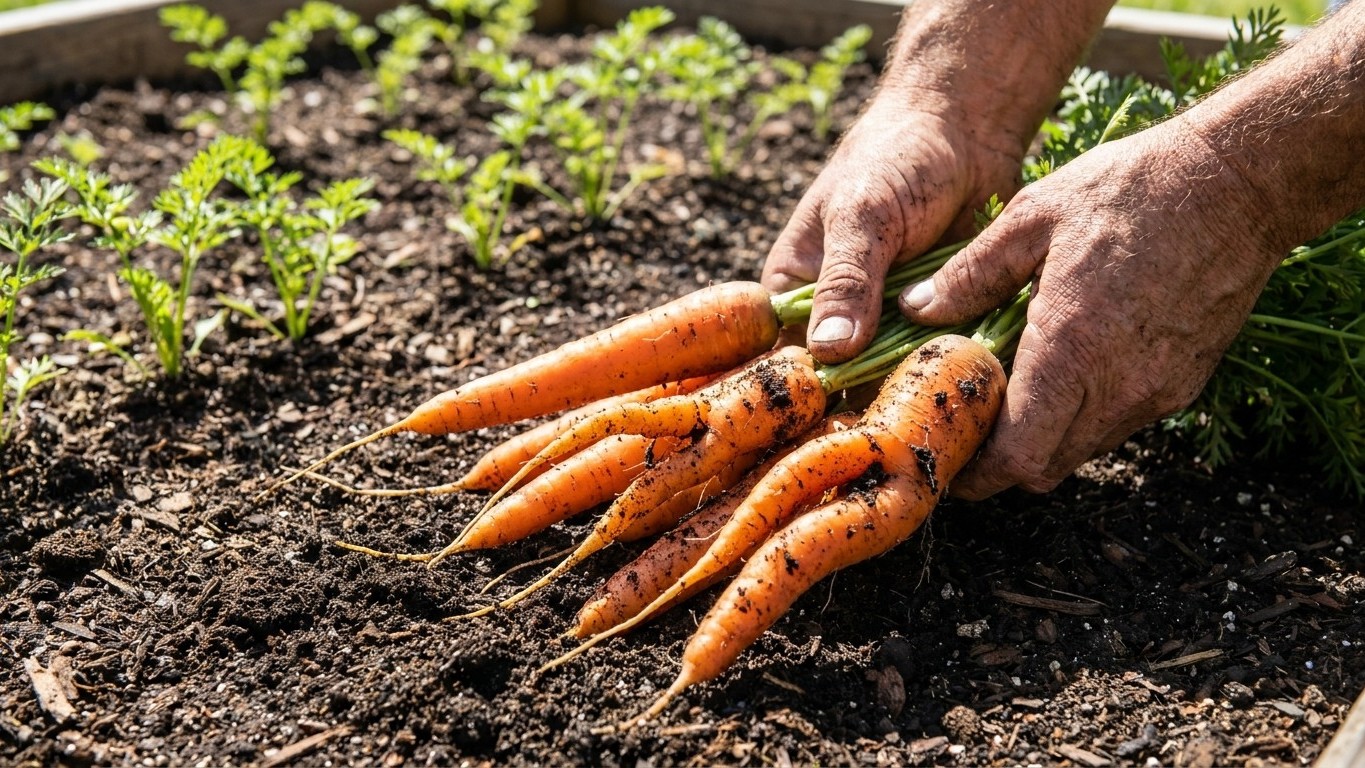

Carrots go into the ground as seed, not as transplants, and they take 70 to 100 days to mature from that sowing date. That means counting backward from your own last frost date, not a province-wide one, since Ontario stretches from the Golden Horseshoe to the far north and frost timing shifts by weeks across that distance. But the calendar only gets you half the answer. The ground those seeds land in decides whether the root grows straight or twists into a fork, and that has nothing to do with frost at all.
The short answer
The most commonly mapped soil across Ontario’s agricultural regions is a Luvisol, a forest-derived soil where clay has migrated down out of the surface layer over time, leaving the topsoil lighter in texture while the subsoil below it turns denser and more clay-rich. Gleysolic soils, which form under poor drainage and standing water, come in second. Where the survey data lands on texture, the median surface horizon runs 43 percent sand, 17 percent clay, and 41 percent silt, a loam to silt loam blend, with a median pH near 6.5 (slightly acid) and organic matter around 4.3 percent. Drainage class for that dominant surface layer reads as well drained.
On paper, that surface texture is workable ground for carrots. A loam with 17 percent clay isn’t the heavy, brick-like soil that stops a root cold. The trouble with a Luvisol isn’t always what’s on top, it’s what’s underneath. Because the defining feature of this soil order is clay that has washed down and concentrated in the subsoil, a carrot root pushing past the first several inches can meet a denser, tighter layer than the surface ever suggested. That’s exactly the condition Utah State University Extension points to when it warns that heavy or rocky soil makes a carrot root fork, splitting around an obstruction instead of driving straight down. The fix isn’t a different variety. It’s working compost into the bed and double digging to break up that denser layer, or building a raised bed deep enough that the root never reaches it in the first place.
Gleysolic soils raise a different flag. These form where water sits rather than drains, and a carrot bed sitting in poorly drained ground tends to produce roots that split or rot at the tip rather than fork, since the problem there is oxygen and drainage rather than a mechanical obstruction. If a Gleysolic profile describes your corner of the yard, raised beds solve that problem too, simply by lifting the root zone above the water table.
None of this is a diagnosis of your particular garden. Ontario’s agricultural land spans hundreds of individual soil series, and the numbers above are the median of nearly 850 mapped components, not a single named soil the way a state or province might designate an official emblem. A backyard a few miles from where these samples were taken can sit on something completely different, especially near a river, in old wetland ground, or on any lot where a builder scraped away the original topsoil and brought in fill. Treat this as a starting point for what the region’s ground tends to do, then confirm what’s actually under your own carrot bed.
The test that settles it in your own garden
The state, or in this case the province, isn’t your yard. The only way to know whether your carrots will fork, split, or grow clean is to look at the dirt they’re actually going into.
- Dig a hole at least a foot deep where the carrot bed will go. Carrots need that much clear depth to grow straight, so this is the first thing worth confirming before anything else.
- Check what’s at the bottom of that hole. Look for a change in color or density partway down, a sign of a compacted or clay-heavy subsoil layer sitting under a lighter topsoil, and note any stones or rocks in the profile, since those are the most common cause of a forked root.
- Rub a handful of the soil between your fingers. Gritty soil that won’t hold a shape is sandy. Soil that smears smooth and holds together when squeezed is high in clay. Something in between that forms a ball but crumbles with a little pressure is closer to a loam.
- Fill the hole with water and watch what happens. Water that disappears within a few hours points to decent drainage. Water that sits for most of a day signals a drainage problem worth addressing before planting, whether that means raised beds or reworking the area.
- Repeat the dig in more than one spot. Soil can change from one end of a yard to the other, so a single test hole near the house may not tell you anything about the bed on the far side of the lot.
What goes wrong here
- Forking in heavy or dense ground. A carrot root meeting compacted subsoil, buried rock, or a heavy clay layer splits and grows around the obstruction instead of pushing straight through. This is the exact failure Utah State University Extension attributes to heavy or rocky soil, and the fix is working in compost and double digging the bed, or switching to a raised bed with a loose, stone-free root zone from top to bottom.
- Poor germination during a hot, dry stretch. Carrot seed is small and sits shallow, which means the top inch of soil can dry out fast during a warm spell right after sowing, leaving gaps in the row where seed simply failed to sprout. Keeping that top layer consistently moist until seedlings appear, rather than letting it crust and dry between waterings, is what gets an even stand up.
- Splitting from uneven watering. A root that grows steadily and then gets hit with a sudden heavy soak after a dry stretch can split along its length as it takes up water faster than the tissue can expand. Watering on a steady schedule, rather than letting the bed dry out hard and then flooding it, keeps that growth rate even.
- Stunted or misshapen roots in ground that was never loosened deep enough. Even soil that looks fine on the surface can turn dense a few inches down, which is the same mechanism behind forking but shows up as a short, blunt root rather than a split one. Testing the bed to a full foot of depth before sowing, as described above, catches this before the seed ever goes in.
Common questions
Do I need to know my exact last frost date to sow carrots?
You need your own local last frost date, not a provincial average, since Ontario’s frost timing varies widely between its southern and northern regions. Carrots are counted back from that date using their 70 to 100 day maturity window from seeding, and gardeners typically get seed in the ground while soil is still cool but workable, well before that date arrives, rather than waiting for warm soil the way a transplanted crop would require.
Can I fix forking carrots without building a raised bed?
Yes, if the dense layer isn’t too deep. Double digging, turning the soil a full spade’s depth and working in compost as you go, can loosen a compacted subsoil layer enough for roots to push through straight. A raised bed becomes the simpler answer when that dense layer runs deep or when drainage is the underlying problem rather than just density.
Does the province-wide soil pH of 6.5 mean my garden is slightly acid?
Not necessarily. That figure is the median of surface soil across hundreds of mapped components in Ontario’s agricultural regions, not a measurement of any specific yard. A home soil test is the only way to know your own bed’s pH, and that number matters less for forking anyway than the physical texture and drainage of the ground itself.
Why do carrots need to be sown directly instead of transplanted?
Carrot roots are sensitive to disturbance, and moving a seedling damages the taproot in ways that show up later as forked or stunted growth. That’s why the 70 to 100 day maturity window is always counted from the seeding date rather than from a transplant date, unlike crops such as tomatoes or peppers that get a head start indoors.