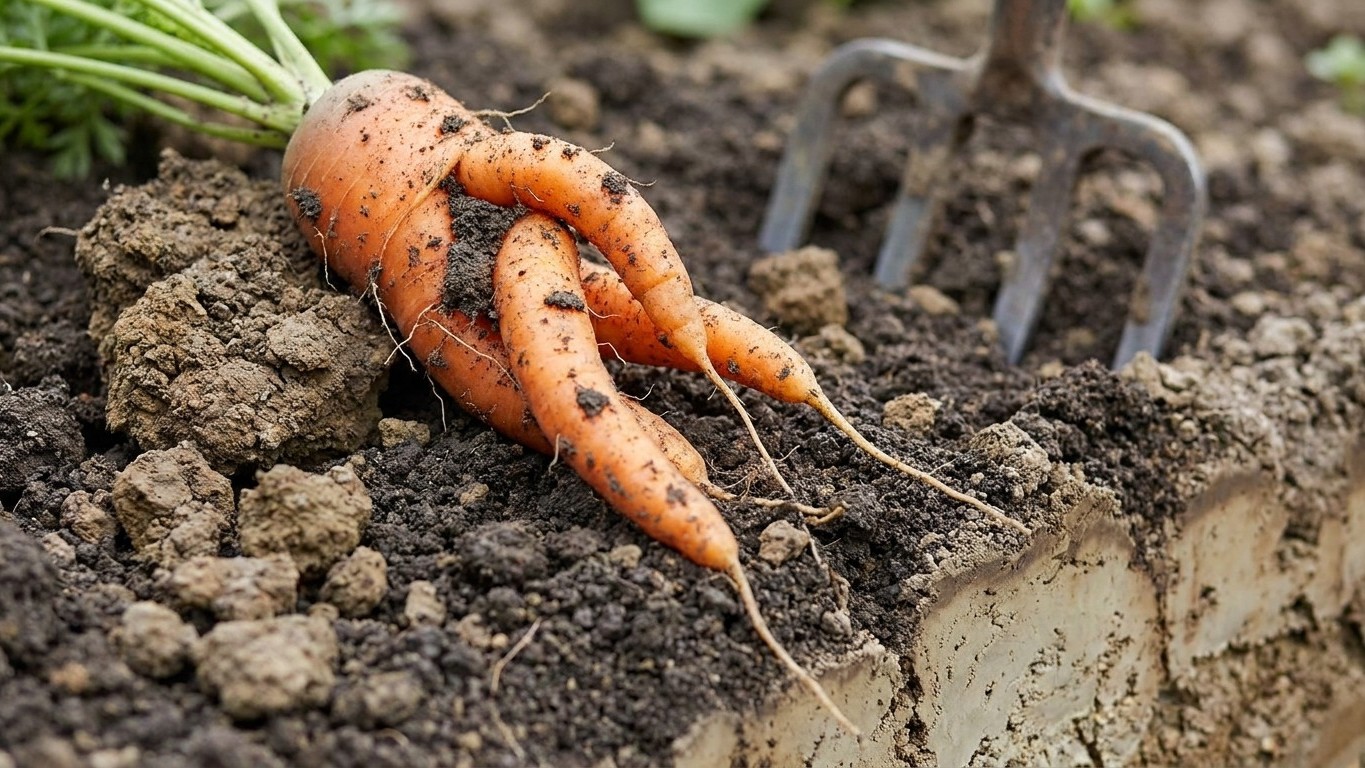

Ontario’s most common cropland soil carries enough clay in its makeup, and a denser layer just beneath the surface, to warn any carrot grower to slow down before dropping seed. A straight, unforked root is possible almost everywhere in the province, but on the province’s dominant ground it usually takes some work first: loosening the soil deeply, and feeding it with compost, before the seed ever goes in. Knowing When to Sow Carrots in Ontario matters just as much as prepping the ground itself.
The short answer
The most commonly mapped soil across Ontario’s agricultural regions is a Luvisol, a forest soil where clay has washed down out of the topsoil over time and settled into a denser band below. It covers 39 percent of the mapped surface, with Gleysolic soils, the wetter, poorly aerated ground typical of low-lying areas, coming in second. Where that Luvisol shows up, the surface layer itself tests out to roughly 43 percent sand, 17 percent clay and 41 percent silt, a texture that lands close to loam with a silt lean. The median surface pH runs about 6.5, just on the acid side of neutral, and organic matter averages around 4.3 percent. Drainage is classed as well drained.
For a carrot, that surface texture is workable news. Loam to silty loam, with clay under a fifth of the mix, is close to what a carrot wants: loose, crumbly ground it can push through without much resistance. The trouble is what sits underneath. A Luvisol’s defining trait is that dense, clay-enriched subsoil, and that’s exactly where a taproot runs into resistance it can’t push past. A carrot root doesn’t stop when it hits something hard; it splits and grows around it, or it curls, or it throws out a second leg. That’s forking, and it happens below the surface, often invisible until harvest day.
So the honest answer to Will Carrots Fork in Ontario Soil? for most gardens sitting on this typical profile: a carrot won’t automatically fork, but the odds rise the moment the root reaches that denser layer, which on a Luvisol can start well within a carrot’s working depth. According to Utah State University Extension, heavy or rocky soil is what forces roots to fork, and the fix isn’t a different variety, it’s changing the ground the root grows in. Working in compost loosens the structure and feeds the soil life that keeps it open, and double digging, turning and breaking up the soil to a full spade’s depth or more, physically removes that compacted layer a young root would otherwise meet. Where the subsoil is too dense or too wet to fix easily, building a raised bed sidesteps the problem entirely by giving the root a foot or more of loose, controlled soil with nothing dense to hit.
None of this is a diagnosis of any single backyard. Ontario spans hundreds of distinct soil series, from sandy river terraces to heavy clay plains to organic muskeg soils in the north that this agricultural survey doesn’t even cover. The Luvisol-and-Gleysolic picture above describes what the province’s farmland tends to look like on average, not what’s under any one person’s carrot bed. It’s a starting point for guessing what you’re dealing with, not a substitute for looking.
The test that settles it in your own garden
The only way to know what a carrot will meet underground is to look at that ground directly, in the actual bed, before seed goes in.
- Dig a hole at least a foot deep. Use a spade and go straight down where you plan to sow. This is the depth range a carrot root will actually try to occupy, so it’s the depth that matters, not just the top few inches.
- Look at what changes as you go down. Note whether the soil stays the same color and texture the whole way, or whether it turns denser, paler, or more compact partway down. That change is exactly the kind of layer a Luvisol subsoil represents, and it’s the layer a root can’t push through.
- Check for stones and rocks. Pull out anything solid you find in the hole. A rock the size of a grape sitting in a carrot’s path can cause the same forking a dense clay layer causes.
- Feel the texture between your fingers. Take a handful of moist soil and rub it. Gritty means sand, smooth and slick means clay, and a mix that feels somewhere between, holding a loose shape but crumbling easily, is closer to loam.
- Watch how water drains. Fill the hole with water and time how long it takes to disappear. Water that sits for hours points to a dense or compacted layer nearby; water that vanishes quickly points to looser, sandier ground.
What you find changes the plan. A hole that stays loose and crumbly the whole way down, with no standing water, is close to what Utah State University Extension describes as the ground carrots want, and needs little more than routine bed prep. A hole that turns dense, or holds water, or is full of stone, is telling you to reach for compost, a double-digging pass, or a raised bed before you sow anything.
When to sow here
Carrots are sown directly into the ground where they’ll grow. There’s no transplanting step to plan around, so every date here counts from the day seed goes into the soil.
- Start from the region’s frost pattern. At Toronto Lester B. Pearson International Airport, the long-term average last spring frost falls on April 30. That’s a mean drawn from decades of records, which means in roughly half of all years, frost arrives after that date, not before it. Treat April 30 as the middle of a window, not a line you can plant right up against.
- Count backward two to three weeks from that average date. Carrots tolerate cool soil better than many garden vegetables, so sowing ahead of the last frost, rather than after it, is the normal approach. Two to three weeks ahead of April 30 puts early sowing somewhere in the middle of April for gardens near the Pearson station’s climate, with earlier or later adjustments for anywhere warmer or colder locally.
- Check soil temperature before sowing, not just the calendar. Carrot seed needs the ground to have warmed to at least 40 F to germinate at all. A cold snap that keeps soil below that mark will hold seed dormant regardless of what the date says, so a simple soil thermometer pushed a couple of inches down is worth more than guessing From the Last Frost date alone.
- Aim for the range where germination actually performs best. Once soil sits between 55 F and 65 F, germination is at its strongest. Seed sown while soil is still near that 40 F floor will typically take longer to come up than seed sown once the ground has warmed further into that window.
- Remember the clock only starts at sowing. Because carrots skip a transplant stage entirely, the 70 to 100 days most varieties take to mature are counted from the day seed goes into the soil, not from any later stage.
What goes wrong here
- Forking in heavy ground. On the province’s typical clay-enriched subsoil, roots split or curl once they meet that denser layer. The remedy is the same one that applies to any heavy soil: work in compost and double dig the bed before sowing, or build a raised bed with a full foot or more of loose soil so the root never reaches the dense layer at all.
- Poor germination during a hot spell. Carrot seed germinates best between 55 F and 65 F, and a stretch of unusually warm weather right after sowing can push soil temperature well past that range, slowing or stalling germination even though the calendar says conditions should be fine. Watering to keep the seed bed cool and consistently moist during a heat spike helps keep germination on track.
- Splitting from uneven watering. Roots that go through a dry stretch and then get soaked, from a heavy rain or a catch-up watering, can split along their length as the interior swells faster than the outer layer can stretch. Steady, even moisture through the growing season, rather than occasional deep soakings after dry spells, keeps that from happening.
- Stalled seedlings in cold, wet soil. Sowing well ahead of the two-to-three-week window before the average last frost, before soil has climbed anywhere near that 40 F minimum, leaves seed sitting inert in cold, often waterlogged ground, where it can rot before it ever germinates.
Checking this against your own county
Everything above describes Ontario’s typical farmland soil and one weather station’s long-term frost average, not any single backyard. Local conditions, particularly further from the Toronto area or at higher elevation, can shift both the soil texture and the frost timing meaningfully.
For a check that reflects your own part of the province, the Ontario Ministry of Agriculture, Food and Rural Affairs is the province’s agricultural authority, reachable through its official site at ontario.ca/page/agriculture-and-food. It’s the right place to look for local soil information and growing guidance specific to your county rather than the province-wide averages covered here.
Common questions
What is the best soil for growing carrots in Ontario?
Utah State University Extension describes the ideal as deep, sandy, well-drained soil rich in organic matter. Ontario’s typical agricultural soil, a Luvisol running roughly 43 percent sand, 17 percent clay and 41 percent silt, sits close to that description at the surface but often carries a denser clay layer underneath, which is the part most likely to cause trouble.
Why do carrots fork in Ontario gardens?
Forking happens when a root meets something it can’t push through, whether that’s a stone or a compacted, clay-heavy layer. On Ontario’s dominant soil type, that dense layer sits below the surface as a natural feature of how the soil formed, which is why digging deep before sowing matters more than what the top few inches look like.
How early can I sow carrot seed in Ontario?
Sowing typically starts two to three weeks ahead of the average last spring frost, which sits at April 30 based on long-term records from the Toronto Pearson airport station. That date is only an average, so in many years frost arrives later, and soil temperature, not the calendar, is the safer signal to check before sowing.
Do carrots need raised beds in Ontario?
Not everywhere, but on ground that tests out heavy, dense, or slow to drain, a raised bed gives the root a controlled column of loose soil it can grow through without hitting a compacted layer. Digging your own test hole is the way to know whether your bed needs one.