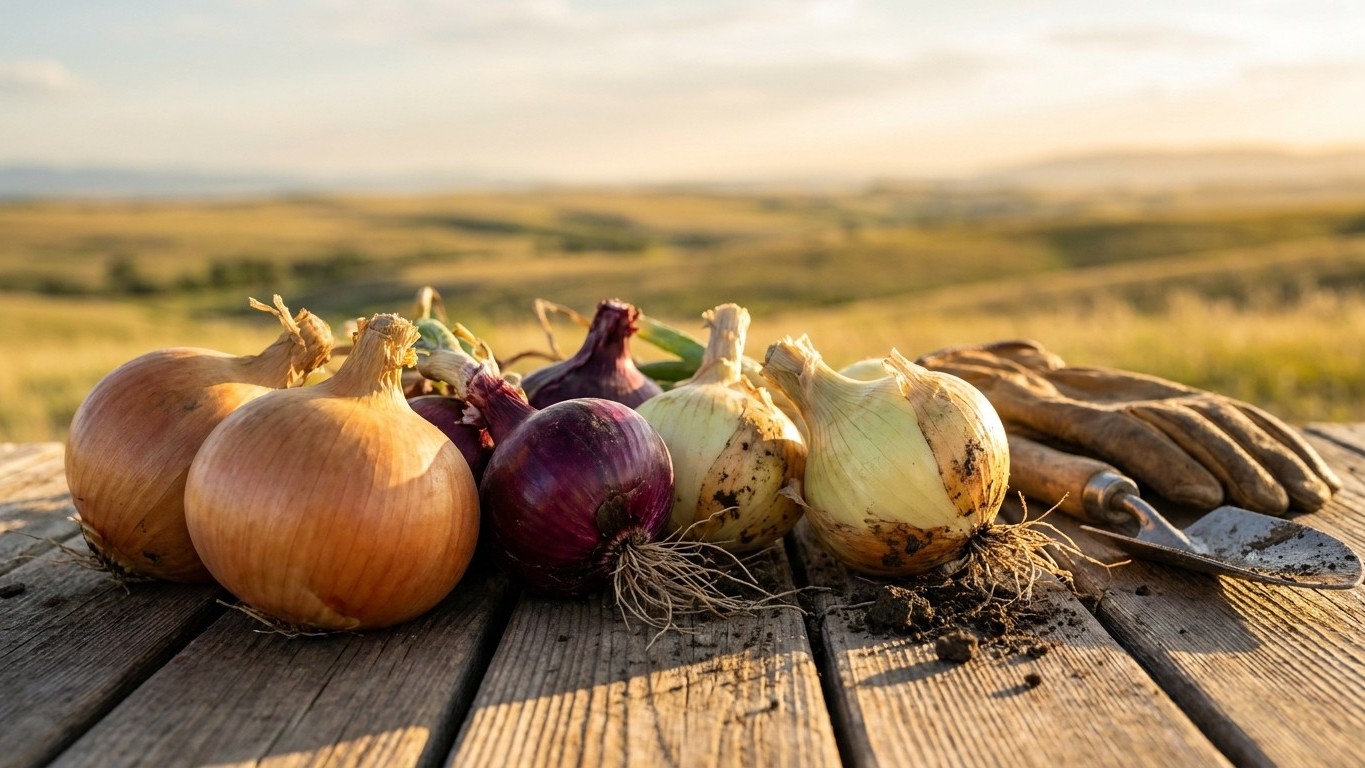

Onion maggot is the pest that actually goes after onions in Ontario, and it does its worst damage in the first few weeks after seedlings or sets go into the ground. A handful of other generalist feeders, cutworms, seedcorn maggot, aphids, will take a bite when conditions favor them, but none of them target alliums the way onion maggot does. The documentation for this region comes from extension services in the three U.S. states that share Ontario’s growing conditions across the Great Lakes.
Which pests attack onion in Ontario

Cornell University CALS Insect Diagnostic Laboratory, Michigan State University Extension (Bulletin E3276), and Ohio State University Extension (Ohioline) together document twenty-four insects as garden and field pests across the border region that shares Ontario’s climate and crop mix. Not one of those lists was built around onions specifically, most of the entries are cucurbit, brassica, or tree pests picked up along the way, so the first job is sorting out which ones ever set foot in an onion row.
Onion maggot heads that short list. It’s the only species among the twenty-four whose larvae specialize in alliums, tunneling into the base of seedlings and young bulbs. Seedcorn maggot (Delia platura) rides along behind it: it’s a generalist that attacks slow-germinating seeds and soft seedlings of many vegetables, onion included, especially in cold, wet, high-organic-matter soil. Cutworms will sever an onion seedling at the soil line the same way they do with tomatoes or peppers, they’re not fussy. Aphids show up on onion foliage occasionally, feeding on sap and sometimes spreading virus between plants. Slugs and European earwigs chew on the soft outer leaves of young transplants when the bed stays damp, more of a nuisance than a crop-ending problem. Twospotted spider mite can turn up late in the season on stressed, drought-stricken onion foliage, though it’s far more of a bean and tomato pest than an onion one.
The rest of the list has no business on an onion page. Apple maggot and emerald ash borer are tree pests, orchard fruit and ash wood, with nothing to eat in a vegetable bed. Colorado potato beetle and three-lined potato beetle specialize in the nightshade family; asparagus beetles won’t touch anything but asparagus ferns. Cabbage maggot, imported cabbageworm, and swede midge are brassica specialists through and through. Squash bug, squash vine borer, striped and spotted cucumber beetle, and spotted wing drosophila are cucurbit or soft-fruit feeders, which makes sense given how much of the Michigan bulletin behind this list is built around cucurbits. Japanese beetle and Asiatic garden beetle chew turf roots and ornamental foliage; viburnum leaf beetle sticks to one shrub genus. If a seedling wilts and pulls loose at the base, check the root plate before assuming it’s insect damage at all, that single habit rules out more false alarms than any spray schedule.
When each one shows up, and what it does first
Onion maggot activity tracks the crop’s earliest stage. Adults are drawn to the smell of a freshly disturbed onion bed, so damage clusters right around transplanting or when sets first go in, before the bulb has any size to it. The first sign isn’t a visible bug at all, it’s a wilting, yellowing seedling that tips over and pulls out of the soil with almost no resistance, because the roots underneath have already been chewed through.
Seedcorn maggot follows a similar early script but favors cool, wet soil with a lot of undecomposed organic matter, fresh compost or a recently turned-under cover crop. It attacks germinating seed and the softest part of a young seedling, so a gap in an onion row where nothing ever came up is often this pest’s signature rather than onion maggot’s.
Cutworms operate on the same early calendar, but the damage looks different: a seedling severed clean at the soil line overnight, with no wilting warning beforehand, just an empty spot where a plant stood the evening before.
Aphids and spider mites arrive later, once the canopy has filled in and the bulb has started to swell. That swelling is tied to day length, not temperature. At the reference station near Toronto, the longest day of the year delivers 15 hours and 17 minutes of daylight, well past the roughly 12-hour threshold that triggers bulbing in short-day onion types, and squarely inside the 14-to-16-hour range long-day types need. Once the plant shifts into bulbing, the lower leaves start to dry down on their own, and that’s exactly when spider mites move into the drying canopy and aphids cluster on the remaining green tissue. Damage at this stage looks like stippled, bronzed leaf tips or curled new growth rather than a collapsed plant.
Telling the damage apart from everything else
Onion beds fail for reasons that have nothing to do with insects far more often than gardeners assume, and the fixes are completely different depending on which one it is.
| What you see | Likely cause | What tells them apart |
|---|---|---|
| Seedling wilts, pulls out with no roots | Onion maggot | Root plate is tunneled and often has visible larvae or a soft, rotted feel |
| Gaps where seed never came up | Seedcorn maggot or poor germination | Dig where a seed was planted, look for tunneling in the seed itself vs. simple failure to sprout |
| Plant severed at soil line overnight | Cutworm | Clean cut, no wilting warning, plant lies flat rather than yellowing first |
| Yellow, stippled leaf tips late season | Spider mites, aphids, or drought stress | Check the underside of leaves with a hand lens for tiny moving specks; drought stress affects the whole bed evenly |
| Pale, thin, slow-growing plants across the whole row | Nitrogen deficiency or poor drainage | Uniform pattern across the bed rather than isolated plants, no tunneling or chewing visible |
The row-wide pattern is the biggest clue of all. Insect damage tends to show up in patches or isolated plants; a nutrient or drainage problem shows up evenly across the whole bed. When the cause isn’t obvious after pulling a few affected plants and checking the roots, that’s the point to send a sample or a photo to a local extension office rather than guess.
What actually works here, and what is a waste of time
Timing beats almost everything else with onion maggot. The adult flies are drawn to the smell of onions in disturbed soil, so a bed planted where onions, garlic, or leeks grew the year before is a magnet for the first generation. Rotating onions to a different part of the yard each year removes that cue and does more than any product applied after the fact. A lightweight floating row cover placed over the bed right after planting and left on until the seedlings have a few true leaves keeps the egg-laying flies off the crop entirely during the one stage when this insect actually matters. Once a seedling has already wilted, there’s nothing to spray or drench that brings it back, the damage is done below the soil line before it shows above it.
Seedcorn maggot responds to a similar principle: working in fresh compost or a green cover crop weeks before planting, rather than right at planting time, gives the organic matter time to break down past the stage that attracts egg-laying adults. Cutworm collars, a simple cardboard or foil ring pushed into the soil around each transplant, stop that pest mechanically and cost nothing.
What doesn’t help is reaching for a broad insecticide as a first response. Timing and physical exclusion address the pest at the one point in its life cycle when it’s actually vulnerable in an onion bed; a product applied afterward, or applied without knowing which pest is present, wastes money and does nothing for a seedling that’s already been tunneled through. Because product availability and label rules differ by province and change from year to year, this is exactly the kind of decision to run past a local extension service rather than guess at the shelf.
Where to check this for your own county
Ontario sits across the Great Lakes from three states whose extension services publish the pest data behind this page: Cornell University CALS Insect Diagnostic Laboratory in New York, Michigan State University Extension, and Ohio State University Extension (Ohioline). Insects don’t stop at a shoreline or a border crossing, so these bulletins are a reasonable starting point for a grower in southern Ontario, but they were written for growing conditions across the lake, not for a specific township north of Toronto or along the Niagara Peninsula.
What’s documented at the state or provincial level describes what’s been found somewhere in that broad territory, not what’s necessarily in any one backyard. A garden on heavy clay near Lake Erie deals with a different moisture pattern, and a different maggot pressure, than one on sandy soil further inland. The single most useful step for an uncertain diagnosis is a call or a photo sent to a local extension or agricultural office before treating anything, since they can confirm what’s actually active in that specific county this season rather than what’s merely possible across the wider region.
For a gardener working several vegetable beds side by side, checking each crop’s own pest page against what’s actually turning up in the yard, rather than assuming one insect problem explains everything growing poorly, saves both time and unnecessary treatment.