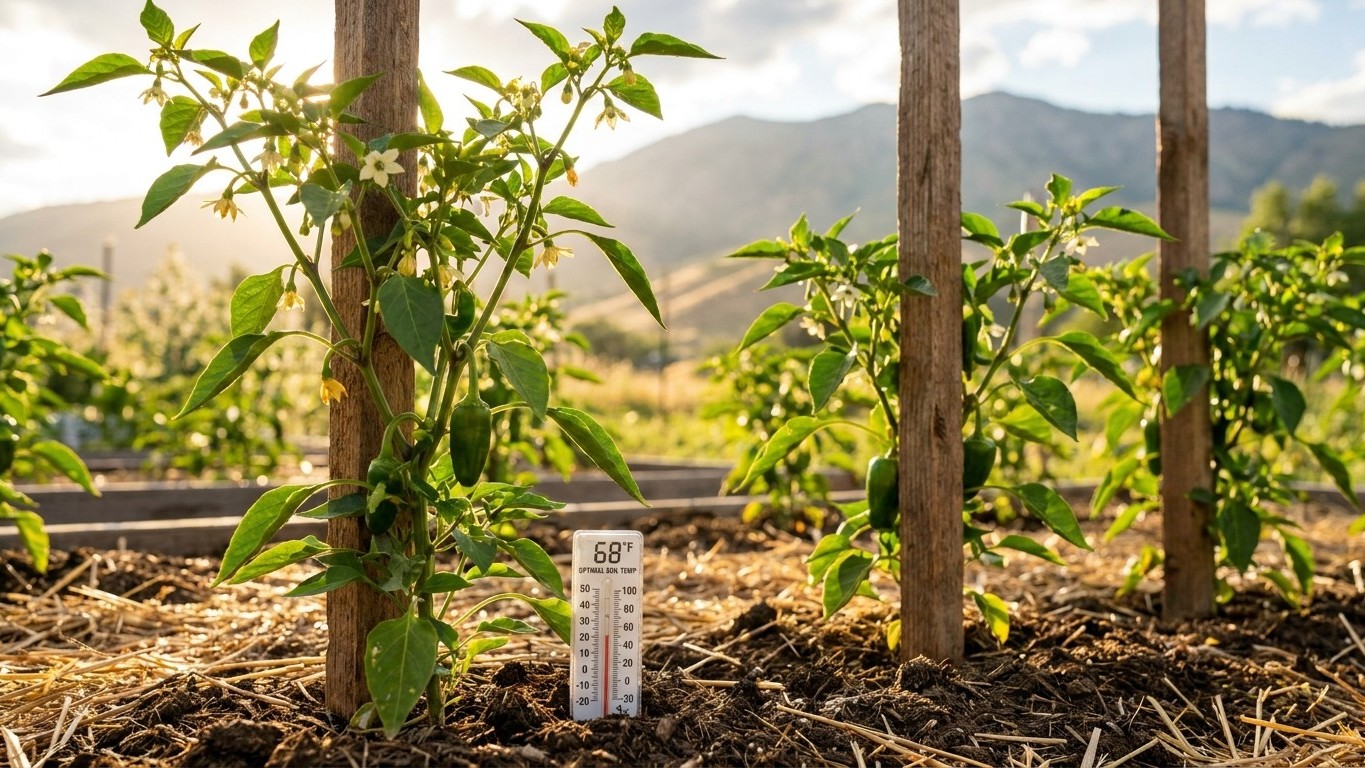

In Ontario, the Toronto reference station logs a mean of 0.0 days a year at or above 90°F, which means pepper plants here almost never face the heat-driven blossom drop that growers farther south fight all summer. The bigger question for Ontario gardeners isn’t heat, it’s the other end of the fruit-set window: cool nights. This site doesn’t track summer night minimums, so that part of the equation is one you’ll need to watch yourself, block by block, yard by yard.
The short answer

Start with the number that’s actually measured here: at the Toronto reference station, the Canadian Climate Normals for 1981-2010 put the average count of days reaching 90°F or higher at 0.0 a year. That’s not a rounding error, it’s the climate signal. Pepper flowers abort when daytime temperatures climb into the low 90s and stay there, because the plant redirects energy away from fruit set and toward simple survival. With essentially zero days crossing that line in a typical Ontario summer, that specific failure mode is rare across most of the province. It can still happen in a short, sharp heat spike, particularly in sheltered urban yards or against south-facing brick, but it isn’t the pattern the climate record predicts.
The other end of the fruit-set range matters more here, and it’s the one that gets overlooked. Utah State University Extension notes that pepper fruit set fails when nighttime temperatures drop below 55°F, just as surely as it fails above 90°F. Cool nights are common in Ontario at both edges of the growing season, late spring and early fall, and sometimes in the middle of a wet, overcast July stretch too. A pepper plant can look perfectly healthy, covered in blossoms, and still drop them one after another because the mercury dipped too low overnight for pollen to remain viable.
This is where the record has a real gap, and it’s worth being honest about it. This site carries days-above-90°F figures by territory, but it does not carry summer night minimums. That data simply isn’t part of the dataset behind this page. So the responsible move isn’t to guess at what your nights probably do based on where Ontario sits on a map, or to borrow a night-temperature assumption from the coldest month of the year. Neither of those methods holds up. Night minimums in a river valley differ from night minimums three miles away on a ridge, and a season’s overall coldness tells you nothing reliable about a specific July night. Track your own nights with a simple min-max thermometer left outside, and you’ll know within a week or two whether your peppers are sitting in the safe 55°F-to-90°F window or slipping below it.
When to start seed here
The seed-starting date isn’t a fixed calendar square, it’s a countdown that starts at the far end and works backward. Here’s how the arithmetic runs for an Ontario garden, step by step, so you can adjust it to your own county’s numbers.
- Anchor on the frost date. Environment and Climate Change Canada’s 1981-2010 normals put the average last spring frost at the Toronto Lester B. Pearson station on April 30. That’s a mean, not a guarantee, meaning in roughly half of all years frost arrives later than that. Treat it as the midpoint of a window, not a green light.
- Wait for the soil, not just the calendar. Utah State University Extension is specific that peppers should go into the ground only once soil temperature reaches 60°F, and only after frost risk has passed. Soil in Ontario often lags well behind air temperature in spring, sometimes by two to three weeks, since a cool clay or loam base takes time to shed the winter chill.
- Add a safety margin past the mean frost date. Because April 30 is an average and not a cutoff, many Ontario gardeners push transplant timing into the second or third week of May before soil and air both cooperate.
- Count back 8 to 10 weeks for indoor seed starting. That same Extension source sets the indoor head start at 8 to 10 weeks before transplant. If your realistic transplant window lands in mid-May, counting back 8 to 10 weeks puts your seed-starting date somewhere in early-to-mid March.
- Re-run the math for your own address. A garden in a low-lying valley or a northern district of the province will run behind the Toronto reference station, sometimes by a couple of weeks. Slide the whole sequence later rather than assuming the provincial average applies exactly to your soil.
What goes wrong here
- Blossom drop in a hot spell. Even though Ontario averages 0.0 days a year above 90°F, a short heat spike against a wall or in a sheltered courtyard can still push local temperatures over that line for an afternoon or two. Blossoms open, then fall without setting fruit. The remedy is simple and mechanical: shade cloth over the row during the hottest hours, and deep, even watering the night before a forecast spike so the plant isn’t drought-stressed on top of heat-stressed.
- Blossom drop from a cool night. This is the more common Ontario failure, tied to the 55°F threshold Utah State University Extension flags. A clear, calm night in late May or early June can drop well below that mark even after a warm day, and the plant sheds its flowers in response. Since this site doesn’t track night minimums, the fix starts with your own thermometer: if overnight readings are dipping into the low 50s, delay transplant, or cover young plants with row fabric that traps a few extra degrees of ground heat.
- Sunscald where the sun is strong. Pepper fruit that’s suddenly exposed to direct sun, often after a pruning session or a storm that strips leaves, develops pale, papery patches on the shoulder facing the light. The remedy is to leave the plant’s own foliage as a canopy rather than pruning hard for airflow, since that leaf cover is doing real protective work.
- Blossom-end rot. This shows up as a sunken, leathery brown patch at the fruit’s bottom end, and it’s driven by inconsistent water delivery rather than a soil calcium shortage in most home gardens. Even, regular watering and a layer of mulch to hold soil moisture steady through dry stretches usually stops it from recurring.
Common questions
Does Ontario ever get hot enough to hurt pepper fruit set?
Rarely, based on the recorded average. The Toronto reference station shows a mean of 0.0 days a year at or above 90°F, the threshold Utah State University Extension cites for heat-driven blossom drop. Isolated hot afternoons can still occur in sheltered spots, but the climate record doesn’t support planning around routine heat stress here.
What’s the actual danger for pepper flowers in an Ontario garden?
Cool nights, not heat. Nights below 55°F cause the same blossom failure that heat above 90°F does, and Ontario spring and fall evenings dip into that range often. This site doesn’t carry night-minimum data, so track your own overnight temperatures rather than assuming.
When should I start pepper seeds indoors for an Ontario transplant date?
Work backward from your realistic transplant date, which should fall after the mean last frost of April 30 and once soil hits 60°F. Subtract 8 to 10 weeks for the indoor head start Utah State University Extension recommends, which typically lands seed-starting in early-to-mid March for a mid-May transplant.
Is April 30 a safe date to transplant peppers outdoors in Ontario?
No. That’s a mean frost date from Environment and Climate Change Canada’s 1981-2010 normals, meaning frost falls later than April 30 in roughly half of all years. Treat it as the center of a window, and confirm soil has reached 60°F before moving transplants outside.