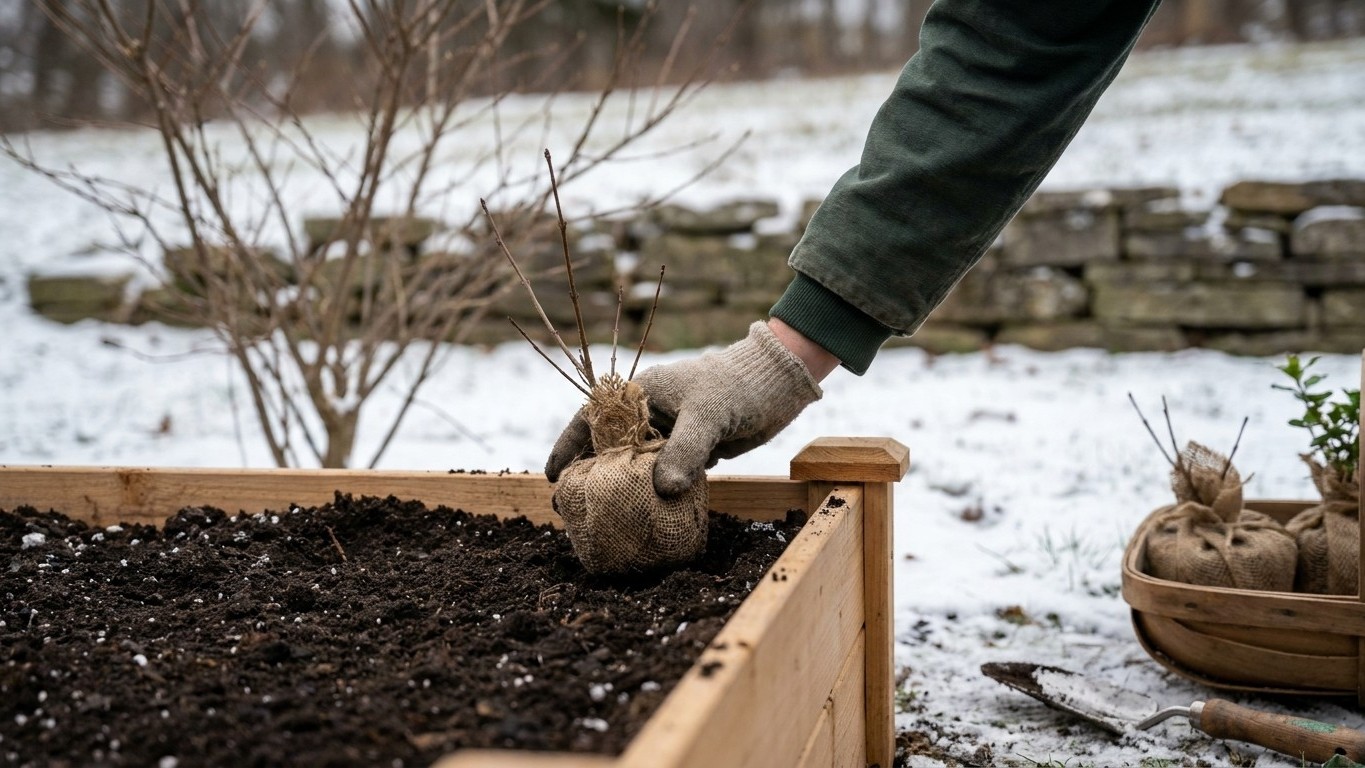

December in Ontario means the ground is closed for business almost everywhere in the province. The direct-sow window shut weeks ago, so this month is about protected growing, forcing crops indoors, dormant pruning, and the planning work that saves a gardener from scrambling in March.
What goes in the ground in December

The decision was never really about the calendar page. It was about soil temperature, and by December that argument is already settled almost everywhere in Ontario. The province sits, at the Toronto reference point, in Canadian hardiness zone 7a, and the average first fall frost there lands around October 16, according to Environment and Climate Change Canada’s Canadian Climate Normals for 1981-2010. That is a mean date, not a guarantee: in roughly half of all years frost arrives later than that, so treat it as the midpoint of a window rather than a line on a calendar. Either way, by December the ground has usually had six to eight weeks of freezing nights behind it. For most of the province, that means no open-ground planting at all.
Say it plainly: nothing new goes into bare soil this month in the majority of Ontario. In a mild pocket, Essex County, the Niagara Peninsula, parts of the southwest along Lake Erie, a late warm spell can leave the top few inches workable into early December. If that window is still open where you garden, garlic and shallots missed in October or November can still go in, cloves and bulbs down before the ground locks up for good. It is a gamble against the calendar, not a reliable plan.
What actually belongs on this month’s list is protected and dormant work. Cold frames and low tunnels sown in autumn with spinach, mâche, or claytonia keep producing slowly under cover. Bare-root fruit trees, roses, and cane fruit that arrive from nurseries this month generally should not go straight into frozen ground; heel them into a trench of damp sand or sawdust in an unheated shed, or hold them in their packaging in a cold but not freezing space, until soil opens again. And this is prime time to force rhubarb and chicory: dig dormant rhubarb crowns or chicory roots, pot them in soil or sand, and move them into a dark, moderately warm spot indoors for pale, tender stalks and leaves within weeks.
What to start under cover
Indoor sowing schedules should be counted backward from the frost window, not forward from a fixed date on the wall. With an average last spring frost around April 30, a crop that needs eight to ten weeks under lights before it can be hardened off and set out points to a start somewhere in February, not December. That arithmetic works the same way for any Ontario gardener: take the local last-frost estimate, subtract the weeks the seed packet or catalog lists for indoor growing plus hardening, and that is the sowing window, wherever in the province the garden sits.
December sits ahead of most of that math, which is exactly the trap. Starting long-season transplants now, tomatoes, peppers, onions from seed, almost guarantees rootbound, leggy plants by the time the ground is finally safe in May. Seedlings held too long under indoor light without the intensity of full outdoor sun stretch, weaken, and transplant poorly. The opposite failure, waiting too long, matters less right now since nothing here should be started yet for the main season.
What legitimately belongs under cover this month is different. Sprouts and microgreens on a windowsill are ready in days, not months, and sidestep the frost-window math entirely. Herb pots, parsley, chives, thyme, can be started or kept going indoors through winter for kitchen use. And for native perennials and wildflowers that need a period of cold to break dormancy, winter sowing in outdoor containers, left exposed to freeze and thaw through December, January, and February, is a legitimate and low-effort way to stratify seed naturally rather than faking it with a refrigerator later.
What is ready to pick
Outdoors, the honest answer is very little. Most annual vegetable crops finished weeks before December arrived. But a few things still hold, especially where snow cover or heavy mulch has insulated the soil. Kale, leeks, parsnips, and Brussels sprouts left in the ground often improve after hard frost, the cold converts stored starches to sugars, so a dig-out on a mild day can still be worthwhile if the ground has not frozen rock-solid.
Cold frames and low tunnels sown earlier in fall keep producing slow but real harvests: spinach, mâche, arugula, and other cold-hardy greens can be cut sparingly through the month as long as the frame stays closed against hard wind and deep cold. Inside the house, sprouts and microgreens are the fastest thing a gardener can put on the table this month, ready within a week of sowing with no soil at all.
Stored crops deserve a regular check now, not a set-and-forget attitude. Squash should feel firm with dry, unbroken skin; any soft spot or sweet smell means it needs eating or composting immediately, before it spreads to the rest of the bin. Potatoes should stay dark, cool, and dry, and any green-tinted or sprouting tuber should be pulled out and discarded. Onions worth keeping feel firm at the neck; a soft neck or sprouting green shoot means that one is on its way out and should not sit next to the good ones.
The jobs that matter this month

Winter does not mean idle, and December carries a full list of jobs that either pay off in spring or cost real ground if they slip.
Pruning, ordering, and planning
Dormant pruning of apple and pear trees, grapevines, and raspberry canes is best done now while the plant is fully asleep and the branch structure is visible without leaves in the way. Pick a dry, mild day rather than the coldest snap of the month, since wood cut during a deep freeze can be more prone to splitting. This is also the moment to order seed: popular varieties from small seed companies routinely sell out by late winter, and ordering now guards against settling for a second choice come February. Sketching next year’s crop rotation while this year’s layout is still fresh in memory beats trying to reconstruct it from memory in April.
Soil, compost, and equipment
Soil testing can happen even in winter; a lab sample sent now comes back with results well ahead of spring amending season, giving lime or sulfur time to work before planting. Compost piles slow down in the cold but do not stop; an occasional turn keeps air moving through the pile, or it can simply be left alone to insulate itself under a layer of snow. Garden tools benefit from a proper cleaning and sharpening now, with metal parts wiped down with a light oil to prevent rust and wooden handles sanded if they are splintering. Raised beds, trellises, and fencing are far easier to repair with no plants in the way, and mulch depth around perennials and shrubs, ideally two to four inches, is worth checking to buffer the freeze-thaw cycles that heave roots out of the ground.
What not to do in December
The most common mistake this month is starting seeds indoors simply because the house feels cozy and the itch to garden sets in early. Tomatoes, peppers, and other long-season transplants sown now will be leggy and rootbound long before the ground is safe in spring, and no amount of hardening off fixes a plant that has already stretched itself thin under indoor light.
A milder stretch of weather in December or January can tempt a gardener to pull mulch or open a cold frame early, thinking spring has arrived ahead of schedule. It has not. Removing protection during a warm spell exposes plants, and exposed soil, to the next hard freeze that almost always follows, and that swing can kill what the mulch was protecting in the first place. Leave winter protection in place until the season has genuinely turned.
Nitrogen fertilizer has no useful role this month either. Plants are dormant or nearly so, and any nitrogen applied to beds or lawns now sits unused in cold soil or leaches away with winter rain and snowmelt before roots can take it up. Save the feeding for when growth actually resumes. And spring-flowering shrubs, lilac, forsythia, and similar plants, should not be pruned now: their flower buds are already set from last season, and cutting them back in December removes next season’s bloom before it ever opens. Finally, do not let stored crops go unchecked for weeks at a stretch; one soft potato or moldy squash left in a bin spreads rot to its neighbors faster than most gardeners expect.
Checking this against your own county
A province-wide month is a starting point, never an instruction. Ontario stretches from the Windsor and Essex County shoreline, milder and closer to the Toronto-area zone 7a reference point, to northern districts that run weeks or months behind on both frost dates and hardiness. Lake effect along the Great Lakes shorelines moderates temperature swings and can delay the first fall frost compared with inland spots only a short drive away, while elevation changes shift things further still. Check any date against the Ontario Ministry of Agriculture, Food and Rural Affairs at ontario.ca/page/agriculture-and-food, and remember that the Canadian frost normals run through 1981-2010, not the most recent decade.
Common questions
Can garlic still go in during December in Ontario?
Only where soil remains workable, which by December is rare outside the mildest pockets of the southwest. Garlic planted in October or early November has a far better chance of rooting before winter than a December attempt.
Is it too early to start tomato and pepper seeds indoors in December?
Yes. Counting back roughly eight to ten weeks from an average last frost around April 30 points to a February start for most transplants; sowing in December almost guarantees leggy, rootbound seedlings by spring.
Should mulch or row cover come off during a warm December stretch?
No. A mild spell is rarely the start of spring, and removing protection early exposes plants to the hard freeze that typically follows, undoing whatever benefit the mulch or cover was providing.
What can actually be harvested outdoors in Ontario in December?
Very little beyond overwintered kale, leeks, and parsnips where the ground has not frozen solid, plus whatever slow-growing greens are holding on in a cold frame or low tunnel.
Gardeners who plant by the Moon can check the December 2026 moon planting calendar, a tradition rather than a proven method.