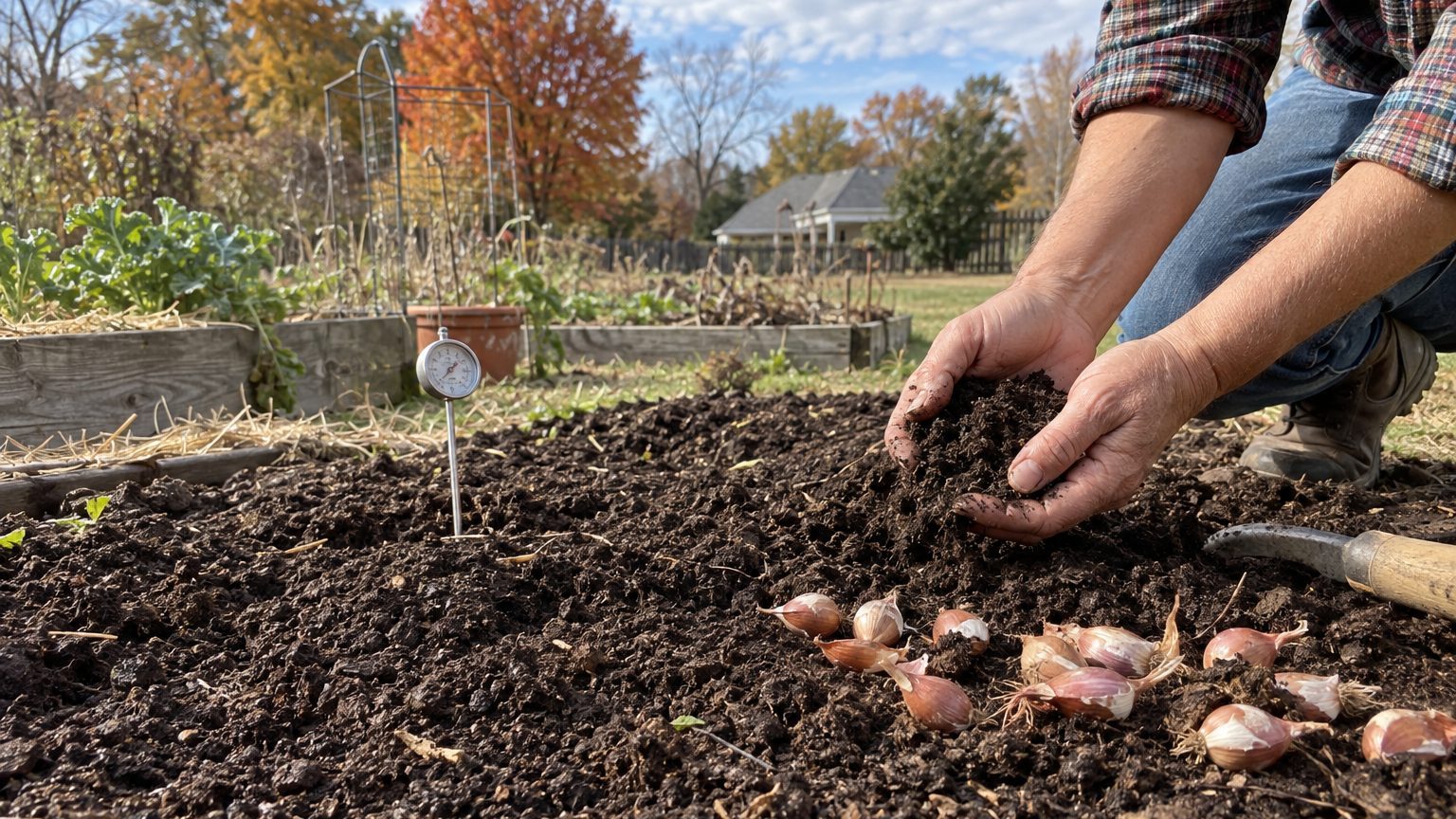

In southern Ontario, plant shallots in spring as soon as the soil can be worked, usually from late April into May. Autumn planting also works, but only where winter is mild enough for the sets to survive. The calendar date matters less than the condition of the ground, and the sections below explain how to read both, and why the Toronto numbers don’t apply to the whole province.
When the soil is warm enough in Ontario
Start with the number most people search for. Environment and Climate Change Canada’s 1981-2010 climate normals for Toronto Lester B. Pearson International Airport (climate ID 6158733) put the last spring frost on average at April 30. That is a mean date, so in one year out of two the final frost arrives later. Treat it as the middle of a window, not a safe date.
Frost is a stand-in for soil
Shallots don’t care about the date on the calendar. They respond to soil, and soil trails the air. The ground warms after the frost risk ends, not at the same moment, and a cold, saturated bed in early May can hold sets back as stubbornly as a frosty night would. The air may feel like spring while the root zone is still sluggish and wet.
A cheap soil thermometer and a week of morning readings that trend upward tell you more than any normal does. So does the squeeze test: a handful of soil that crumbles is ready, and one that smears into a ribbon or drips water is not. Shallots are a cool-season crop and tolerate chilly soil better than tomatoes or beans do, so you can plant earlier than you would for those. Earlier does not mean into mud.
One caution about the source. The Pearson station sits in the Greater Toronto Area, and Ontario is not one climate. Districts to the north and on higher ground run weeks behind it, and the shoreline communities along the Great Lakes can behave differently again. The Canadian normals cover 1981-2010, while the US figures cover 1991-2020, so don’t line the two sets up as if they were drawn from the same years.
Autumn planting, curing and storage: what carries over from garlic
Garlic has its own section, with pages for every region, and the shared groundwork lives there: how autumn planting works, how curing works, how to store the harvest, and why alliums shouldn’t follow alliums in the same bed. Read those for the basics. What differs for shallots is mostly scale. A shallot set is smaller than a garlic clove and carries less in reserve, so it has less margin if it sits in cold, waterlogged ground. For the general method from set to harvest, see Growing Shallots: One Bulb In, a Handful Out.
Curing and storage touch food safety, so no one can promise a keeping time. When you handle cured bulbs, check the neck, the base and the outer skins. A soft, damp or slimy neck, or a moldy base, ends the question, and that bulb goes in the compost instead of the pantry. A bulb that looks fine on the outside has not proven it is sound.
How long the season lasts here
Both frost dates come from the same Toronto Pearson station and the same 1981-2010 normals: April 30 on average for the last spring frost, and October 16 on average for the first fall frost. Counting the days from one to the other gives 169 days, a little under 24 weeks. These are still mean dates, so some years the window is shorter and some years longer, and the arithmetic describes a typical year, not a guaranteed one.
The number matters because of what it allows. A window of that length leaves room for more than one sowing. A first planting of sets in spring can be followed a couple of weeks later by a second, so the harvest of young green shallots and the later bulb harvest don’t all land in the same few days. The same room also makes transplanting optional. Starting shallots indoors and moving them out costs a root check, the stall a seedling suffers when its roots are disturbed, and in a long season that stall is easy to absorb. In a short season it is not.
That is the part to keep in mind if you garden outside the Toronto area. Shorten the window by three or four weeks, as happens in colder northern districts, and the logic flips. The first sowing becomes the only sowing, there is no time to recover from a transplant setback, and you want sets in the ground at the first workable moment. The 169 days are a ceiling for a mild corner of the province, not a figure to carry north.
For the mechanics of staggering plantings, including how far apart to space them, the succession sowing guide covers the method. Shallots take to it well, because even a modest second batch spreads out both the green-onion harvest and the curing workload. If you’re deciding where to start, the full set-to-harvest sequence is in Growing Shallots: One Bulb In, a Handful Out, and the Ontario-specific question is mostly how much of that 169-day window you can afford to spend.
Heat and water in Ontario
For your own garden, a few seasons of notes beat any provincial average, and your nearest weather station data will tell you more than a regional description.
What can be said is what the crop does under each kind of summer. Southern Ontario summers are humid, and when they run cool and damp, shallots tend to suffer from foliar mildew, slow ripening and tops that refuse to fall over on schedule. Bulbs that ripen slowly in wet weather are harder to cure and more likely to carry rot into storage. When a summer runs hot and dry, the tops die back earlier, bulbs finish smaller and the main job becomes steady watering through bulbing. In both cases the practice is the same: give the bed good drainage, space the plants so air moves between them, and shade the soil with a light mulch.
The winter decides the autumn-versus-spring question. At the Toronto reference station the mean daily minimum of the coldest month is -10.2 °C (13.6 °F), according to the same Canadian normals. Natural Resources Canada places the city in plant hardiness zone 7a, in the Canadian system, which is built from seven climate variables and does not convert to a USDA zone. A mean minimum is not a record low, so individual cold snaps go well below it.
| Planting time | Where it suits | Main risk |
|---|---|---|
| Autumn | Milder winters, well-drained ground, mulch available | Rot or frost heave if the ground freezes hard and stays wet |
| Spring | Colder or wetter districts, heavy soil | Smaller, later bulbs; a squeezed season in the north |
Where the ground freezes hard and stays wet, autumn sets rot or heave out of the soil, and spring is the safer call. A milder winter rewards autumn planting with larger, earlier bulbs, which is why people bother. Gardeners in colder places can compare notes with Growing Shallots in Maine, and the opposite end of the map is covered in Growing Shallots in Hawaii.
Which shallots suit Ontario
The only recommendation that means anything is one from trials run in conditions like yours. A name pulled from a general list may do well in one corner of the province and poorly in another. So the choice is by type, with the local variety list left to people who have grown them.
Start with the season. In districts where the window is shorter than Toronto’s, favor the earliest-maturing types, because a bulb that cannot finish before the fall frost is wasted effort. In the milder south, with the longer window, you can consider types that need more time. Heat is next. In a hot summer, choose types that tolerate it, and help any type with airflow and shade at the root: wider spacing, a thin mulch, and no crowding between rows.
Humidity decides the third criterion, and in Ontario it often comes first. Wet years bring mildew and neck rot, so disease resistance should be the first thing you look for in a catalog description, ahead of flavor or size. Seed-grown types and set-grown types behave differently in a damp year, so ask the seller how each has done in humid conditions, and prefer clean, certified planting stock over bulbs of unknown origin.
For named varieties that have actually been trialled in the province, start with the Government of Ontario’s agriculture and food pages, and then ask local growers and nearby nurseries what has held up in your district. Whatever you grow, inspect the harvest before you trust it. Cure the bulbs, then check the neck and base, and discard any with a soft neck or a moldy base. For shared practices such as crop rotation and storage, the garlic pages go into more depth than a shallot-only page could.
Common questions
When should I plant shallots in Ontario?
In spring, once the soil is workable and no longer waterlogged. At Toronto Pearson the average last frost is April 30, but that is a mean date, so use the soil’s condition as your guide and not the calendar. Colder districts will be weeks later.
Is autumn or spring planting better?
It depends on the winter where you live. Where the ground freezes hard and stays wet, autumn sets can rot or heave, and spring is safer. Where winters are milder and drainage is good, autumn planting can give larger, earlier bulbs.
Does Ontario’s zone 7a mean the same as USDA zone 7a?
No. The Natural Resources Canada zone for the Toronto reference city is 7a in the Canadian system, which is built on seven climate variables. The USDA system uses one, and the two do not convert.
How do I know my cured shallots are safe to store?
Check the neck, the base and the outer skins. A soft neck or a moldy base ends the question, and a sound appearance alone proves nothing. No page can promise a keeping time, since it depends on your curing, your storage conditions and the bulbs themselves.