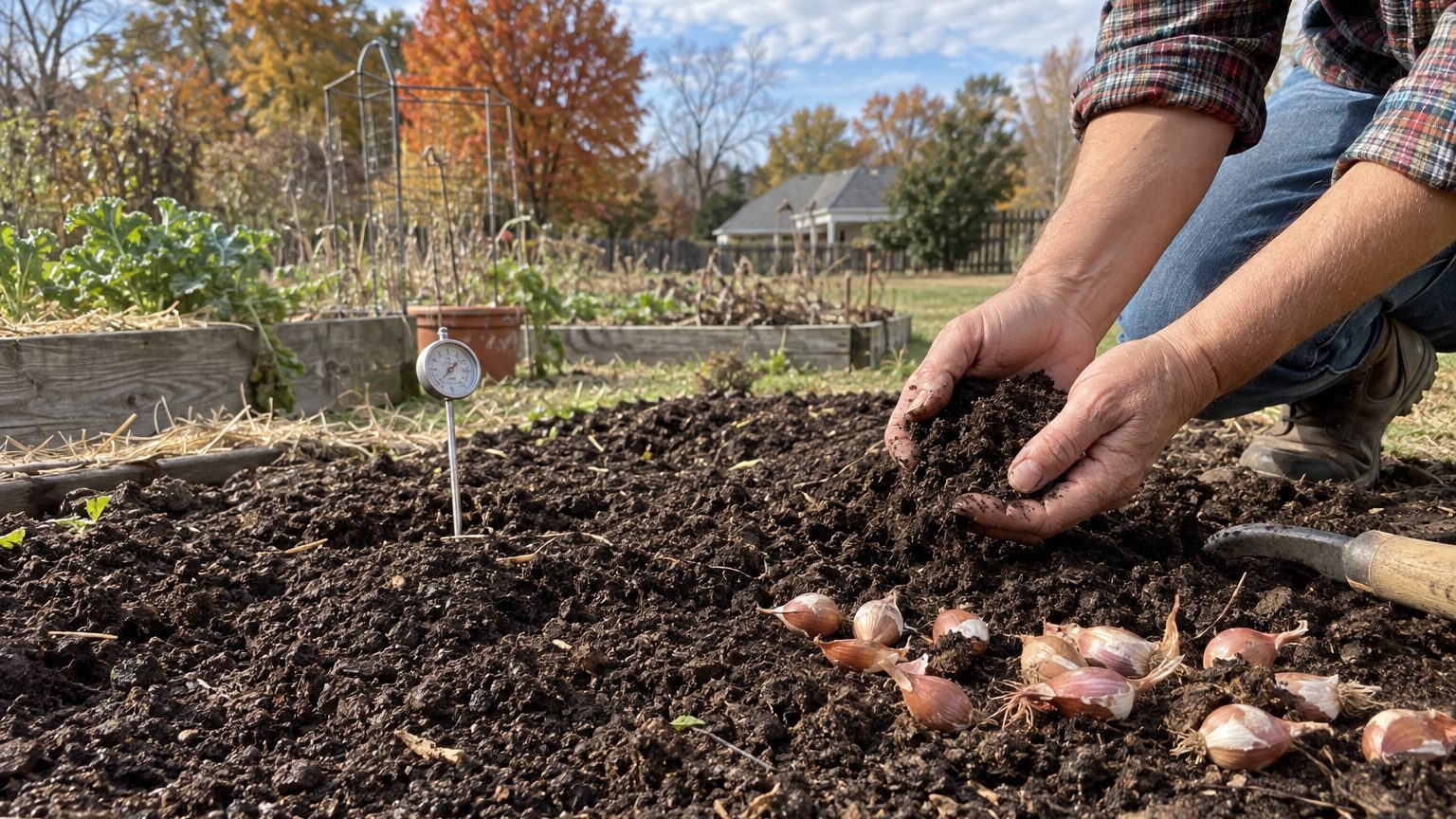

There is no frost date to plant shallots around in Hawaii. NOAA’s 1991-2020 normals for the Honolulu reference station show zero days a year at or below 32°F, so the calendar mainland gardeners follow does not exist here. Rainfall, elevation and which side of the mountain the garden sits on take its place. Heat, not cold, is the problem to solve.
When the soil is warm enough in Hawaii
The date question gets an unusual answer: the last spring frost never arrives. The NOAA NCEI 1991-2020 Climate Normals for station USW00022521 flag every freeze percentile at 32°F and 36°F as not computable, and record zero days per year at or below 32°F (NOAA station data). No freeze occurs in inhabited areas. Frost shows up only on the high summits of Mauna Kea, Mauna Loa and Haleakala, where nobody is planting alliums. Like any frost statistic, this is a probability built from past decades and not a promise about a given night, but in the lowlands the odds are about as lopsided as they get.
Frost is a proxy, and here it goes silent
On the mainland, a last-frost date stands in for something else. Shallots wait for warm soil, and the soil warms after the frost risk ends, not with it. The date is shorthand for the ground. In Hawaii the shorthand fails, and so does the question behind it. Lowland soil is never cold. At Honolulu, the mean daily minimum of the coldest month is 66.8°F. “Is the soil warm enough?” is always yes. The useful question is whether it is cool enough, and dry enough, for a crop that prefers mild weather while its roots and leaves build.
That points to the cooler months, which in many leeward districts are also the wetter ones, and to higher elevations where nights run cooler. A planting date for your garden depends on your island’s rain pattern and your altitude, and the local planting calendars come from University of Hawaii CTAHR Extension, not from a national chart.
What the hardiness zone does and doesn’t say
The USDA Plant Hardiness Zone Map (2023 edition, built on 1991-2020 normals) places Hawaii in zones 9a to 13a. That is a territory-wide range, and parts of the state differ sharply from the reference city. It rests on a single variable, the average annual extreme minimum temperature, so it measures whether a plant survives cold. Shallots survive cold easily. The zone tells you nothing about the real constraints here.
If you have read the general guide, Growing Shallots: One Bulb In, a Handful Out, the logic of planting one bulb to harvest a cluster still holds. Autumn planting, which this site’s garlic pages cover at length, assumes a winter to plant into, and Hawaii does not supply one. What differs for shallots is the payoff: each set must multiply into a cluster, and a rotted set returns nothing.
How long the season lasts here
Normally this is a subtraction: first fall frost minus last spring frost, and the answer is the growing window. Both frost dates in the NOAA normals are absent, because no freeze occurs in inhabited areas. With no dates to subtract, this page gives no number of days. Any figure would be a guess dressed as a fact.
What a frost-free window allows
Without a frost wall at either end, the window is bounded by weather. It lasts as long as the cool, tolerable stretch lasts at your elevation and on your side of the island, and it opens and closes with rain and heat. That changes how you sow. A long open window allows succession planting, small batches set out a few weeks apart instead of one big bed. In Hawaii the case is stronger than usual: one stretch of saturated weather can ruin a single large planting, while staggered batches spread the risk. The succession sowing guide on this site lays out the spacing logic.
Transplanting looks different too. A set or start that is disturbed has to rebuild roots, and that root check costs time. On the mainland, a frost deadline makes that cost hard to afford. Here you can raise starts in light shade while the ground is too hot or too wet, then set them out when conditions settle. Where the tolerable window is narrow, as at low elevation in a hot, dry leeward district, direct planting of sets avoids the stall entirely. Which choice is better depends on your site.
Three things stretch or squeeze the window:
- Elevation: higher districts on Maui and Hawaii Island run cooler, which lengthens the stretch shallots tolerate.
- Windward or leeward exposure: windward sides take frequent showers, leeward sides run drier and hotter.
- Local microclimate: a slope, a windbreak or a shaded corner can shift conditions within a single property.
Heat and water in Hawaii
The number of days above 90°F and the summer rainfall totals are not among the figures this page can source, so it quotes none. The verified facts are narrower: zero freeze days and a coldest-month minimum of 66.8°F, both from the Honolulu reference station. One lowland station cannot describe Hilo, upland Kula or a Kauai valley. Rainfall in the islands can change dramatically over a few miles, which is why the extension office’s local guidance outweighs any statewide rule.
Autumn or spring when winter never freezes
On the mainland, the winter low decides this question. Where the ground freezes hard and stays wet, autumn-planted sets rot or heave, and spring is the safer call. A milder winter gives the larger, earlier bulbs that autumn planting is grown for. Hawaii sits beyond the mild end. Heaving is not a risk, but neither is a deep cold that sets a rhythm for the crop.
| Factor | Cold-winter mainland | Hawaii (Honolulu reference) |
|---|---|---|
| Freeze days | Ground freezes and thaws | Zero days per year at or below 32°F |
| Coldest-month nights | Often below freezing | Mean daily minimum of 66.8°F |
| Main risk to planted sets | Heaving and rot in frozen, wet ground | Rot in saturated soil, heat stress |
| What sets the planting date | Frost dates and soil temperature | Rainfall, elevation, exposure |
So autumn against spring becomes wet against dry and cool against hot. Gardeners comparing hot-climate approaches can read Growing Shallots in Texas and Growing Shallots in Oklahoma, where freezing winters still frame the choice. Hawaii removes that frame, and the question gets harder, not easier.
Rain, humidity and disease
Where showers are frequent, wet foliage and saturated soil invite fungal leaf disease and bulb rot. A few practices help in nearly every setting: raised beds or ridged rows so water drains away, drip irrigation instead of overhead watering, generous spacing for airflow, and a long gap before alliums return to the same bed. Onions, garlic and shallots share pests and diseases, so rotation should treat them as one family.
On the dry leeward side the picture reverses. Shallot roots are shallow and need steady moisture while the plant is growing, and a light mulch keeps the root zone cooler. Keep the mulch pulled back from the neck, since a damp collar is where rot starts. As tops begin to yellow, easing off water helps the bulbs finish and cure.
Which shallots suit Hawaii
This page names no variety, and the reason matters. A variety that thrives in a cool northern garden can sulk at sea level in the tropics, and the only recommendation worth following is one trialled where you garden. Island, elevation and exposure all change the answer, and this page has no trial data. Ask University of Hawaii CTAHR Extension which varieties have performed locally. Inventing a name would be the fastest way to lose a gardener’s trust.
Choosing by type
You can still reason from the territory’s conditions:
- A narrow cool window favors the earliest-maturing types, which finish before heat or heavy rain arrives.
- Hot sites favor upright, open-habit types, planted with airflow and shade or mulch at the root zone.
- Humid, windward sites make disease resistance the first criterion, ahead of size or flavor.
Also decide between multiplier types, grown from sets that split into clusters, and types grown from seed. Sets are the familiar route, but a mainland shipment raises another question. Check plant import rules with the Hawaii Department of Agriculture before ordering sets from outside the state.
Curing and inspecting
Humid weather makes curing the weak point. Cure bulbs in shade with moving air, out of the rain, and handle them gently. Then inspect each one: the neck should be dry and tight, the base clean and firm. A soft neck or a moldy base ends the question for that bulb, and appearance alone never proves one is sound. The garlic pages on this site cover curing and storage in more detail; the difference with shallots is that clusters hold moisture between the bulbs, so separate and check each one.
Common questions
Can you grow shallots in Hawaii year-round?
No frost stops you, but heat and rain do. Planting is limited by the stretch of cool, manageable weather where you garden, and that varies by island and elevation. Your county extension agent can tell you where that stretch falls locally.
Does the USDA hardiness zone matter for shallots in Hawaii?
Hardly. The 2023 USDA map places the state in zones 9a to 13a, and the zone measures only how much cold a plant survives. Shallots handle cold well, and in Hawaii the limits are heat, humidity and rainfall.
Should I plant in autumn or spring?
The mainland rule turns on freezing winters, which lowland Hawaii does not have. Choose by rainfall and temperature instead: favor the cooler months and avoid planting into saturated soil.
Where do I find varieties that work on my island?
Start with University of Hawaii CTAHR Extension, which has local trial knowledge. Tell them your island, elevation and whether your garden is windward or leeward. Frost occurs only on the summits of Mauna Kea, Mauna Loa and Haleakala, so cold is not the factor to ask about.