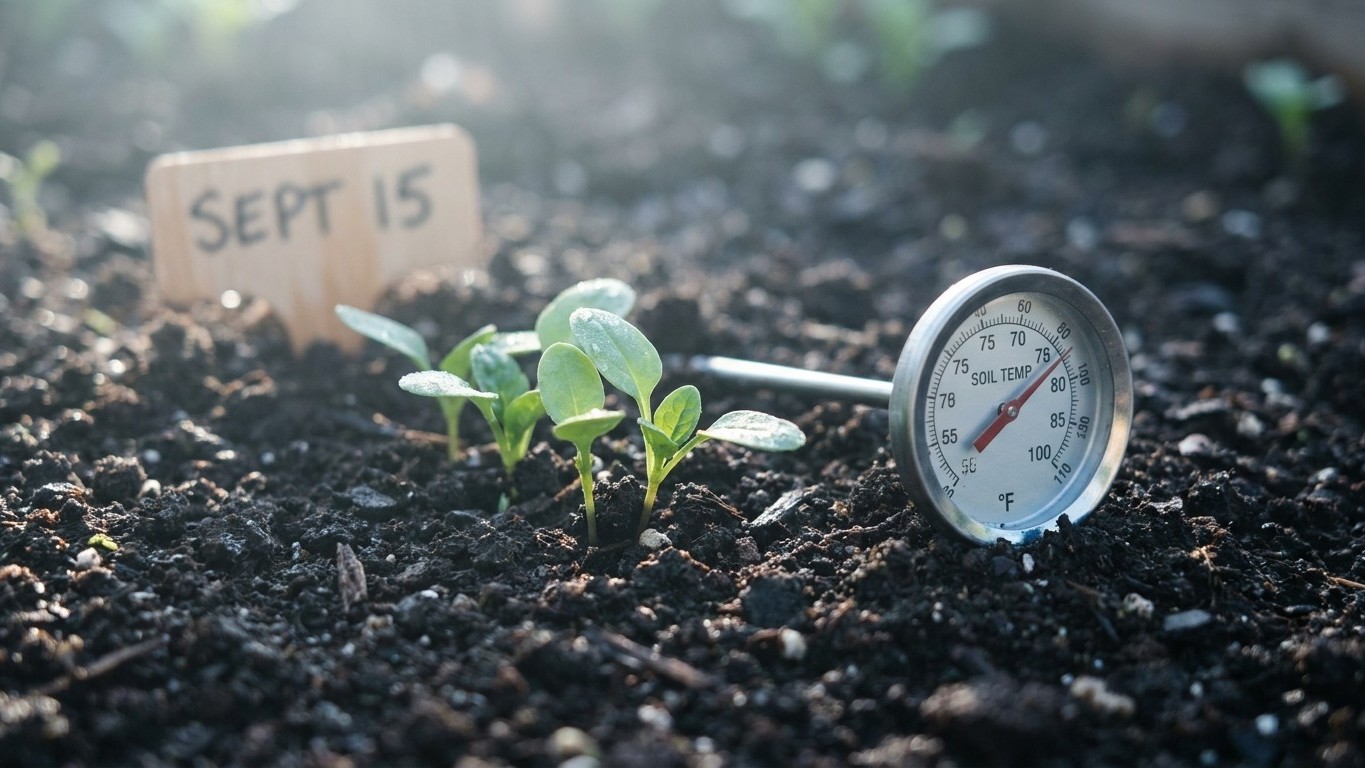

Sow spinach for a spring harvest in early-to-mid April, roughly two to three weeks before Ontario’s average last frost. For a fall crop, get seed into the ground sometime between early and late August, counting back 50 to 75 days from a target harvest date ahead of mid-October frosts. Both windows are narrow, and the reason has less to do with cold than with how many hours of daylight this region gets in June.
The short answer
At the summer solstice, the Toronto-area reference station sees 15 hours and 17 minutes of daylight, among the longest stretches of light Ontario gardens get all year. More light usually sounds like good news for a vegetable bed, but spinach reacts to it in reverse. Long days trigger flowering, known as bolting, in spinach just as reliably as heat does, so a run of cool, cloudy Ontario weather in June does not buy extra weeks the way it might for a crop that only responds to temperature. The plant reads the calendar through daylight hours, and once days stretch long enough, it shifts energy into a seed stalk instead of leaves, whether or not the thermometer cooperates.
Heat plays a smaller role here than it does in many US states. Toronto-area climate normals show an average of zero days a year reaching 90 F, so there is essentially no extreme summer heat load to contend with. Spinach grows best under 75 F, and that ceiling matters in Ontario less as a threat of scorching afternoons and more as a quality marker: leaves can turn bitter and tough on a mild day near that mark, well before any wilting shows. The real limit in this region is day length first, with the 75 F ceiling acting as a secondary quality check rather than a survival threat.
That combination is why the crop splits into two short seasons rather than one long one. A spring sowing has to finish its run before the solstice pushes daylight past what spinach tolerates. A fall sowing has to wait until days shorten again, then race the first frost. Gardeners who treat Ontario’s mild summers as an invitation to keep sowing spinach through June and July usually watch a bed bolt to seed within days of the longest stretch of daylight, no matter how cool that particular June feels.
How long the spring window really is
Two rules pin down the spring sowing window on their own. Seed should go into the ground two to three weeks before the last frost, and growth quality falls apart once temperatures push past 75 F. Lining those rules up against this region’s own numbers narrows the calendar quickly.
- Start with the frost date. The Toronto-area station’s average last spring frost falls on April 30. That date is a mean, not a guarantee: roughly half of all years see frost arrive later than that, so treating April 30 as a hard finish line understates the real risk.
- Move the sowing date back two to three weeks. That lands spinach sowing somewhere between roughly April 9 and April 16, once soil has usually thawed and warmed enough for germination but before the season’s heat and daylight build up.
- Track how much cool growth is left before the 75 F ceiling arrives. Spinach sown in early-to-mid April gets several weeks of cool soil and moderate daylight before the region’s daylight and warmth both climb toward the solstice.
- Watch daylight, not just the thermometer. Because bolting responds to long days as well as heat, the spring window effectively closes as the region approaches its 15-hour-17-minute peak in June, regardless of whether that June stays mild.
- Add it up. In practice that leaves roughly eight to nine usable weeks of spring growing, from an early-to-mid April sowing until lengthening days, sometime around late May to early June, start pushing the crop toward bolting.
That is a tight stretch by any measure, and it is the reason gardeners in this region often plan for two short spinach crops rather than one long one: a fast spring planting timed to beat the solstice, and a second sowing later in the year once daylight starts shrinking again.
The autumn crop, and when the soil lets you sow
Fall sowing flips the spring problem. Instead of racing daylight, the fall crop has to wait out summer’s leftover soil warmth, then get established before frost closes the season down. Utah State University Extension, the source behind these thresholds, states the fall sowing rule plainly: put seed in the ground 50 to 75 days before the date a gardener wants to harvest. Working that formula backward against this region’s own frost data gives a usable, if narrow, planting window.
Soil still too warm to germinate
Spinach seed germinates poorly once soil temperatures climb above 80 F. Ontario’s summers help here more than many US regions do: the Toronto-area reference station records an average of zero days a year reaching 90 F, so extreme surface heat is rare. Even so, soil in a sunny bed can sit warm enough through late July and into early August to slow or block germination, even without triple-digit air temperatures ever showing up. Waiting until soil has cooled from its midsummer peak, generally sometime in August, gives seed a better shot at coming up evenly. Gardeners choosing among the varieties named by Utah State University Extension, Bloomsdale, Melody, Teton, and Olympia, will not find days-to-maturity figures published by that source for any of them; the extension guidance covers sowing timing and temperature thresholds, not variety-by-variety performance.
The frost that ends the season
On the other end, the Toronto-area station’s average first fall frost lands on October 16, another mean figure rather than a guaranteed cutoff. Roughly half of all years see frost arrive later than that date, and half see it arrive earlier. Counting back from October 16 using the 50-to-75-day rule gives a sowing window running from roughly August 2 to August 27. Sowing on the earlier side of that range, in the first half of August, gives the crop a better cushion if frost arrives ahead of schedule. Sowing near the end of August pushes harvest closer to the frost date itself, leaving less room to absorb an early cold snap.
Common questions
Can spinach survive a light frost in Ontario?
The data behind this page does not include a frost-tolerance threshold for spinach, only the average frost date itself, October 16 at the Toronto-area reference station. Because that date is a mean rather than a guarantee, the safer approach is to plan a fall harvest ahead of it rather than assume the crop will ride out whatever frost eventually arrives.
Does a cool Ontario summer let me keep sowing spinach through June?
No. Bolting in spinach is triggered by long days as well as by heat, and Ontario’s daylight climbs toward 15 hours and 17 minutes at the solstice regardless of how mild the temperatures stay. A cool June does not cancel out that daylight signal, so sowings made in late spring tend to bolt on schedule even in a mild year.
Which spinach variety works best for Ontario’s short seasons?
Utah State University Extension names four varieties, Bloomsdale, Melody, Teton, and Olympia, but publishes no maturity data or performance comparison for any of them. Without published figures to compare, there is no sourced basis here for recommending one over another for this region.
How much does the last frost date actually vary year to year?
Quite a bit. The April 30 figure is a mean drawn from the Toronto-area reference station’s climate normals, meaning frost arrives later than that date in roughly half of all years and earlier in the other half. Locations north or upland of that station typically run behind it by weeks, so gardeners farther from the reference station should treat these dates as a starting point rather than a fixed local rule.