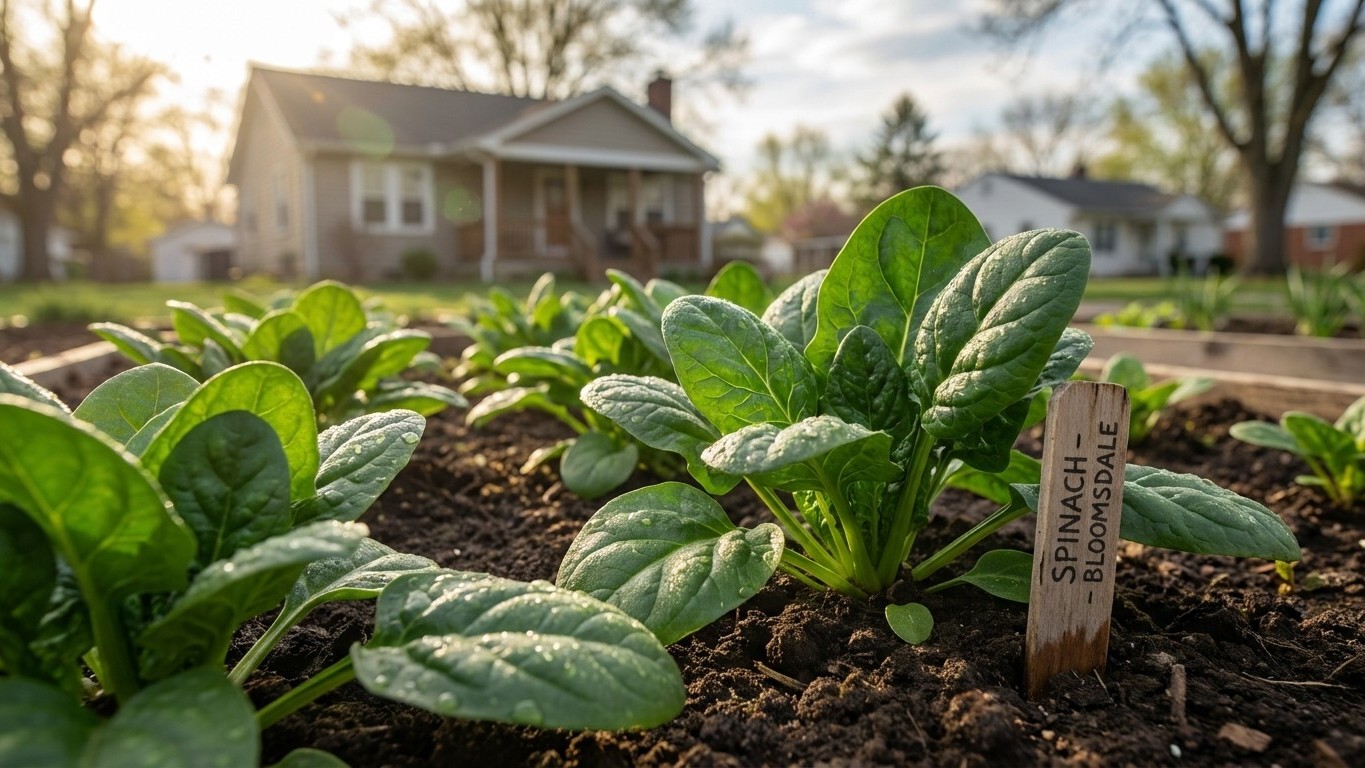

Spinach growing in Ontario doesn’t fail because of heat, it fails because of light. The region’s summer days stretch to 15 hours and 17 minutes at their longest, well past the point where spinach switches from making leaves to sending up a flower stalk. That shift, called bolting, runs on a schedule set by day length as much as by warmth. A spring sowing made in early April can usually outrun it. One made in late May usually can’t. Here’s how that calendar actually works.
The short answer
On the longest day of the year, Ontario sees 15 hours and 17 minutes of daylight, worked out from the latitude of the region’s reference climate station near Toronto. That’s a long day by any garden crop’s standard, and for spinach it’s the biggest problem in the garden. Long daylight, not heat, is what pushes spinach out of leaf production and into flowering. As the calendar moves from the spring equinox toward the June solstice, every day adds a few more minutes of light, and spinach keeps a running tally. Once enough long days accumulate, the plant bolts, sending up a central stalk, going to seed, and turning bitter, whether or not the thermometer ever climbs.
That mechanism matters more here than the temperature record does, because Ontario’s temperature record is mild. The Toronto Pearson station, the reference point for the region’s climate normals, averages 0.0 days a year above 90°F. Extreme heat essentially doesn’t happen. Spinach grows best below 75°F, and that ceiling is rarely tested through most of spring. So if the picture in your head is a heat wave cutting the season short, that’s not what happens in Ontario. The real question, Will Spinach Bolt Early in Ontario?, comes down to the sun staying up too long, not the mercury climbing too high.
That distinction changes what a gardener can and can’t do about it. Someone fighting heat can chase shade, mulch heavily, water at dawn, and buy a few extra weeks. Someone fighting day length has no such lever. Shade cloth blocks the sun’s intensity, not the clock’s arithmetic. The plant counts daylight hours whether the bed sits in full sun or dappled shade. That’s why the standard approach for Ontario spinach isn’t “keep it cool,” it’s “get it in early, and get it out before the days get too long.”
So the short answer: the limit here is day length, not heat. Ontario’s summers are mild enough that spinach rarely bolts from a heat wave, but the region’s daylight, over 15 hours at the peak, arrives well ahead of any temperature problem and pushes the plant toward flowering on its own schedule. A cool Ontario summer doesn’t buy extra weeks the way it might for a heat-limited crop, because heat was never the trigger. Sow early, harvest young, and treat the approach of the solstice as the real deadline, not the forecast high for the week. For gardeners who miss that spring window, When to Sow Autumn Spinach in Ontario lays out the second chance the shortening days of fall provide.
How long the spring window really is
Spinach seed goes in the ground 2 to 3 weeks before the last spring frost, while the soil is still cold enough to sting bare hands. In Ontario, that frost date averages April 30, based on the 1981-2010 Canadian Climate Normals recorded at Toronto Pearson. That’s a mean, not a guarantee. In half of all years on record, frost has arrived after April 30, sometimes well after. Treat it as the middle of a range, not a line to plant against with full confidence.
- Count back from the mean last frost. April 30 minus 2 to 3 weeks lands sowing around April 9 to April 16 in a typical year, earlier if the season runs warm, later if a cold snap keeps the soil locked up.
- Let the plant work through the short-day stretch first. In early-to-mid April, day length is still well under its summer peak, so spinach spends these weeks building leaves rather than racing toward a flower stalk.
- Watch the days lengthen toward the June 21 peak of 15 hours and 17 minutes. Every week that passes after the spring sowing adds daylight, and by mid-to-late May the accumulated long days start pushing plants toward bolting, even though Ontario’s air temperature almost never exceeds 75°F this early, given the average of 0.0 days a year above 90°F.
- Expect the harvest window to close by early-to-mid June in a typical year. That gives a realistic spring run of roughly six to seven weeks from a mid-April sowing: plant, grow, harvest young, and pull the crop before the flower stalk appears, since day length rather than heat sets the deadline.
The autumn crop, and when the soil lets you sow
Fall spinach in Ontario means working backward from the first frost rather than forward from spring. Utah State University Extension advises sowing 50 to 75 days before the date you want to harvest. No days-to-maturity figure is published for spinach by that source, so that sowing-to-harvest window is the only planning tool available, and it has to be checked against two separate obstacles.
Soil too warm to germinate
Germination drops once soil passes 80°F. Ontario’s air rarely reaches 90°F, but bare soil baking in full summer sun can run considerably hotter than the air above it, and a garden bed through July and early August can sit above that 80°F threshold even on a day that feels mild. That means a gardener can’t just count backward from frost and sow on the day the math suggests; the ground has to have started cooling first. Mulching the bed, sowing in the cooler part of the day, or waiting for an overcast stretch in late summer all help bring soil temperature down before seed goes in.
The frost that ends the season
Ontario’s first fall frost averages October 16, again from the Toronto Pearson climate normals. The same caveat as spring applies: that’s a mean, and in half of the years on record frost arrives later than that date, in the other half, earlier. Counting back 50 to 75 days from October 16 places the fall sowing window between roughly August 2 and August 27. That’s tight against the soil-temperature problem above, since early August is usually the warmest stretch of the Ontario summer. Many gardeners split the difference by sowing in the second half of August, accepting a harvest closer to the 50-day mark than the 75-day mark, and by choosing a bed that cools faster, one shaded through the afternoon, for instance.
Checking this against your own county
Every figure here comes from one station, Toronto Pearson, a reasonable stand-in for southern Ontario but not for the whole province. Gardeners in the Ottawa Valley, along Georgian Bay, or in northern districts like Thunder Bay or Timmins work with a different frost calendar entirely, often weeks behind the dates used in this article. Elevation matters too; a garden on high ground can see frost weeks before a garden in a nearby valley.
The Ontario Ministry of Agriculture, Food and Rural Affairs keeps regional data and extension contacts that go well beyond one weather station. Their agriculture and food portal is the right starting point for anyone who wants frost dates, soil temperature guidance, or planting calendars specific to their own county rather than to Pearson airport: ontario.ca/page/agriculture-and-food. A quick check there, or a call to a local extension office, is worth doing before locking in a sowing date based on provincial averages alone.
Common questions
Can shade cloth stop spinach from bolting in Ontario?
Not really. Shade cloth cuts the intensity of the sun and can lower leaf temperature a little, but it doesn’t shorten the number of hours the sky stays light. Since bolting in spinach is driven by day length as well as warmth, shading a bed through May and June won’t hold off the flower stalk once the days have gotten long enough.
What spinach varieties do best in Ontario?
Utah State University Extension names four common varieties, Bloomsdale, Melody, Teton, and Olympia, without publishing performance data for any of them. There’s no verified information here on which one resists bolting longest or yields best in this climate, so treat the names as a starting point for your own comparison rather than a ranking.
Is it safe to sow spinach right on April 30, the average last frost date?
Not on its own. April 30 is a mean figure from Toronto Pearson’s climate normals, and in roughly half of all years frost has landed after that date. Sowing 2 to 3 weeks before it, as the general guidance suggests, still means watching the local forecast rather than planting strictly by the calendar.
Can spinach still be harvested after the first fall frost hits around October 16?
Spinach is a cold-tolerant leaf crop and light frost often doesn’t end the harvest outright. There’s no published threshold here for exactly how much cold the plant can take before it’s damaged beyond use, so the practical approach is to check the bed after a frost and pick what still looks usable rather than assuming the season is over the moment the average date arrives.