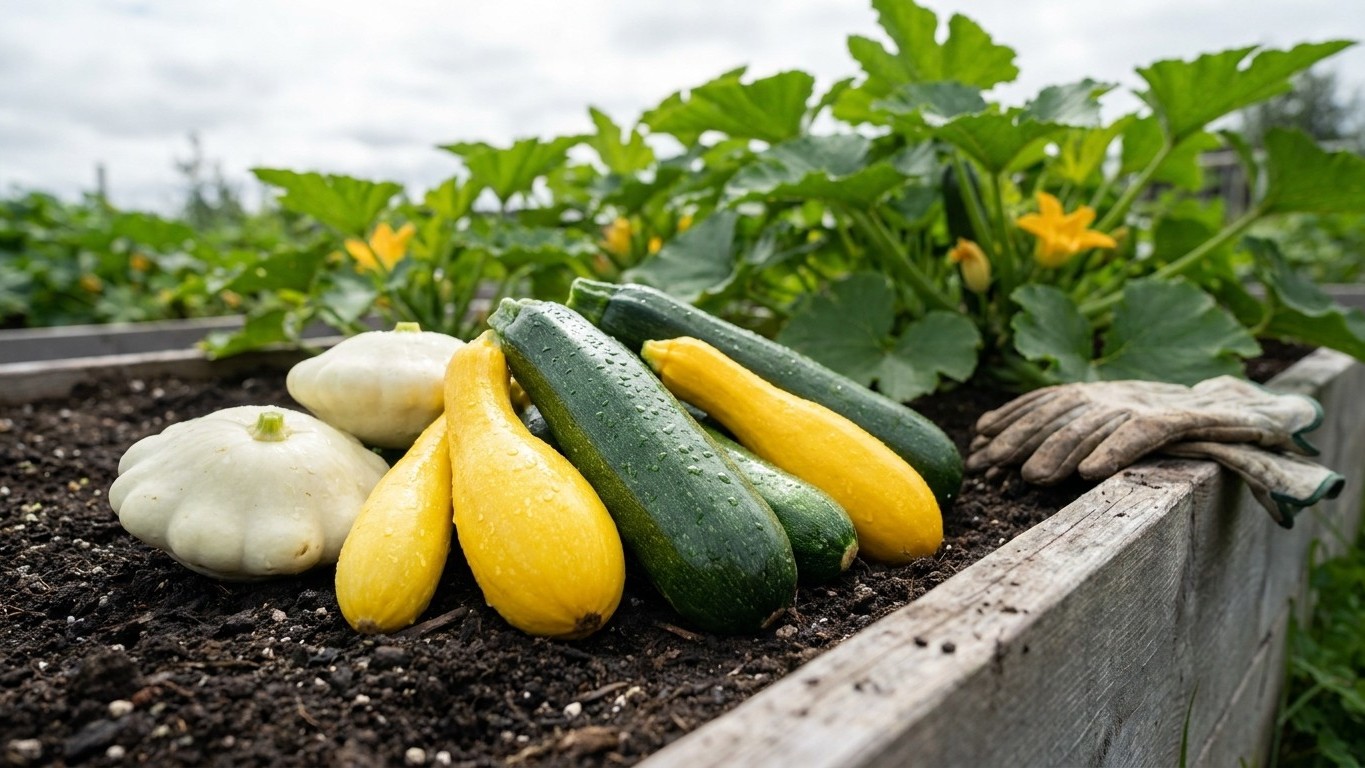

Bush zucchini and yellow crookneck squash, chosen for a 45- to 55-day maturity, are the safest picks across most of Ontario. Pattypan and scallop types in that same fast range do nearly as well. The slower, vine-hungry specialty squash that gardeners see in seed catalogs need a longer, hotter run than this province’s climate normals reliably deliver.
The short answer for Ontario
Start with the two numbers that actually decide this. At the Toronto Pearson reference station, the average last spring frost falls April 30 and the average first fall frost falls October 16. That’s a mean frost-free stretch of roughly 169 days. But a mean is not a promise: in one year out of two, frost arrives later than April 30 in spring, or earlier than October 16 in fall. Treat that 169-day figure as a midpoint you can lose a few weeks from at either end, not a number you can plant against with confidence.
That’s still generous for most summer squash, which mature in 45 to 60 days. The second number matters more for variety choice than for timing: Toronto averages 0.0 days a year at or above 90°F. There’s no real heat load here. Summer squash bred for scorching, arid climates, the kind marketed for the desert Southwest, simply won’t get the heat accumulation they were selected for. Squash bred for temperate, moderate-summer growing do better.
Put those two facts together and the decision by type looks like this:
| Squash type | Typical days to maturity | Fit for Ontario |
|---|---|---|
| Bush zucchini | 45-55 days | Strong fit |
| Yellow crookneck/straightneck | 50-58 days | Strong fit |
| Pattypan/scallop | 50-55 days | Strong fit |
| Cousa/Lebanese | 55-60 days | Workable, tighter margin |
| Trailing/vining types (e.g. tromboncino) | 80-100 days | Risky as a summer squash here |
The pattern holds even after you discount for a shorter real-world window: anything that finishes under 60 days has room to spare against an average 169-day season, and room to spare is exactly what a mean frost date, not a guaranteed one, requires.
What will not work here
The trailing, long-season squash sold as summer squash but grown more like a winter squash vine, tromboncino and similar cucuzza types among them, are the clearest mismatch. They want 80 to 100 days of warm, unbroken growth. Soil here doesn’t reliably warm enough for transplanting until well into May, which eats into that average 169-day window before the vine has even gone in the ground. Run the math and there’s little buffer left for a late spring or an early fall frost, both of which happen in roughly half of all years by definition of a mean date.
Heat-hungry cultivars bred for hot, dry regions are the second failure point, and for a different reason. With 0.0 days a year averaging 90°F or higher, Ontario summers don’t deliver the heat accumulation those varieties were selected to use. They tend to grow more slowly and set fruit less reliably here, not because the season is too short, but because it never gets hot enough.
Rainfall is the third trap, and it works in the opposite direction from what a dry-climate variety expects. Toronto averages about 8.9 inches of rain across June, July and August, split fairly evenly (2.81 inches in June, 2.98 in July, 3.07 in August). That’s steady summer moisture, not a dry heat that evaporates it quickly, since there’s no 90°F stretch to drive fast evaporation. Varieties and spacing plans built for arid gardens, tight bush spacing meant to save space under dry air, run into trouble in this more humid, evenly wet pattern. Powdery mildew and downy mildew both thrive when foliage stays damp and airflow is restricted, and closely packed bush plants are exactly where that shows up first.
None of this rules squash out of an Ontario garden. It rules out the varieties and spacing habits built for a different climate than the one Toronto’s normals describe.
What changes across Ontario
Toronto Pearson sits at Canadian hardiness zone 7a, and it’s worth being precise about what that means: this is the Canadian system, built from seven climate variables, not the single-variable USDA system used elsewhere on this site. The two don’t convert directly. Natural Resources Canada has said as much itself, noting that a single Canadian zone can span nine different USDA zones. So 7a here describes Toronto specifically, not a number to carry across the border for comparison.
It also doesn’t describe the province. Ontario is enormous, and its hardiness zones run from around 0a in the far north down to 7b in sheltered pockets near Niagara and Windsor. That’s not a small spread, it’s most of the Canadian zone scale contained inside one province’s borders. A planting plan built on Toronto’s average frost dates and rainfall will be too optimistic for a garden several zones colder, and possibly too cautious for one in a milder microclimate near the Great Lakes.
The practical shift for a reader further north or at higher elevation: expect the frost-free window to close in from both ends, not just start later. That favors the fastest end of the maturity range, the 45-day bush zucchini and crookneck types, over anything pushing 55 to 60 days. It also argues for starting seed indoors two to three weeks before the local transplant date, since native soil in a colder zone warms later than it does around Toronto, and squash transplanted into cold soil simply sits rather than growing.
This page can’t tell an individual reader which zone applies to their own property. What it can do is point to where that answer lives: Natural Resources Canada’s Plant Hardiness Site maps zones by municipality across the country, and it’s the right place to find a local number rather than borrowing Toronto’s.
Where to check this for your own county
The Ontario Ministry of Agriculture, Food and Rural Affairs publishes provincial agricultural guidance at ontario.ca/page/agriculture-and-food. That’s the right first stop, but it’s still a provincial page, and everything above already shows why a provincial or even a single reference-station page has limits: Ontario’s frost dates, heat load and rainfall vary too much across its own borders for one set of numbers to fit every county.
Two things are worth hunting for once there. First, a local or regional planting calendar, if the county or nearest agricultural region publishes one, since it will reflect actual local frost patterns rather than the Toronto Pearson normals used on this page. Second, any list of squash or vegetable varieties trialled specifically in that county or region. Trial results carry more weight than a general recommendation, because they show what actually finished a full season and yielded well in that particular soil and climate, not just what the seed catalog claims for an average garden.
A county-level recommendation beats a provincial one every time, for the same reason a provincial one beats a page written for a different country’s climate normals. This page works from Toronto Pearson’s 1981-2010 averages because that’s the reference station with a complete public record. It is the provincial-scale answer, not the county one. Anyone gardening well outside the Greater Toronto Area, especially further north or in a different lake-effect zone, should treat the numbers here as a starting frame to adjust, not a final answer.
Checking this against your own garden
Every date and average on this page describes what happens most often at one weather station. What happens in a specific backyard is a separate question, and three simple checks answer it better than any calendar.
Soil warmth by feel is the first and most direct. Press a hand into the planting bed a few inches down in mid to late spring. Squash seed and transplants sulk in cold soil regardless of what the calendar says, so if the ground still feels cold and damp rather than mild, the plant will tell the same story as the thermometer would, without needing one.
The first flush of male flowers is the second signal. Summer squash typically produces a wave of male blossoms before the female flowers, the ones with a small swelling at the base that will become fruit, appear in any number. Seeing plenty of male flowers but few or no females for a stretch usually points to a plant still adjusting to its conditions rather than one that’s failed.
The first true leaves, the second set that emerges after the rounded seed leaves, mark the point where a young squash plant is genuinely established rather than just sprouted. Slow, pale, or delayed true leaves after transplant are often the clearest early sign that soil temperature or a late cold snap is holding growth back, well before it would show up as a stunted plant later in the season.