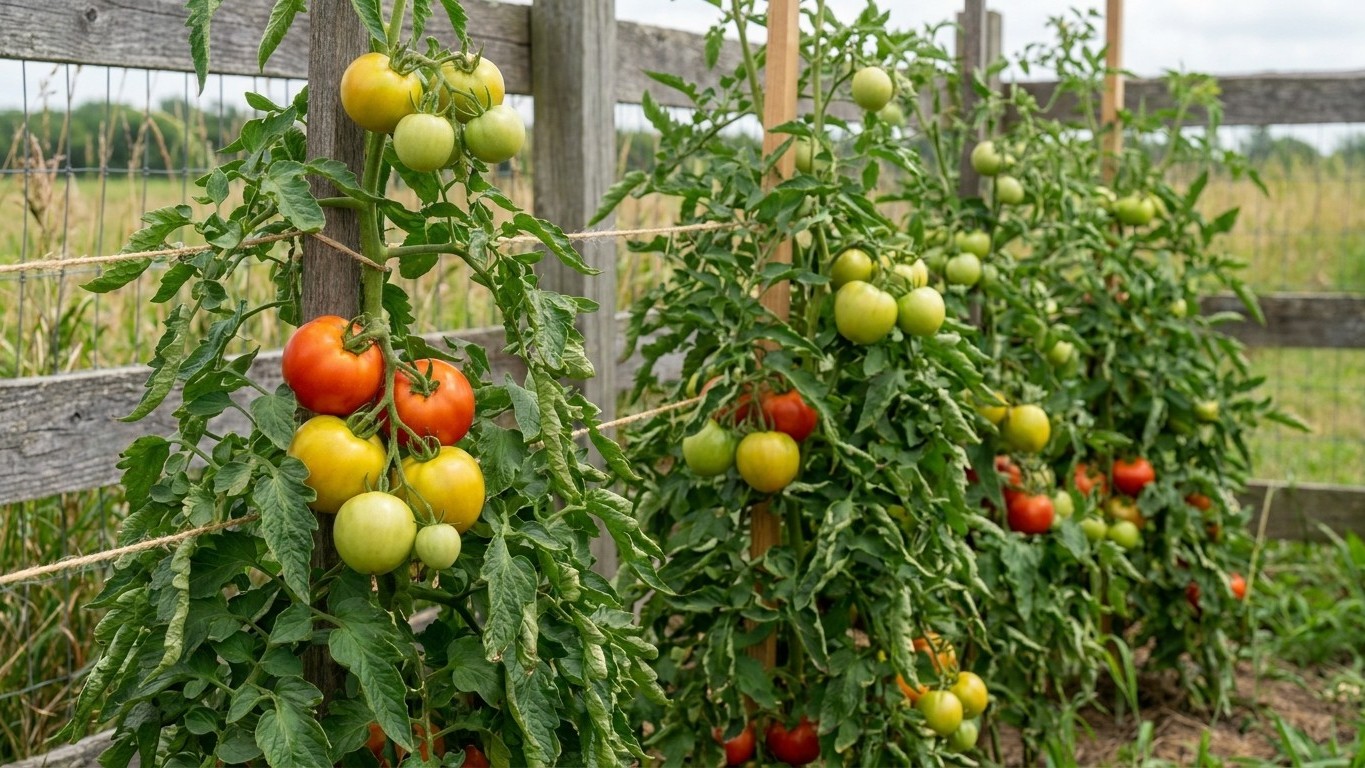

The short answer: pick by color and feel, not by the calendar, and treat mid-October as a soft deadline rather than a hard one. Ontario’s growing season runs on averages that shift year to year, so the real skill is reading the fruit and the sky together, then knowing what to do with whatever’s still green when the cold finally arrives.
When to pick tomatoes in Ontario
Ripeness on a tomato plant isn’t a single moment. It’s a slide from hard and green to a stage growers call “breaker,” when a faint blush of pink or yellow first shows at the blossom end. Once a fruit hits breaker, it’s already produced enough internal ethylene and sugar to finish ripening on its own, whether it stays on the vine or comes indoors. That single fact does more to answer “when to pick” than any date on a wall calendar.
The calendar still matters because it sets the outer boundary. Environment and Climate Change Canada’s 1981-2010 climate normals for the Toronto Lester B. Pearson International Airport station put the average first fall frost at October 16. That’s the number most Ontario gardeners lean on, but it’s a mean, not a promise. In roughly half of all years, frost at that station lands later than October 16; in the other half, it lands earlier, sometimes by a couple of weeks. Treat it as the midpoint of a window, not a safe date to plan around.
The spring side works the same way. The average last spring frost at that same station is April 30, which means the frost-free stretch most Ontario tomato growers are actually working with runs, on average, from roughly late April to mid-October. That’s a guide for backing out a planting window, not the topic here. What it means for harvest is simpler: once nights start dipping toward freezing in early-to-mid October, every tomato still on the vine is on borrowed time.
Location changes the math more than most gardeners expect. The Pearson station sits in the Greater Toronto Area; a garden in Northern Ontario or an upland area away from Lake Ontario’s moderating effect can see frost weeks earlier than that October 16 average. Ontario spans a Canadian plant hardiness rating as far south as zone 7a in the reference area tied to these normals, but that number covers seven climate variables (not the single-variable USDA system used south of the border), and it applies to one location, not the whole province. If your garden sits well north or at higher elevation, shift every date in this article earlier and watch your own thermometer more than the average.
Practically, that means checking plants daily once nights start cooling in late September. Any fruit at breaker stage or beyond can come off immediately if frost threatens. Fruit that’s still fully green needs a different decision, covered next.
What to do with the green ones
When frost is realistically days away, the choice isn’t whether to pick, it’s how. Two approaches work, and they suit different quantities of fruit.
The first is the whole-plant method: pull the entire plant by the roots before the freeze and hang it upside down in a garage, shed, or basement. The theory is that the plant’s remaining sugars and moisture keep feeding the fruit for a few more days, buying a little extra ripening time compared to fruit cut cold from a dead vine. It’s a reasonable option if you’ve only got a plant or two and limited space to sort fruit individually.
The second, and generally more reliable, approach is picking fruit individually and sorting it by maturity. This matters because not every green tomato is equally likely to ripen. A good field test: look at the blossom end (opposite the stem). If the tomato has reached what’s called the mature green stage, the interior gel has formed around the seeds and the skin has a slight waxy sheen; these will usually ripen indoors with reasonable success. Immature green fruit, smaller, matte-skinned, still rock-hard throughout, rarely ripens well and is more likely to shrivel or rot before it colors up.
Sorting fruit this way before frost hits saves a lot of disappointment later. A simple approach:
- Pick everything from breaker stage onward first; these are nearly ripe and need almost no help.
- Pick full-size mature green fruit next; these are your best bet for successful indoor ripening.
- Set aside small, hard, immature green fruit for the kitchen rather than the ripening tray, since they’re the least likely to color up.
That last category isn’t wasted. Immature green tomatoes are exactly what fried green tomato recipes, green tomato relish, and green tomato pickles call for. Rather than watching them sit and slowly rot on a windowsill while never turning red, using them fresh in a recipe within a day or two is often the better outcome. It turns a frost-driven harvest crunch into two separate paths instead of one long shot at ripening everything.
Ripening indoors, and how long they keep
Once tomatoes are inside, temperature does most of the work. Fruit ripens fastest in the range of roughly 55 to 70 degrees Fahrenheit, out of direct sunlight. That last part surprises people: a sunny windowsill looks like the obvious spot, but direct sun can heat fruit unevenly and encourage soft spots rather than even color development. A kitchen counter, a spare room, or a shaded shelf works better than a bright window.
Ethylene gas is the other lever. Tomatoes produce a small amount of it themselves, but pairing green fruit with a ripe banana or apple in a loosely closed paper bag concentrates that gas around the tomatoes and speeds up the color change. It’s not a dramatic shortcut, but it reliably shaves days off the process compared to open-air ripening on a countertop.
Checking and storing fruit as it ripens
Lay fruit in a single layer rather than piling it in a bowl or box. Contact points between tomatoes are where rot tends to start first, and a single bad tomato in a pile can take its neighbors down with it. Check the batch every few days, pull anything showing soft spots, wrinkling, or mold immediately, and move fruit that’s reached full color to the refrigerator or the counter for eating.
Refrigeration deserves a caution of its own. Temperatures below about 55 degrees Fahrenheit slow or stop the ripening process and degrade both flavor and texture in tomatoes that haven’t fully colored yet, which is why the classic advice is to never refrigerate a green or partially ripe tomato. Once a tomato is fully red and you’re not eating it same-day, the fridge is fine; before that point, it does more harm than good.
How long the whole process takes depends heavily on where a given fruit started. Breaker-stage tomatoes typically finish coloring within a week or so at room temperature. Mature green fruit takes noticeably longer and shows more variability, since some fruit in that category is closer to breaker than others. There’s no single published number that covers every batch, and this article won’t invent one, but a mature green tomato that hasn’t shown any color after several weeks indoors is unlikely to ripen at all and is better used green in the kitchen.
What goes wrong here
The most common mistake is trusting the average frost date as a firm deadline. Because October 16 is a mean drawn from the Pearson station’s 1981-2010 climate normals, plenty of years bring frost well before that date, and gardeners who wait until “the 16th” to start checking often lose a chunk of their crop overnight. Checking forecasts nightly through late September and early October, rather than watching a single date, avoids that surprise.
Wet fall weather causes a second cluster of problems. Ontario’s autumn often brings cooler, damper conditions than midsummer, and tomatoes picked during or right after a soaking rain carry extra surface moisture into storage. That moisture is exactly what accelerates mold on a countertop tray. Letting picked fruit air-dry for an hour before laying it out for ripening cuts down on this noticeably.
Overcrowding is the third recurring issue, and it’s an easy one to fix. Piling green tomatoes into a cardboard box for indoor ripening feels efficient, but it hides early rot until it’s spread to several fruit at once. A single layer, checked regularly, catches problems while they’re still isolated to one tomato.
Finally, gardeners sometimes pick immature green fruit expecting it to ripen like mature green fruit does, then blame the method when it shrivels instead. That outcome traces back to the fruit’s stage at picking, not to anything done wrong indoors. Sorting carefully before frost, as covered above, prevents most of this disappointment. For broader growing-season guidance specific to the province, Ontario’s agriculture ministry maintains resources at ontario.ca/page/agriculture-and-food.
Common questions
Can I ripen tomatoes on the vine after pulling the whole plant?
Yes, hanging a pulled plant upside down in a garage or basement is a workable method for a small number of plants, and some gardeners find it slightly extends ripening compared to fruit cut cold. It’s less practical than sorting and picking individually once you’re dealing with more than a plant or two.
Does the zone 7a rating mean I can leave tomatoes outside longer in fall?
Not reliably. That 7a figure is a Canadian hardiness zone tied to a specific reference location and built from seven climate variables, not a frost-date guarantee, and it doesn’t convert directly to the USDA zones used elsewhere in the U.S. Watch nightly forecasts rather than relying on a hardiness zone number to judge frost timing.
What temperature actually damages tomato plants and fruit?
The facts available for this page don’t include a specific frost or freeze threshold in degrees, so this article won’t invent one. What’s established is the average frost date itself, October 16 at the Pearson station, and the fact that it’s a midpoint, not a guaranteed safe cutoff.
How can I tell if a green tomato is mature enough to bother ripening?
Check the blossom end for a slight waxy sheen and full size for the variety, both signs the interior gel has formed around the seeds. Small, matte-skinned, rock-hard fruit is less likely to ripen well and is generally better used fresh in a green-tomato recipe than left on a ripening tray for weeks.