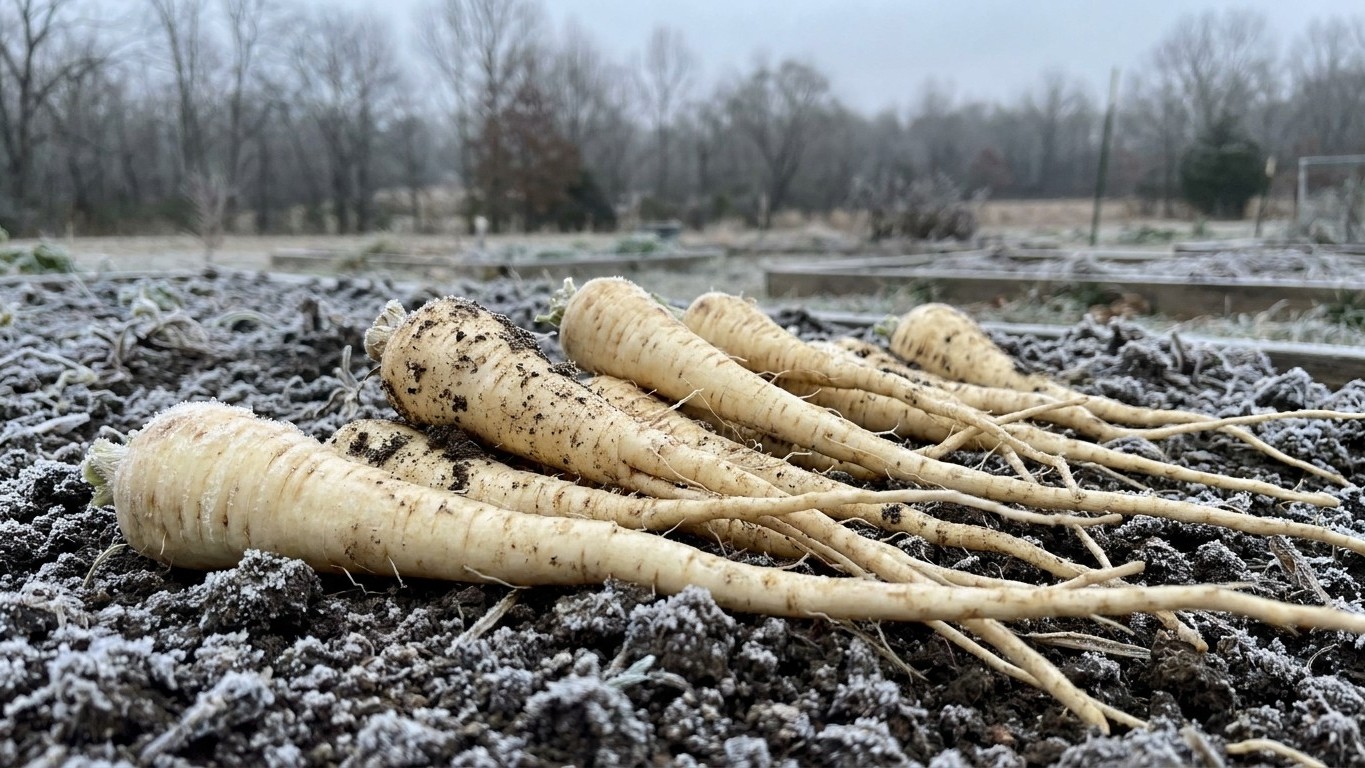

West of the Cascades, Oregon’s winters are too mild and too brief in their cold snaps to reliably sweeten parsnips the way a harsh continental winter would. The mean minimum for the coldest month sits at 36.2°F in the Portland area, a temperature that hovers right at the freezing line rather than dropping well below it for weeks on end. Parsnips grown here will size up fine. Whether they turn genuinely sweet is a different question.
The short answer
The number that matters isn’t the hardiness zone printed on a seed packet. It’s how many frosty weeks a place actually delivers, because that’s what triggers the starch-to-sugar conversion inside a parsnip root. At the Portland reference station, NOAA’s 1991-2020 Climate Normals put the mean daily minimum for the coldest month at 36.2°F. That’s an average of daily lows across the entire coldest month, not a record low and not a description of a single hard freeze. It sits above 32°F, which tells you something important: cold nights happen, but the month as a whole doesn’t sink into sustained subfreezing territory.
That’s the maritime signature of western Oregon. Storms off the Pacific keep temperatures moderate through winter, so frost arrives in scattered pulses rather than settling in for a stretch. A parsnip root sitting in Willamette Valley soil will see some frosty nights between fall and late winter, and each of those nights does trigger a bit of starch conversion. But “several frosty weeks” of the kind Utah State University Extension describes as ideal for sweetening is a harder ask in a place where the coldest month barely dips below freezing on paper.
Practically, this means gardeners west of the Cascades should expect a good, usable parsnip crop with a decent but not dramatic sweetness. Leaving roots in the ground through the coldest stretch of the season, rather than pulling them at the first light frost, gives them the best shot at converting whatever starch they can. Central and eastern Oregon sit in a different climate entirely, a high desert with harder and more sustained freezes that would push sweetening further. No specific coldest-month figure for those regions appears in the data behind this article, so that comparison stops at description rather than a number.
The honest takeaway: growing parsnips in the Portland area and similar valley locations produces a solid crop, not necessarily the deeply sweet, frost-kissed parsnip that gardeners in colder inland climates get after a real winter. The plant will grow well here. The sugar payoff is the part that’s uncertain.
Does the season fit?
Parsnips need 100 to 120 days from seeding to maturity, and they’re sown directly in place rather than started indoors and transplanted. Lining that requirement up against Portland’s frost calendar shows exactly how much room there is to work with.
- Set the sowing date. Seed goes in the ground 2 to 3 weeks before the last spring frost. With the Portland area’s last spring frost falling between March 6 and March 21, that puts sowing somewhere in mid-February to early March.
- Budget for germination first. Parsnip seed is slow. Expect 14 to 21 days before anything breaks the surface. A gardener who doesn’t see seedlings after a week hasn’t failed; the clock just hasn’t finished running. Digging up the row to check is the single most common way people accidentally undo a planting that was working fine.
- Count the full 100 to 120 days from seeding, not from emergence. The germination window is part of that total, so the plant only has roughly 80 to 105 days of active above-ground growth once it finally emerges.
- Compare that to the frost-free window. The gap between the last spring frost (March 6-21) and the first fall frost (November 11-27) runs somewhere in the neighborhood of 235 to 265 days in the Portland area. That’s a wide window.
- Judge the fit. A 100-to-120-day crop dropped into a 235-to-265-day window fits comfortably, with room to sow a bit later than the earliest recommended date and still finish well before the ground freezes hard. This is a low-pressure timeline for anyone gardening west of the Cascades.
Central and eastern Oregon’s high desert climate is a different calculation entirely, with a shorter frost-free stretch that squeezes the same 100-to-120-day requirement much tighter. No specific frost-date figures for those regions are part of the data used here, so gardeners east of the Cascades need their own local numbers rather than the Portland window above.
What goes wrong here
- Forked roots in heavy or stony ground. Willamette Valley soils often run heavy with clay, and a parsnip root pushing into compacted or rocky ground splits around the obstruction instead of growing straight. Utah State University Extension’s guidance is direct on this: parsnips want deep, sandy soil, and heavy soil has to be double dug before sowing to loosen it well below root depth.
- Forked roots from overwatering. This is a separate cause from soil texture, not a variation of it. Soil kept too wet encourages the taproot to branch rather than drive straight down. Water consistently but moderately, and let the top inch or two of soil dry between waterings rather than keeping the bed saturated.
- A season that runs out before the crop finishes. This is a minor risk west of the Cascades given the wide frost-free window, but sowing late, combined with a slow 14-to-21-day germination stretch, can still push a crop closer to the fall frost line than a gardener expects. Sow within the recommended window, 2 to 3 weeks before the last spring frost, to keep the full margin available.
- A winter too mild to sweeten. Given a coldest-month mean minimum of 36.2°F, the Portland area’s cold snaps may not be sustained enough for deep sugar conversion. The remedy isn’t a growing technique so much as patience at harvest: leave roots in the ground through the coldest run of nights available rather than pulling them at the first frost, giving whatever cold does arrive the maximum chance to work.
Handling parsnip foliage and roots carries a real skin risk, and it’s one most garden guides skip entirely. North Carolina State Extension states it plainly: “All parts of this plant contain furocoumarins which can make skin sensitive to light causing burns so be sure to wear gloves, long sleeves and long pants when dealing with it.” That’s every part of the plant, not just the leafy tops.
The mechanism is what makes this catch people off guard. The burn doesn’t come from the sap alone. It takes sap on the skin followed by sunlight hitting that same patch of skin, a reaction called phytophotodermatitis. That’s exactly why it shows up after a bright, sunny day spent harvesting or pulling tops in the garden, and why the mark often doesn’t appear until hours later, well after the work is done and the sap has already dried. Because sunlight is the second ingredient, washing the skin afterward isn’t the protection that matters. Covering up before handling the plant, with gloves, long sleeves, and long pants, is what actually prevents the reaction in the first place.
Checking this against your own county
The Portland-area frost dates and coldest-month figures used here describe a specific reference station west of the Cascades. A garden in Bend, Klamath Falls, or anywhere in central or eastern Oregon’s high desert is working with a genuinely different climate, and the numbers above shouldn’t be stretched to cover it. The most reliable next step is checking local data directly with Oregon State University Extension Service, which maintains county-level offices across the state and can supply frost dates and soil guidance specific to a given garden’s location. Their site is at extension.oregonstate.edu. A quick call or visit to the local county office is worth more than applying a Portland-based average to a garden two mountain ranges away.
Common questions
Can parsnips grow in the Portland area even if they don’t sweeten much?
Yes. The 100-to-120-day growing requirement fits comfortably within the region’s frost-free window, so the plant reaches full size without issue. Sweetness is the variable in question, not viability.
Should parsnips be harvested at the first frost or later?
Later, generally. Since sweetening depends on sustained cold exposure rather than a single frost, leaving roots in the ground through more of the cold season, rather than pulling at the first light frost, gives them more time to convert starch to sugar.
Why did my parsnip roots come out forked instead of straight?
Two separate causes produce this. Heavy, compacted, or stony soil forces the taproot to split around obstructions, which is why double digging matters in valley clay soils. Overwatering is a distinct cause, encouraging branching even in loose soil, so consistent rather than excessive watering matters too.
Is it safe to compost or handle parsnip tops without gloves?
No. Every part of the plant contains furocoumarins that can sensitize skin to sunlight and cause burns, according to NC State Extension. Gloves, long sleeves, and long pants are the recommended protection whenever handling any part of the plant, not just the roots.