
Collards go into Pennsylvania ground once the soil has caught up with the calendar, which in the Philadelphia region means late March into early April, and two to four weeks later across the northern tier and the Alleghenies. The crop shrugs off a light frost but not a hard freeze, and the state’s cold winters (26°F average low in the coldest month) decide whether collards stand all winter or finish as an autumn-only crop.
When the soil is warm enough in Pennsylvania

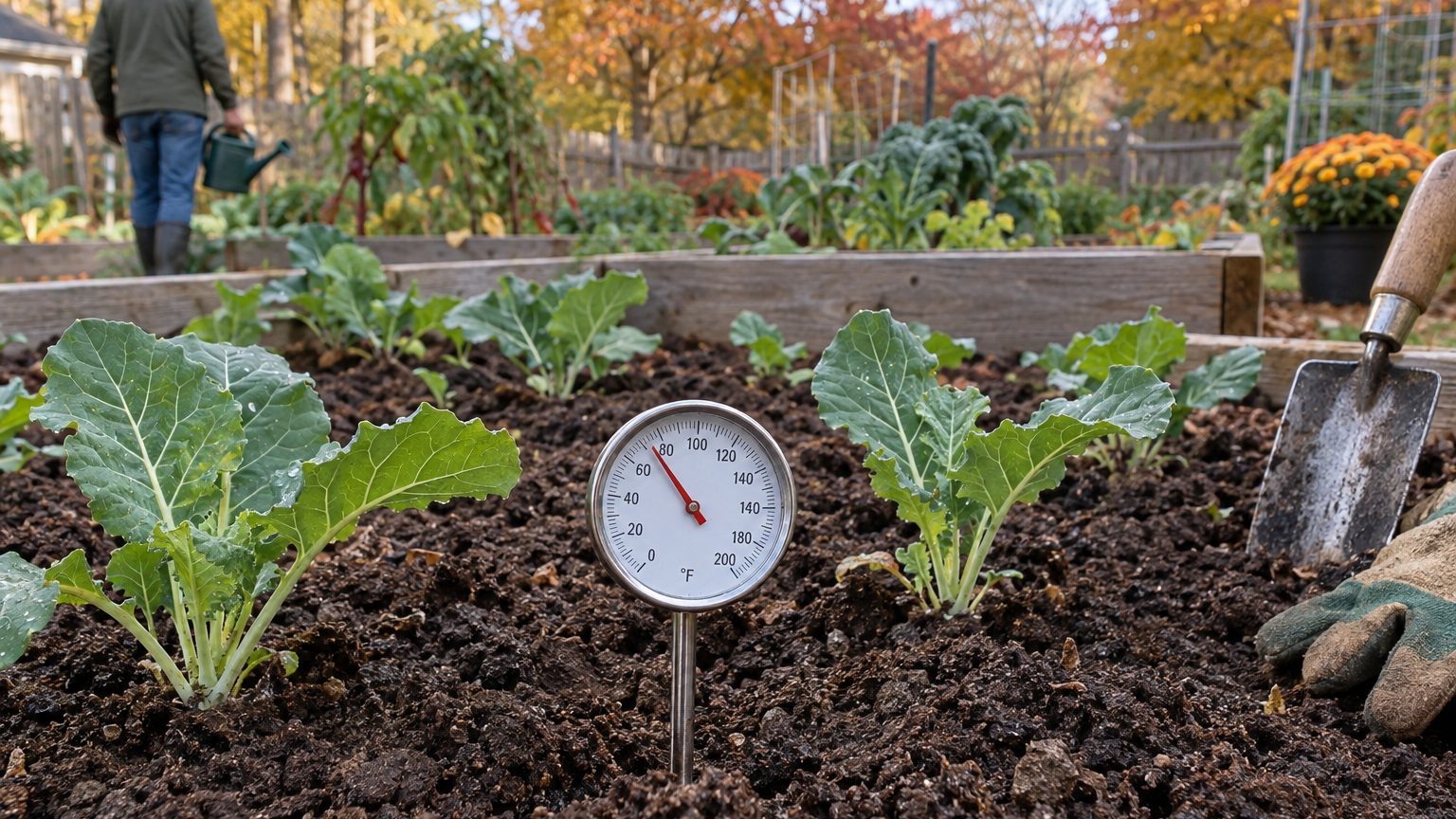
Frost dates get all the attention, but they’re a stand-in for the figure that actually governs germination and root growth: soil temperature. Collard seedlings sit and sulk in cold ground even after the air has cleared the frost threshold, so a gardener who transplants the day frost risk ends is often planting into soil that hasn’t caught up yet. For the Philadelphia climate station, NOAA’s 1991-2020 Climate Normals put the last spring frost, defined as the 30-70% probability band for a 32°F freeze, between March 29 and April 6.
That window is a probability, not a promise. Some years the last frost lands earlier, some years later, and the further you move from Philadelphia the later spring arrives. The mildest corner of the state, along the lower Delaware Valley, warms first. The northern tier counties and the higher ground of the Alleghenies run two to four weeks behind that same date range, so a gardener in Erie or Somerset County should treat early April as far too soon and wait for the local ground to actually warm.
What this means for collards is straightforward once you separate the two ideas. Frost defines when it’s safe to set plants outside without losing them to a freeze. Soil warmth defines when they’ll actually grow instead of stalling. Direct-seeded collards benefit most from waiting an extra week or two past the frost date, since cold soil slows germination more than it slows an established transplant. Transplants started indoors and hardened off can go out closer to the frost window itself, because they’ve already done their slow growing in controlled conditions.
Type matters more than variety name here. Earlier-maturing collard types handle a compressed spring window better in the parts of the state where the last frost runs later, while types bred for extended standing tolerate the wait for soil warmth without bolting. Rather than naming a specific cultivar this page can’t verify for Pennsylvania conditions, the better move is checking which types Penn State Extension has actually trialled in your county, since that list changes with soil, elevation, and local disease pressure in ways a general guide never captures.
How long the season lasts here
Bookend the last spring frost against the first fall frost and the frost-free window in the Philadelphia area runs from around April 6 to November 5 at the tightest, or March 29 to November 16 at the widest, since NOAA’s Climate Normals give both dates as ranges rather than single days. Taking the conservative pairing (latest spring frost to earliest fall frost) yields a frost-free stretch of roughly 213 days, close to seven months.
That length changes what’s worth planting. A 213-day window is long enough for two collard sowings in the milder parts of the state: an early crop that comes in ahead of summer heat, and a second sowing timed so it matures after the worst heat breaks but before the first fall frost shuts things down. In the higher, colder parts of Pennsylvania where the frost-free season shrinks, that math doesn’t hold. A single spring sowing, carried through summer and picked into fall, is often the only realistic plan, and transplanting becomes less a convenience and more a requirement for getting a crop matured before frost.
The gap between those two situations is exactly why a blanket planting calendar for “Pennsylvania” undersells the state’s range. Philadelphia’s extended window supports succession sowing the way a shorter Alleghenies season simply can’t. Anyone trying to plan a second or third collard planting around that longer window should work from the succession sowing approach on the main collards guide rather than assuming the frost dates from one end of the state apply at the other.
Elevation and local frost pockets shift both ends of that window in ways the state-level normals can’t show. A valley bottom that pools cold air will see frost days later in spring and earlier in fall than a slope a few hundred feet higher, even within the same county. That’s the kind of detail no climate normal captures, and it’s worth watching for two or three seasons in a specific garden before locking in a planting date.
Heat and water in Pennsylvania

This page doesn’t have a sourced count of days above 90°F or a summer rainfall total for Pennsylvania, and rather than guess at numbers that would misrepresent the state, it’s worth being upfront about that gap and working instead from the figure that is sourced and that actually decides how a collard bed gets planned here: the coldest-month minimum.
Philadelphia’s coldest month averages a minimum of 26.0°F, according to NOAA’s 1991-2020 Climate Normals. That number, not the summer heat, is what determines whether collards behave as a standing winter crop or an autumn-only one in a given Pennsylvania location. Where winter lows stay in that range or milder, collards can be picked leaf by leaf from November into March, since the plant tolerates repeated light freezes and often sweetens after a cold snap. Where winter drops harder than that (which describes much of the state outside the southeastern corner, given the statewide hardiness range of zone 5a to 7b), the crop is better planned as an autumn harvest that wraps up at the first hard freeze rather than a bed left standing through deep winter.
That zone range itself is worth reading carefully. USDA’s Plant Hardiness Zone Map, built from the average annual extreme minimum temperature, spans 5a to 7b across Pennsylvania, which is a wide enough range that citing “the state” means very little for a planting decision. A gardener in the Philadelphia zone 7 corridor is planning a genuinely different winter than one in a zone 5a pocket of the Alleghenies, and the coldest-month figure for the local area matters more than the statewide range.
On the water side, Pennsylvania’s humid continental climate brings steady rainfall through the growing season in most years, though this page doesn’t have a specific rainfall total to cite. What that humidity reliably brings, regardless of the exact number, is pressure from foliar disease. Collards grown in tight spacing with poor airflow are more prone to mildew and leaf spot in a humid mid-Atlantic summer than the same plants spaced generously with room for leaves to dry between rains.
Which collards suit Pennsylvania
None of this points to a single named variety, and that’s deliberate. The types trialled and recommended for Pennsylvania conditions are published by Penn State Extension, and they’re the only recommendation grounded in actual local trial data rather than a general guide guessing at what performs well across a state with a 5a to 7b hardiness spread. A cultivar that thrives in the Piedmont clay around Philadelphia isn’t necessarily the one bred for the shorter, cooler season of the Alleghenies, and naming one here would be a guess dressed up as advice.
What’s reasonable to say is which traits matter more given this state’s facts. Where the frost-free window runs shorter, in the northern tier and higher elevations, earlier-maturing types are worth prioritizing over slower, larger-leaved ones, since they have a better chance of reaching a useful harvest before the season closes. Where the coldest month stays mild enough to support standing winter harvest, cold-hardy types bred for extended field standing make more sense than ones selected purely for a fast single cutting.
Humidity is the other filter. In a climate where summer moisture brings real mildew and leaf-spot pressure, disease resistance belongs at the top of the list, ahead of leaf size or color. That’s also where crop family matters: collards are brassicas, in the same family as cabbage, kale, mustard, turnip, and rutabaga, and they share the same soil-borne diseases and pest pressures as all of them. Planting collards where any of those crops grew the previous season, or rotating them into a bed that just finished cabbage, doesn’t count as rotation at all. The main collards growing guide lays out a workable rotation sequence, and it’s worth following before the type of collard chosen ever becomes the limiting factor.
Set against neighboring states, the differences are less about variety and more about which climate facts drive the decision. Match the collard type to the local coldest-month low and the local frost window, not to the state name on the seed packet.
| Territory | Last spring frost | Coldest month min (°F) | USDA zone range |
|---|---|---|---|
| Pennsylvania (Philadelphia) | March 29 to April 6 | 26.0 | 5a-7b |
| Colorado | Varies by elevation, see territory page | See territory page | See territory page |
| Illinois | Varies by region, see territory page | See territory page | See territory page |