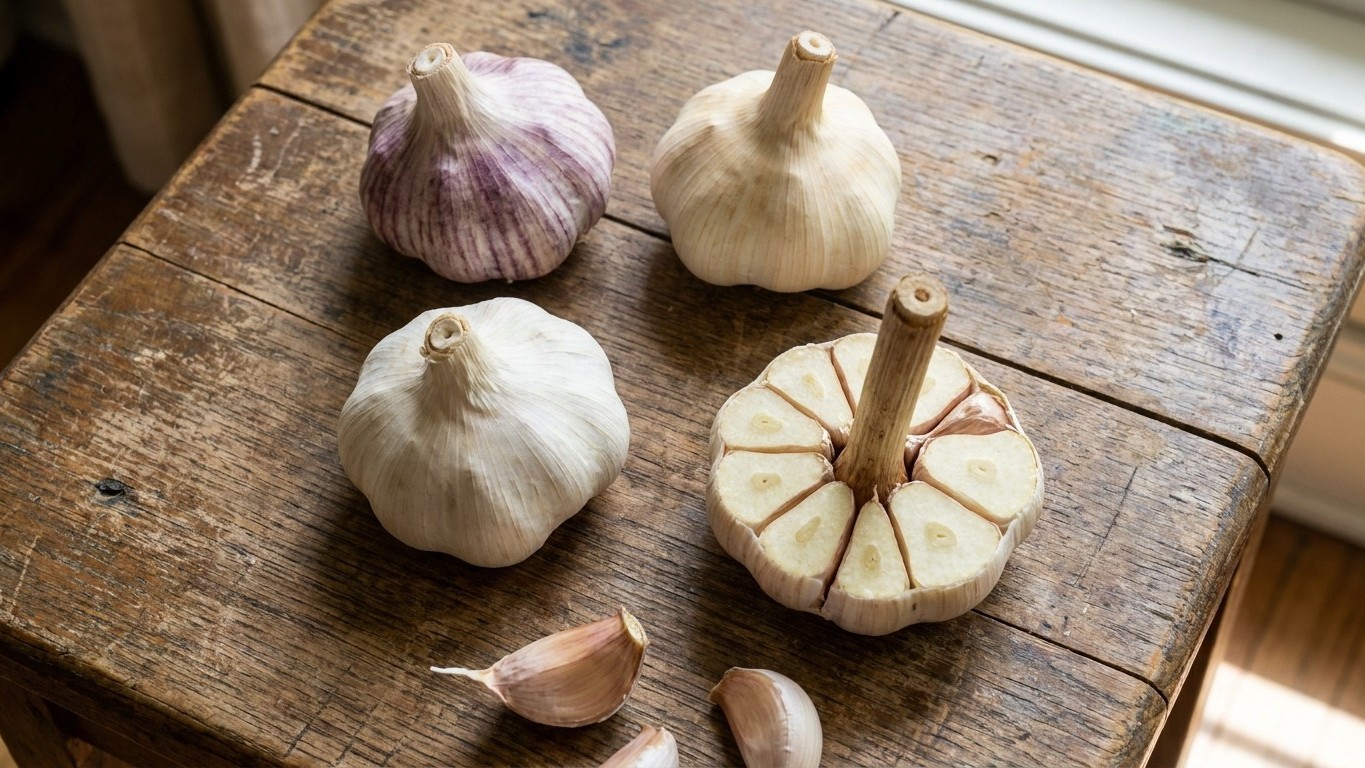

In most of Pennsylvania, garlic planted the previous fall comes out of the ground between late June and mid-July, once the bottom leaves have browned and the top five or six stay green. But that window shifts by region and by season, and the visual cues matter more than any date on a calendar. Here’s how to read them, cure the bulbs properly, and keep them sound through a Pennsylvania winter.
When garlic is ready to lift in Pennsylvania
The leaf count is the real clock. Garlic foliage tracks the layers of wrapper around the bulb underneath it, so when roughly half the leaves have gone brown or yellow and the rest are still upright and green, the bulb has usually finished sizing. Pull too soon, while eight or more leaves are still green, and the wrapper hasn’t thickened enough to protect the cloves through curing. Wait until every leaf has collapsed, and the bulb has often already split its skin underground, letting soil and moisture into the clove wrappers.
A test dig settles the question faster than staring at leaves. Loosen the soil around two or three plants a few days before you think you’re ready, lift one bulb, and brush off the dirt without peeling it. Clove segments should be distinct and the wrapper should still feel snug, not papery-loose or, at the other extreme, still fused into a single round mass with no visible clove lines.
Why the date moves around the state
Because garlic goes into the ground in autumn and comes out the following summer, the whole cycle is set by how fast the soil warms in spring, not by any single fall marker. NOAA climate data for the region shows that Philadelphia and the southeastern corner warm up earliest, while the northern tier and the Alleghenies run two to four weeks later in spring. That lag carries straight through the growing season, so a bed in Erie or Potter County can still have green leaves when a bed outside Philadelphia is already three-quarters brown. Growers in the higher, cooler counties should expect to check bulbs into late July rather than assume an early-July date applies statewide.
Weather in the weeks before harvest matters too. A stretch of heavy rain can make leaves look greener and healthier than the bulb underneath actually is, delaying the decision past the ideal point. If rain is forecast, it’s worth lifting a test bulb a few days early rather than waiting for a dry stretch that might not come until the bulbs have already started to split.
Curing it, and where to hang it here
Curing is what turns a freshly dug bulb into something that will keep for months instead of rotting in a week. The bulbs need three to four weeks in a spot that’s dry, shaded, and has steady airflow, with the roots and stems still attached and the dirt left on rather than washed off. Washing bulbs before curing traps moisture against the clove wrappers and invites mold before storage even begins.
Pennsylvania summers make the airflow part non-negotiable. July and August humidity in much of the state, especially the southeast and the river valleys, sits high enough that garlic hung in a still, closed space can mildew before it finishes curing. A garage with the door cracked and a box fan running, a covered porch with cross-breeze, or a barn loft with open vents all work better than a closed basement or a sealed shed. Bundling stems in small groups of six to ten bulbs and hanging them, rather than stacking bulbs in a pile, keeps air moving around every bulb instead of just the ones on top.
Signs curing is finished
The wrapper leaves turn papery and rustle rather than feel cool and pliable, the roots dry to a stiff brittle mass, and the neck above the bulb, if you press it, feels tight and dry rather than soft or damp. Only after that point should stems be trimmed to an inch or two above the bulb and roots snipped close. Trimming a green, undried neck seals in moisture and shortens storage life before the garlic even reaches the pantry.
Growers who want more detail on regional pest and disease pressure during the growing season can check Penn State Extension, which covers vegetable crops county by county across the state.
Storing it through a Pennsylvania winter
Once cured, garlic keeps best somewhere cool, dark, and dry, ideally in the range most root cellars and unheated basements naturally sit in through fall and winter. Mesh bags, loosely woven baskets, or shallow cardboard boxes with a few air holes all let the bulbs breathe; sealed plastic containers trap humidity and bring mold back into the picture even after a good cure. Braiding softneck stems together and hanging the whole braid is another option that keeps air circulating around every bulb.
Where you put that storage matters as much as the container. An unheated garage or detached shed works fine into fall, but Pennsylvania’s first fall frost lands somewhere between November 5 and November 16 across most of the state, based on NOAA climate normals for the period 1991-2020. That date is a midpoint, not a guarantee: in one year out of two, the first freeze arrives later than that window, and in the other half it arrives earlier. Either way, once temperatures start dropping toward freezing, an unheated outbuilding can swing below 32°F on cold nights, and garlic exposed to hard freezing in storage turns soft and eventually breaks down. A basement, an insulated closet, or an attached but unheated room that stays a few degrees above freezing is a safer bet than a detached shed once fall turns toward winter.
Check stored bulbs every few weeks over the winter. Any bulb that’s gone soft, sprouted a green shoot, or developed a sour smell should come out before it affects its neighbors in the same bag or box. A little sprouting is normal by late winter as bulbs sense lengthening days, even in cold storage, and doesn’t mean the whole batch is failing.
What goes wrong here
Mold is the most common failure, and it almost always traces back to moisture at some stage, either bulbs pulled after a rain and cured without enough airflow, or bulbs washed before hanging. The fix is upstream of storage: dry conditions during curing prevent most of the problems that show up later in the pantry.
Pests are a smaller factor for garlic specifically than for many other vegetables, but they’re not zero. Penn State Extension documents a range of pests affecting crops across the state, and among the ones on that list, onion maggot and aphids are the two most relevant to garlic, since both target alliums directly. Onion maggot larvae can tunnel into bulbs still in the ground or freshly lifted, weakening the base plate and letting rot start early; aphids cluster on foliage earlier in the season and can stress plants enough to reduce bulb size, though they rarely damage the bulb itself once it’s underground. Neither pest is unique to garlic in Pennsylvania, but they’re the two documented species most likely to intersect with a garlic bed.
Temperature swings during storage cause a different kind of failure. Garlic held somewhere that cycles between cold nights and warm days, like an attached garage that gets some heat bleed from the house, tends to sprout early or soften faster than garlic held at a steady temperature. A consistent, moderately cool spot beats a colder spot that fluctuates.
Common questions
Can I harvest garlic early if the leaves are still mostly green?
It’s better to wait or run a test dig first. Bulbs pulled while most leaves are still green often haven’t finished sizing, and the wrapper hasn’t thickened enough to survive curing without shrinking or drying out unevenly.
How do I know curing is actually finished, not just started?
The neck should feel dry and tight when pinched, not soft or cool, and the outer wrapper should rustle like paper rather than feel pliable. That usually takes three to four weeks with good airflow, longer in a humid stretch.
Can cured garlic go in the refrigerator for winter storage?
Refrigeration isn’t the best long-term option. The cold, humid environment inside most refrigerators can trigger early sprouting or introduce moisture that a dry basement or unheated closet won’t. A cool, dark, dry room is a better match for cured bulbs.
Does hardneck or softneck garlic store differently?
Softneck types generally hold up longer in storage than hardneck types, though exact keeping time depends heavily on how well the bulbs were cured and how stable the storage temperature stays, rather than the variety alone.