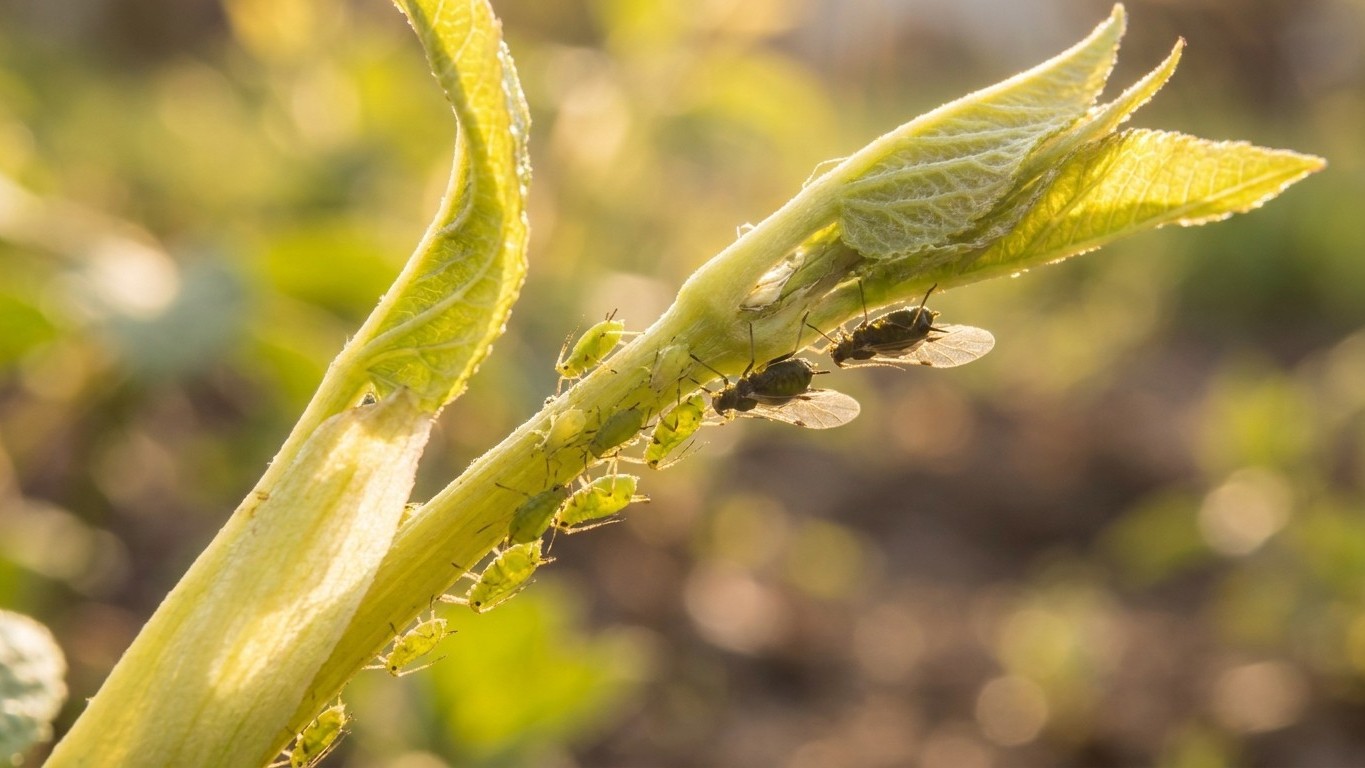

Aphids show up the moment tender new growth breaks in spring, and they keep showing up all season because they don’t rely on a single hatch date the way many pests do. The exact week depends on regional warmth, not a fixed spot on the calendar, and the insect’s biology, reproducing without mating for most of the year, is what turns a handful of stowaways into a colony almost overnight.
The stages, in order

Aphids (family Aphididae) skip the larva-and-pupa routine that defines moths or beetles. There’s no cocoon stage here. Instead, an aphid hatches or is born as a nymph that already looks like a miniature, wingless version of the adult, and it simply molts several times, growing bigger with each shed skin, until it reaches full adult size in about a week to ten days under warm conditions.
What makes this group unusual is how most of that life cycle unfolds. For the bulk of the growing season, female aphids reproduce through parthenogenesis, meaning they don’t need a mate at all. They give birth to live nymphs, already developing, rather than laying eggs. One female can produce several nymphs a day, and those nymphs mature and start reproducing themselves within roughly a week. Run that math over a month and a single stowaway on a rose bush becomes a colony numbering in the hundreds, sometimes thousands, without a single male ever entering the picture.
Only in autumn, as daylight shortens and temperatures drop in colder territories, do winged males and egg-laying females appear. That sexual generation mates, and the females lay true eggs, small, oval, often yellowish turning to black, tucked into bark crevices or bud scales. Those eggs are the version built to survive winter.
What a gardener actually sees
The stage homeowners notice is almost always the nymph-and-adult cluster: soft-bodied, pear-shaped insects packed onto the undersides of leaves and along new shoots, often accompanied by a sticky honeydew residue and, later, a black sooty mold growing on that residue. Ants tending the colony are a strong tip-off too, since they harvest the honeydew and will actively defend the aphids from predators.
What almost nobody sees is the egg stage. Those eggs are tiny, camouflaged against bark, and laid in places nobody thinks to check in November. By the time damage is visible again in spring, it’s nymphs and adults doing the feeding, piercing plant tissue and withdrawing sap, which causes the curled, yellowing, distorted growth that usually triggers the first search for “what’s wrong with my plant.”
When it appears, and why that varies
Aphid emergence tracks accumulated warmth, not a printed date. Overwintering eggs hatch once a plant’s tissue and the surrounding air have logged enough cumulative heat units, a threshold entomologists track using degree-day models rather than a fixed day on the calendar. That’s why the same species can appear on roses in one state while gardeners two states north are still waiting, sometimes by several weeks, for their own plants to leaf out enough to host the first colony.
Latitude is the obvious driver, but it isn’t the only one. Microclimate matters just as much: a south-facing wall, a sheltered courtyard, or an unusually mild stretch of late winter can push local warming ahead of the regional average, meaning two yards a few miles apart can see their first aphids on noticeably different weeks. Elevation works the same way in reverse, delaying emergence in higher terrain even within a single county.
Host plant matters too. Aphids that overwinter as eggs on a woody host need that host’s buds to swell before the hatch makes biological sense, since newly emerged nymphs need soft tissue to feed on immediately. A tree or shrub that breaks dormancy early effectively sets the aphid’s start date for that location, which is one reason the same species can seem to “arrive early” on an ornamental plum but late on a nearby oak.
Why a national date doesn’t work
Because the trigger is cumulative heat rather than the calendar, any single date printed for the whole country would be wrong for most readers most years. University extension services track local degree-day accumulation and publish territory-specific emergence windows and monitoring guidance for exactly this reason, updating them as seasons run warmer or cooler than average. The right move is checking the guidance for your own state or region rather than relying on a generic timeline, and this site’s territory-specific page for your area links to that extension resource directly.
One generation or several
Aphids are a multi-generation pest, and that single fact reshapes how long a gardener needs to stay alert. This isn’t an insect that hatches once, causes a defined window of damage, and disappears for the year. Thanks to parthenogenetic reproduction, a colony can cycle through a new generation roughly every one to two weeks during warm weather, which means a warm growing season can produce ten, fifteen, or more overlapping generations between spring and fall.
That overlap is the part that catches people off guard. Because reproduction doesn’t require synchronized mating, a single colony contains nymphs, newly matured adults, and heavily pregnant females all at once, at every stage simultaneously. There’s no clean generational break where the population resets to zero. Treat a visible cluster and, without follow-up, a new wave from the same colony can rebuild within days, especially on fast-growing new shoots that keep producing the soft tissue aphids prefer.
Warm, humid conditions accelerate the cycle further, while a stretch of cool weather slows reproduction without stopping it outright. That’s different from pests with a single defined generation, where missing the window effectively ends the year’s threat. With aphids, missing one wave just means meeting the next one, often on the same plant, within a couple of weeks.
What that means for monitoring
Season-long vigilance, not a one-time inspection, is the realistic approach. Checking new growth every week or two during the active growing season catches colonies while they’re small, before honeydew, sooty mold, and visible leaf curling set in. Watching for natural enemies matters just as much as watching for aphids themselves.
- Lady beetles (Coccinellidae), both adults and their spiky larvae, are voracious aphid predators.
- Lacewings (Chrysopidae), particularly the larval stage, consume large numbers of aphids per day.
- Parasitic wasps in the subfamily Aphidiinae lay eggs inside aphids, eventually killing the host.
- Hover fly larvae (Syrphidae) feed directly on aphid colonies and are often mistaken for pests themselves.
Broad-spectrum insecticide use tends to wipe out these natural enemies faster than it controls the aphids, which is one reason repeated spraying often makes the multi-generation problem worse rather than better over a season.
Where it spends the winter
Overwintering strategy is what makes next spring predictable, and aphids use more than one approach depending on climate and species. In colder territories, the eggs laid by the autumn sexual generation are the survival mechanism, tucked into bark crevices, bud scales, or other protected spots on a woody host plant. Those eggs tolerate freezing temperatures that would kill an active nymph outright, and they simply wait for spring warmth to trigger the hatch.
In milder climates, or wherever a suitable host stays green through winter, some aphids skip the egg stage entirely and continue reproducing asexually at a slower pace right through the cold months, especially on evergreen ornamentals or in sheltered locations. Greenhouses and indoor plants offer the same loophole year-round, since a stable, warm environment lets a colony persist indefinitely without ever needing the cold-hardy egg stage at all.
A number of aphid species also practice host alternation, moving between a woody primary host in fall and winter and an herbaceous secondary host, often a garden vegetable or ornamental, during the growing season. That shift explains why a colony can seem to appear from nowhere on a vegetable bed each spring: the source was a shrub or tree nearby all along, not the vegetable bed itself.
Why autumn cleanup matters here
Because eggs and, in milder zones, active colonies overwinter directly on plant material, what gets left standing in a garden bed in October has a direct line to what emerges in spring. Fallen leaves, plant debris, and old stems near known host plants can shelter eggs or slow-moving colonies through winter, effectively banking next year’s starting population close to where this year’s problem occurred.
Clearing that debris, and inspecting the bark and buds of woody hosts that had aphid trouble during the growing season, gives a realistic head start before the following spring’s degree-day accumulation triggers the next hatch. It won’t eliminate the population regionally since aphids move between properties easily on wind currents and winged adults, but it reduces the odds that the exact same colony picks up right where it left off on the exact same plant.
Common questions
Do aphids bite or harm people?
No. Aphids feed exclusively on plant sap through a needle-like mouthpart called a stylet and have no interest in biting humans or pets. Their damage is limited to the plants they colonize.
Why do I keep seeing ants near an aphid colony?
Ants feed on the sugary honeydew aphids excrete as a byproduct of sap feeding, and many ant species actively protect aphid colonies from predators like lady beetles in exchange for that food source. Seeing ants patrol a plant is often the first visible clue that an aphid colony is established nearby.
Can one aphid start an entire infestation?
Yes. Because most aphid reproduction is parthenogenetic, a single female that lands on a suitable host can begin producing live nymphs without ever mating, and those nymphs mature and reproduce within about a week, allowing one insect to seed a colony numbering in the hundreds within a month.
Does cold weather kill aphids for good?
Not reliably. Active nymphs and adults die in hard freezes, but the eggs laid by the autumn sexual generation are built to survive winter cold, and in mild climates or indoor environments some colonies simply keep reproducing at a reduced pace all winter without needing eggs at all.