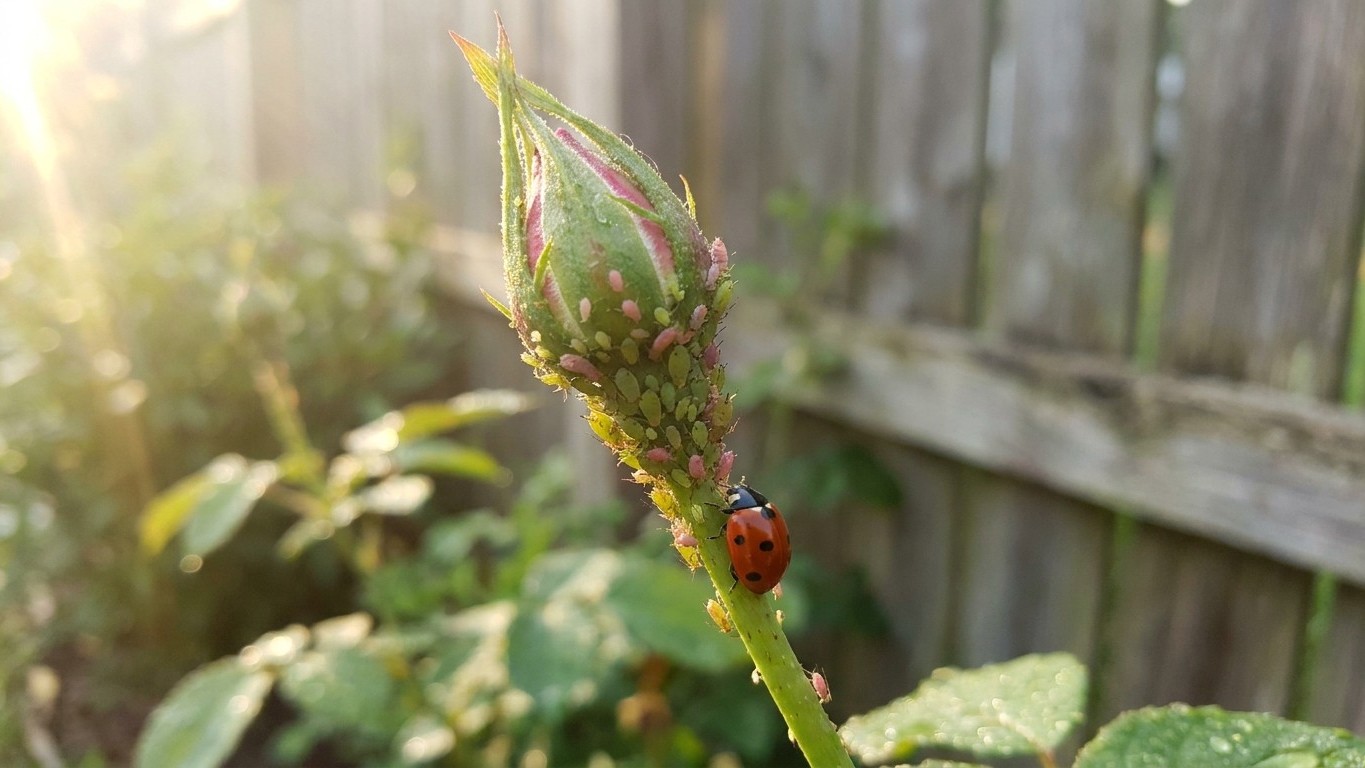

Aphid control that actually works combines three things at once: catching the population at the right growth stage, using physical and cultural tactics before reaching for anything else, and protecting the natural enemies already patrolling your yard. A spray applied at the wrong moment, or one that wipes out ladybugs along with the aphids, often makes next month’s infestation worse than this month’s.
Timing beats product

Here’s the piece most advice skips: aphids (Aphidoidea) reproduce without mating for most of the growing season. Female aphids give birth to live young, already pregnant with the next generation, in a cycle called parthenogenesis. That’s why a handful of aphids on a rose bud can become several hundred within days, and why an intervention timed even a week late can miss the window entirely.
This biology changes what “control” means in practice. Spraying, releasing beneficial insects, or hand-picking after the colony has already produced winged forms that disperse to new plants does almost nothing for the infestation you’re looking at. The population has already moved on. Conversely, acting during the early wingless-nymph stage, before that population explosion, can knock back an entire colony with minimal effort.
The stages that matter (egg overwintering, nymph buildup, winged dispersal) don’t happen on the same calendar everywhere. Before deciding on any tactic below, it’s worth reading through the aphid life-cycle page on this site, because it lays out what each stage looks like and why the sequence, not the calendar date, is what should drive your timing.
One more honest point: a single treatment rarely ends the problem. Because reproduction is so fast and continuous, most effective approaches involve monitoring over several weeks rather than a one-time fix. Checking the undersides of new growth every few days during active feeding periods tells you more than any fixed schedule could.
What works without a product
Several tactics reduce aphid numbers without any pesticide, though they demand different amounts of effort and timing.
- Row covers and physical barriers: effective only when installed before aphids arrive, typically right after planting or transplanting. Once aphids are established underneath, the cover just protects them from predators. Covers also need removal during flowering for pollinated crops.
- Hand removal: works well on small infestations, houseplants, and ornamentals where colonies are visible and contained. A strong jet of water or a gloved hand crushing clusters can cut numbers fast, but it has to be repeated every few days since it doesn’t touch eggs or nymphs hidden in curled leaves. Labor-intensive, and not practical on a large vegetable bed or an orchard.
- Trap crops: planting something aphids prefer (nasturtiums are a common choice) near the main crop can pull colonies away, but only if the trap crop is established and attractive before the target crop reaches its vulnerable stage. Plant it too late and the aphids never bother switching over.
- Planting timing: shifting planting dates to avoid the peak emergence window for local aphid populations sidesteps the worst pressure altogether. This is one of the few tactics that requires almost no ongoing labor, but it depends on knowing the local emergence pattern, which again varies by region and season.
- Fall and winter cleanup: removing plant debris, weeds, and overwintering host material reduces the eggs and adults that restart the cycle next spring. It’s a once-a-year task, but skipping it means starting the next season with a head start already given to the pest.
None of these are magic. They’re most effective layered together, and least effective when used alone on an infestation that’s already past the early nymph stage.
The allies you already have
Long before any product gets involved, a functioning yard usually has predators already working on aphids. The most consistent ones are lady beetles (Coccinellidae), whose larvae are actually more voracious aphid eaters than the familiar spotted adults; green lacewings (Chrysopidae), whose larvae are sometimes called “aphid lions” for good reason; parasitic wasps in the subfamily Aphidiinae, which lay eggs inside aphids and leave behind the telltale swollen, papery “mummies”; and hoverfly larvae (Syrphidae), which look unremarkable but can each consume dozens of aphids a day.
These predators don’t show up overnight. Populations of lady beetles and lacewings typically build a few weeks behind the aphids they feed on, which is part of why an early, isolated aphid colony sometimes resolves itself if left alone for a short window rather than sprayed immediately.
This is also the point where a lot of well-meaning treatment backfires. A broad-spectrum insecticide doesn’t distinguish between the aphid and the lacewing larva eating it. Kill both, and the aphids, which reproduce far faster thanks to that parthenogenetic cycle, rebound within days. The predators, which reproduce more slowly and need aphid prey to sustain their own populations, take much longer to recover. The result is a yard with more aphids and fewer of the insects that used to keep them in check, sometimes within the same growing season.
Protecting these allies mostly means restraint: avoiding unnecessary broad-spectrum applications, leaving some flowering plants (dill, yarrow, and alyssum are commonly recommended) that give adult lacewings and hoverflies a nectar source, and treating spot infestations locally rather than blanket-spraying an entire bed or tree when only one section shows damage.
When a product is the answer
There’s an honest case for treatment, and it usually applies when a colony has already outpaced what physical removal and natural predators can manage, often on a high-value plant, a food crop close to harvest, or an infestation that’s spread across multiple plants before predators arrived.
Even then, timing still governs whether a product does anything useful. Materials that target aphids generally work best against the earlier nymph stages, before winged adults have dispersed and before dense, waxy colonies (common on some aphid species) start shielding individuals from contact treatments. Applying to a colony that’s already producing winged dispersers treats a problem that’s already left the plant.
What this site won’t do is name a specific product, brand, or application rate here, and there’s a real reason for that beyond caution. Which materials are permitted for aphid control, at what concentration, and under what conditions, differs by state and changes from season to season as registrations are reviewed and updated. A recommendation that’s accurate for one territory this year can be outdated or simply illegal in another. The authority on that detail is each state’s university extension service, not a national gardening article.
This site carries a dedicated page for your territory that names the extension service and links to its current guidance, including which materials are registered locally and what application windows they recommend. That’s the resource to check before buying anything, and it’s updated as state guidance changes, which a printed or generic article can’t keep up with.
If you do treat, targeted options (insecticidal soaps and horticultural oils, applied directly to visible colonies) tend to spare more of the predator population than broad-spectrum alternatives, precisely because they act on contact and break down quickly rather than persisting on the plant. Confirming what’s currently permitted and effective for your specific aphid species and region is still a conversation for your local extension office.
Common questions
Why do aphids keep coming back after I spray?
Because most sprays kill visible aphids but not the eggs, hidden nymphs, or the winged adults that have already flown to a neighboring plant. Combined with parthenogenetic reproduction, surviving individuals can rebuild a colony within days, especially if the same spray also killed the lady beetles and lacewings that would otherwise have kept numbers down.
Can I just let natural predators handle an aphid infestation?
Sometimes, particularly with early, isolated colonies, since predator populations often catch up within a few weeks. But by the time an infestation is heavy or spread across many plants, predators alone usually can’t reproduce fast enough to keep pace, and some intervention (physical removal, targeted treatment, or both) becomes more realistic.
Do ants make an aphid problem worse?
Ants often protect aphid colonies from predators because they feed on the sugary honeydew aphids excrete. Where ants are farming aphids on a plant, controlling the ant trail (with barriers like sticky bands on trunks) can indirectly help predators reach the aphids more effectively.
Is it normal to see aphids on new plant growth every spring?
Yes. New, tender growth is the preferred feeding site for most aphid species, and a small early population isn’t unusual or necessarily a sign of a bigger problem. What matters is whether that population is checked regularly and managed before it reaches the rapid-reproduction stage described above.