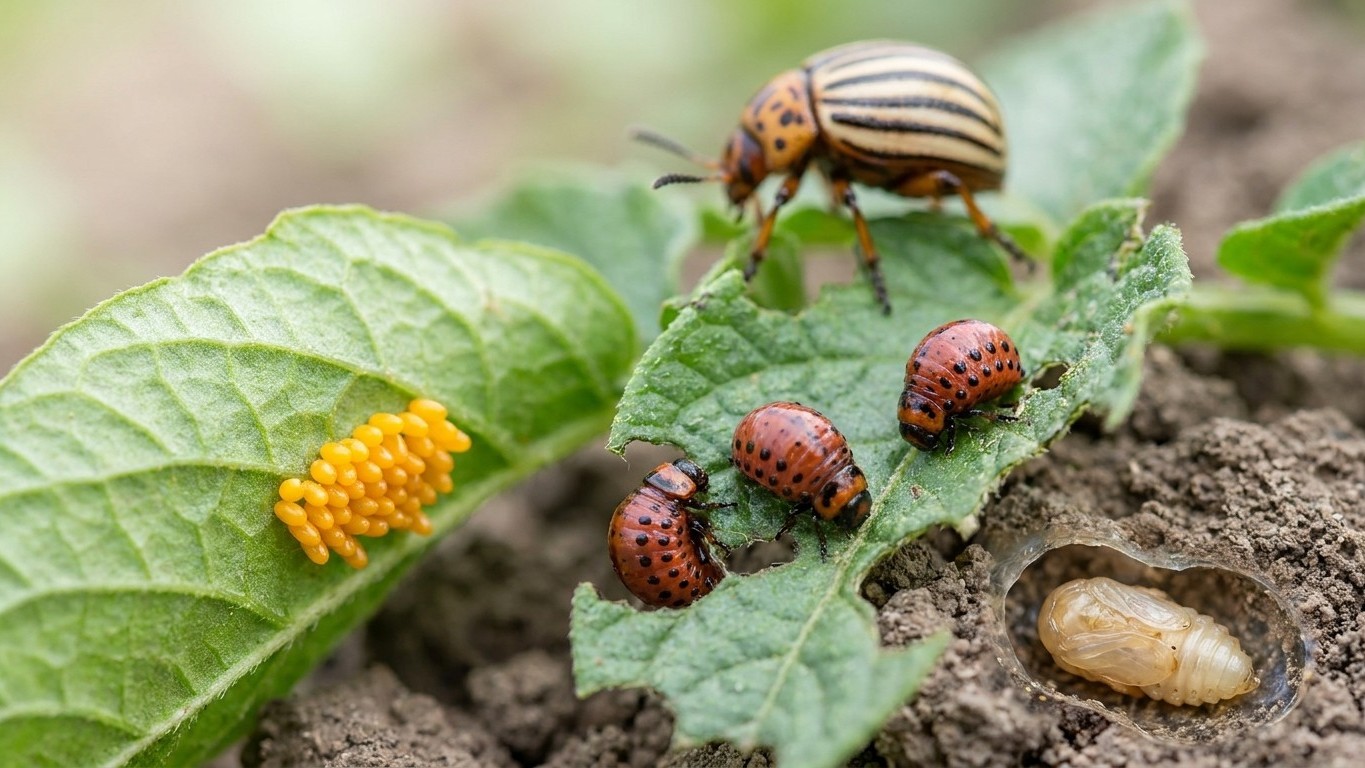

Colorado potato beetle (Leptinotarsa decemlineata) moves through four stages: egg, larva, pupa, and adult. Eggs hatch into the humpbacked, reddish larvae that do most of the chewing, then those larvae drop into the soil to pupate before emerging as the black-and-yellow striped adults gardeners recognize on sight. Both larvae and adults feed on foliage at the same time, which is part of why this insect is such a stubborn one to manage once it settles into a potato patch or a bed of tomatoes and eggplant.
The stages, in order

The cycle starts with clusters of bright orange-yellow eggs glued to the underside of leaves, usually in tidy rows of a few dozen. Nothing eats yet at this point, but the clustering matters: a single female can start several of these clusters, so one adult female arriving in spring can seed a much bigger problem within weeks.
The larva does the heaviest damage
Once eggs hatch, the larvae emerge soft-bodied, dark red to orange, with rows of black spots along the sides. They feed constantly, growing through several size classes before they’re through, and this stage is responsible for the bulk of the defoliation gardeners see. A plant that looked fine on Monday can be skeletonized by the following week once a cluster of larvae reaches its later, hungriest instars.
When larvae finish feeding, they drop to the soil and burrow a short distance down to pupate. This is the stage almost nobody sees. There’s no visible activity above ground, no feeding, nothing chewing on leaves. Gardeners who scout their plants regularly and suddenly find the pest activity has paused are usually looking at a field full of pupae working underground rather than a population that’s disappeared.
Adults feed, mate, and start it over
Adults emerge from the soil ready to feed immediately, and they mate and lay new eggs within days of emerging. This is the other stage everyone sees: the classic beetle with cream and black longitudinal stripes on its wing covers, moving deliberately across leaves and doing real, if usually less severe, feeding damage of its own.
The practical takeaway is that a gardener never observes the pupal stage and rarely misses the other three. Eggs on leaf undersides, larvae stripping foliage, adults moving in to feed and breed again: that’s the visible arc of the infestation, with the soil stage as the invisible bridge between generations.
When it appears, and why that varies
Colorado potato beetle doesn’t consult a calendar to decide when to show up. Emergence from winter dormancy is driven by accumulated warmth in the soil and air, the kind of heat buildup that entomologists track as degree-days rather than dates on a page. That’s why the same pest can be actively feeding on foliage in one region while it’s still weeks away from emerging a few states north.
Soil temperature is the trigger that matters most, because overwintering adults are sitting just below the surface and won’t move until the ground around them warms past a threshold that keeps them active. A mild, early spring pushes that threshold earlier in the season; a cold, wet spring pushes it back. Two years in the same garden can see emergence separated by real, noticeable stretches of time depending on how the winter and early spring played out.
Why a single regional date won’t work
Because the trigger is accumulated heat rather than a fixed point on the calendar, a single national or even regional emergence date would be misleading almost everywhere it was applied. Extension services track local degree-day accumulation and pest emergence reports for exactly this reason, and their guidance is built around the specific conditions of their state, not a generalized average. A garden in a warm coastal valley and a garden a few hundred miles inland at higher elevation can be on entirely different emergence timelines even within the same state.
The practical move for a gardener is to stop looking for a universal date and start watching two things instead: the degree-day tracking and pest alerts published by the local extension service, and the plants themselves. Early-season scouting of potato, tomato, and eggplant foliage, especially the undersides of leaves near the soil line, catches the first egg clusters and newly hatched larvae before a population builds. This site carries a page for individual territories with links to the relevant extension resources, which is the right place to find the actual local threshold rather than guessing at one.
One generation or several
This is the fact that changes how long a gardener needs to stay alert. Colorado potato beetle is not a single-generation pest that shows up, does its damage, and disappears for the year. It’s a multi-generation insect, capable of producing more than one full cycle of eggs, larvae, pupae, and adults within a single growing season, with the number of generations depending heavily on how long and warm that season runs.
In regions with a long, warm growing season, populations can complete several generations before frost shuts things down, meaning the pest that seemed managed in June can be back in force by August with an entirely new cohort of larvae. In cooler, shorter-season regions, the beetle may only manage a single generation, or push into a partial second one that doesn’t fully mature before cold weather arrives.
What multiple generations mean for monitoring
The practical consequence is that one successful early-season knockdown of larvae doesn’t mean the job is done for the year. Adults from that first generation, if any survive to reproduce, lay the eggs for a second wave, and that second wave can be just as damaging as the first if it goes unnoticed. Gardeners who stop scouting after an early spray or a round of hand removal are often surprised in mid to late summer by a fresh batch of small larvae feeding on regrowth or on later-planted crops.
This is also why timing any intervention around a single calendar event, rather than around ongoing scouting, tends to underperform against this particular pest. A multi-generation insect calls for a monitoring habit that runs through most of the growing season, not a one-time treatment window. Checking leaf undersides for new egg clusters every week or two through summer catches the second and third generations before they reach the damaging larval stage.
Where it spends the winter
Colorado potato beetle overwinters as an adult, not as an egg or larva, and it does so in the soil. Adults burrow several inches down, usually at or near the edge of the field or garden bed where they fed the previous season, and they sit dormant through the cold months in that below-ground shelter. Some also move into the shelter of nearby windbreaks, hedgerows, fence lines, or piles of plant debris at the field margin, anywhere that offers a bit more insulation than open, tilled ground.
This overwintering behavior is exactly why autumn cleanup matters as much as anything done during the growing season. A garden bed left with old potato, tomato, or eggplant debris sitting on the surface, or soil that’s never disturbed after harvest, gives overwintering adults an easier, more sheltered spot to settle into for the winter. Tilling or turning the soil after harvest, and clearing plant debris rather than leaving it in place, disrupts some of that shelter and can reduce the number of adults that survive to emerge the following spring.
Natural enemies worth protecting through the off-season
Biological control matters more for this pest than a lot of gardeners realize, and it’s easy to undercut without meaning to. Predatory insects such as the spined soldier bug feed on Colorado potato beetle larvae, and lady beetles and lacewings will take eggs when they find them on leaf undersides. Certain parasitic tachinid flies target adults and larvae as well, laying eggs that develop inside the host and eventually kill it.
None of these natural enemies survive well around broad-spectrum insecticide use, which tends to knock down the predators and parasitoids just as hard as it knocks down the pest, sometimes harder, since the pest has a well-documented history of developing resistance to a wide range of chemical controls. Keeping some flowering plants and untreated field margins nearby gives these natural enemies a place to persist between seasons, and that persistence is part of what keeps a beetle population from exploding unchecked the following spring.
Common questions
Does Colorado potato beetle only attack potatoes?
No. It feeds readily on other nightshade family crops including tomato, eggplant, and pepper, along with related wild host plants, so a garden without potatoes isn’t automatically free of it.
How many eggs does a single female lay?
Females lay eggs in clusters on the underside of leaves over an extended period, and a single female can produce several clusters across her adult life, which is part of why populations can build quickly once mated adults are established.
Can adults fly to new fields or gardens?
Yes. Adults are capable fliers and will move between fields or from wild host plants into cultivated beds, which is one reason isolated gardens aren’t automatically protected just because they’re far from the nearest commercial potato field.
Is the pupal stage vulnerable to control efforts?
Not practically. Pupae are underground and inactive, out of reach of foliar treatments and largely out of sight of hand removal, which is why scouting and management focus on the egg, larval, and adult stages instead.